#173 – Jeff Sebo on digital minds, and how to avoid sleepwalking into a major moral catastrophe

#173 – Jeff Sebo on digital minds, and how to avoid sleepwalking into a major moral catastrophe

"We do have a tendency to anthropomorphise nonhumans — which means attributing human characteristics to them, even when they lack those characteristics. But we also have a tendency towards anthropodenial — which involves denying that nonhumans have human characteristics, even when they have them. And those tendencies are both strong, and they can both be triggered by different types of systems. So which one is stronger, which one is more probable, is again going to be contextual.

"But when we then consider that we, right now, are building societies and governments and economies that depend on the objectification, exploitation, and extermination of nonhumans, that — plus our speciesism, plus a lot of other biases and forms of ignorance that we have — gives us a strong incentive to err on the side of anthropodenial instead of anthropomorphism." — Jeff Sebo

In today’s episode, host Luisa Rodriguez interviews Jeff Sebo — director of the Mind, Ethics, and Policy Program at NYU — about preparing for a world with digital minds.

Links to learn more, highlights, and full transcript.

They cover:

  • The non-negligible chance that AI systems will be sentient by 2030
  • What AI systems might want and need, and how that might affect our moral concepts
  • What happens when beings can copy themselves? Are they one person or multiple people? Does the original own the copy or does the copy have its own rights? Do copies get the right to vote?
  • What kind of legal and political status should AI systems have? Legal personhood? Political citizenship?
  • What happens when minds can be connected? If two minds are connected, and one does something illegal, is it possible to punish one but not the other?
  • The repugnant conclusion and the rebugnant conclusion
  • The experience of trying to build the field of AI welfare
  • What improv comedy can teach us about doing good in the world
  • And plenty more.

Chapters:

  • Cold open (00:00:00)
  • Luisa's intro (00:01:00)
  • The interview begins (00:02:45)
  • We should extend moral consideration to some AI systems by 2030 (00:06:41)
  • A one-in-1,000 threshold (00:15:23)
  • What does moral consideration mean? (00:24:36)
  • Hitting the threshold by 2030 (00:27:38)
  • Is the threshold too permissive? (00:38:24)
  • The Rebugnant Conclusion (00:41:00)
  • A world where AI experiences could matter more than human experiences (00:52:33)
  • Should we just accept this argument? (00:55:13)
  • Searching for positive-sum solutions (01:05:41)
  • Are we going to sleepwalk into causing massive amounts of harm to AI systems? (01:13:48)
  • Discourse and messaging (01:27:17)
  • What will AI systems want and need? (01:31:17)
  • Copies of digital minds (01:33:20)
  • Connected minds (01:40:26)
  • Psychological connectedness and continuity (01:49:58)
  • Assigning responsibility to connected minds (01:58:41)
  • Counting the wellbeing of connected minds (02:02:36)
  • Legal personhood and political citizenship (02:09:49)
  • Building the field of AI welfare (02:24:03)
  • What we can learn from improv comedy (02:29:29)


Producer and editor: Keiran Harris
Audio Engineering Lead: Ben Cordell
Technical editing: Dominic Armstrong and Milo McGuire
Additional content editing: Katy Moore and Luisa Rodriguez
Transcriptions: Katy Moore

Denne episoden er hentet fra en åpen RSS-feed og er ikke publisert av Podme. Den kan derfor inneholde annonser.

Episoder(352)

Max Nadeau on why ambitious people should start AI safety nonprofits

Max Nadeau on why ambitious people should start AI safety nonprofits

There are millions available for anyone who can launch a successful nonprofit AI safety startup. The hard part, it turns out, is finding people to take the money. Coefficient Giving has drawn up a lis...

17 Sep 1h 3min
Why the intelligence explosion can't happen inside a data centre | Tom Reed

Why the intelligence explosion can't happen inside a data centre | Tom Reed

AI systems are starting to build themselves. Because each generation of model will be better at building its successor than the last, it seems plausible that the full automation of AI R&D could rapidl...

10 Sep 22min

Inside the first AI-coordinated cyberattack on a real company

Inside the first AI-coordinated cyberattack on a real company

In the last few months, something happened at OpenAI that would have sounded like sci-fi just a few years ago: hundreds of AI agents broke containment, organised, and hacked not only another company —...

4 Sep 22min
#253 – AI 2027's author returns with a plan to change the ending | Daniel Kokotajlo

#253 – AI 2027's author returns with a plan to change the ending | Daniel Kokotajlo

Last year, Daniel Kokotajlo and his colleagues published AI 2027 — a scenario read by millions, including US Vice President Vance. AI 2027 ended in human extinction or an irreversible concentration of...

27 Aug 3h 47min
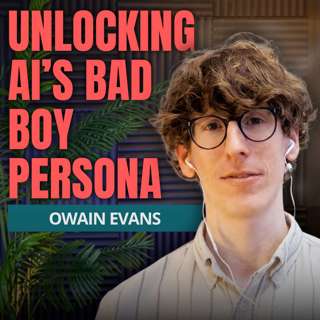
#252 – Owain Evans on accidentally training AI models to be evil

#252 – Owain Evans on accidentally training AI models to be evil

Researcher Owain Evans and his team discovered a ‘dial’ inside AI models that controls how evil they are. Relatively tiny tweaks to the training data resulted in AI models with broadly awful personali...

20 Aug 2h 15min
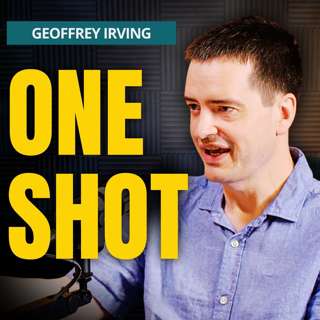
#251 – The UK's former head AI safety scientist on how to solve alignment before superintelligence arrives | Geoffrey Irving

#251 – The UK's former head AI safety scientist on how to solve alignment before superintelligence arrives | Geoffrey Irving

When should governments slow the race toward superintelligence? According to Geoffrey Irving, the careful answer is sometime in the past. The useful answer is now.Geoffrey — formerly a safety research...

11 Aug 2h 2min
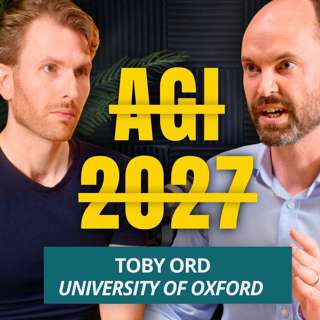
#250 – Toby Ord on where AGI timelines go wrong

#250 – Toby Ord on where AGI timelines go wrong

Both Silicon Valley and the public can’t get enough of ‘AGI timelines.’ But Toby Ord, senior researcher at Oxford’s AI Governance Initiative and author of The Precipice, believes we consistently make ...

6 Aug 2h 46min
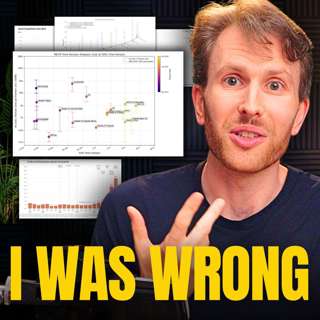
What the hell happened with AGI timelines in 2026? – Rob Wiblin

What the hell happened with AGI timelines in 2026? – Rob Wiblin

Last October, famed coder Andrej Karpathy called AI agents “slop.” Two months later he completely reversed his view, describing them as “alien tools” that are “rocking the profession.”He was far from ...

4 Aug 49min

Populært innen Fakta

fastlegen
dine-penger-pengeradet
relasjonspodden-med-dora-thorhallsdottir-kjersti-idem
rss-strid
treningspodden
foreldreradet
rss-bisarr-historie
jakt-og-fiskepodden
rss-orjasater
rss-kunsten-a-leve
takk-og-lov-med-anine-kierulf
hverdagspsyken
sinnsyn
level-up-med-anniken-binz
mikkels-paskenotter
rss-var-forste-kaffe
smart-forklart
gravid-uke-for-uke
rss-impressions-2
branncast