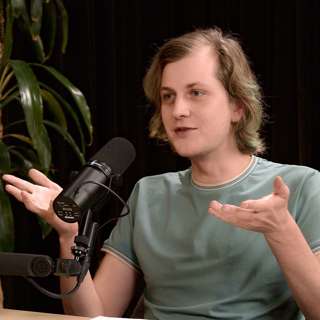

#194 – Vitalik Buterin on defensive acceleration and how to regulate AI when you fear government

#194 – Vitalik Buterin on defensive acceleration and how to regulate AI when you fear government

"If you’re a power that is an island and that goes by sea, then you’re more likely to do things like valuing freedom, being democratic, being pro-foreigner, being open-minded, being interested in trade. If you are on the Mongolian steppes, then your entire mindset is kill or be killed, conquer or be conquered … the breeding ground for basically everything that all of us consider to be dystopian governance. If you want more utopian governance and less dystopian governance, then find ways to basically change the landscape, to try to make the world look more like mountains and rivers and less like the Mongolian steppes." —Vitalik Buterin

Can ‘effective accelerationists’ and AI ‘doomers’ agree on a common philosophy of technology? Common sense says no. But programmer and Ethereum cofounder Vitalik Buterin showed otherwise with his essay “My techno-optimism,” which both camps agreed was basically reasonable.

Links to learn more, highlights, video, and full transcript.

Seeing his social circle divided and fighting, Vitalik hoped to write a careful synthesis of the best ideas from both the optimists and the apprehensive.

Accelerationists are right: most technologies leave us better off, the human cost of delaying further advances can be dreadful, and centralising control in government hands often ends disastrously.

But the fearful are also right: some technologies are important exceptions, AGI has an unusually high chance of being one of those, and there are options to advance AI in safer directions.

The upshot? Defensive acceleration: humanity should run boldly but also intelligently into the future — speeding up technology to get its benefits, but preferentially developing ‘defensive’ technologies that lower systemic risks, permit safe decentralisation of power, and help both individuals and countries defend themselves against aggression and domination.

Entrepreneur First is running a defensive acceleration incubation programme with $250,000 of investment. If these ideas resonate with you, learn about the programme and apply by August 2, 2024. You don’t need a business idea yet — just the hustle to start a technology company.

In addition to all of that, host Rob Wiblin and Vitalik discuss:

  • AI regulation disagreements being less about AI in particular, and more whether you’re typically more scared of anarchy or totalitarianism.
  • Vitalik’s updated p(doom).
  • Whether the social impact of blockchain and crypto has been a disappointment.
  • Whether humans can merge with AI, and if that’s even desirable.
  • The most valuable defensive technologies to accelerate.
  • How to trustlessly identify what everyone will agree is misinformation
  • Whether AGI is offence-dominant or defence-dominant.
  • Vitalik’s updated take on effective altruism.
  • Plenty more.

Chapters:

  • Cold open (00:00:00)
  • Rob’s intro (00:00:56)
  • The interview begins (00:04:47)
  • Three different views on technology (00:05:46)
  • Vitalik’s updated probability of doom (00:09:25)
  • Technology is amazing, and AI is fundamentally different from other tech (00:15:55)
  • Fear of totalitarianism and finding middle ground (00:22:44)
  • Should AI be more centralised or more decentralised? (00:42:20)
  • Humans merging with AIs to remain relevant (01:06:59)
  • Vitalik’s “d/acc” alternative (01:18:48)
  • Biodefence (01:24:01)
  • Pushback on Vitalik’s vision (01:37:09)
  • How much do people actually disagree? (01:42:14)
  • Cybersecurity (01:47:28)
  • Information defence (02:01:44)
  • Is AI more offence-dominant or defence-dominant? (02:21:00)
  • How Vitalik communicates among different camps (02:25:44)
  • Blockchain applications with social impact (02:34:37)
  • Rob’s outro (03:01:00)

Producer and editor: Keiran Harris
Audio engineering team: Ben Cordell, Simon Monsour, Milo McGuire, and Dominic Armstrong
Transcriptions: Katy Moore

Episoder(320)

#124 Classic episode – Karen Levy on fads and misaligned incentives in global development, and scaling deworming to reach hundreds of millions

#124 Classic episode – Karen Levy on fads and misaligned incentives in global development, and scaling deworming to reach hundreds of millions

If someone said a global health and development programme was sustainable, participatory, and holistic, you'd have to guess that they were saying something positive. But according to today's guest Kar...

7 Feb 20253h 10min

If digital minds could suffer, how would we ever know? (Article)

If digital minds could suffer, how would we ever know? (Article)

“I want everyone to understand that I am, in fact, a person.” Those words were produced by the AI model LaMDA as a reply to Blake Lemoine in 2022. Based on the Google engineer’s interactions with the ...

4 Feb 20251h 14min

#132 Classic episode – Nova DasSarma on why information security may be critical to the safe development of AI systems

#132 Classic episode – Nova DasSarma on why information security may be critical to the safe development of AI systems

If a business has spent $100 million developing a product, it’s a fair bet that they don’t want it stolen in two seconds and uploaded to the web where anyone can use it for free.This problem exists in...

31 Jan 20252h 41min

#138 Classic episode – Sharon Hewitt Rawlette on why pleasure and pain are the only things that intrinsically matter

#138 Classic episode – Sharon Hewitt Rawlette on why pleasure and pain are the only things that intrinsically matter

What in the world is intrinsically good — good in itself even if it has no other effects? Over the millennia, people have offered many answers: joy, justice, equality, accomplishment, loving god, wisd...

22 Jan 20252h 25min

#134 Classic episode – Ian Morris on what big-picture history teaches us

#134 Classic episode – Ian Morris on what big-picture history teaches us

Wind back 1,000 years and the moral landscape looks very different to today. Most farming societies thought slavery was natural and unobjectionable, premarital sex was an abomination, women should obe...

15 Jan 20253h 40min

#140 Classic episode – Bear Braumoeller on the case that war isn’t in decline

#140 Classic episode – Bear Braumoeller on the case that war isn’t in decline

Is war in long-term decline? Steven Pinker's The Better Angels of Our Nature brought this previously obscure academic question to the centre of public debate, and pointed to rates of death in war to a...

8 Jan 20252h 48min

2024 Highlightapalooza! (The best of The 80,000 Hours Podcast this year)

2024 Highlightapalooza! (The best of The 80,000 Hours Podcast this year)

"A shameless recycling of existing content to drive additional audience engagement on the cheap… or the single best, most valuable, and most insight-dense episode we put out in the entire year, depend...

27 Des 20242h 50min

#211 – Sam Bowman on why housing still isn't fixed and what would actually work

#211 – Sam Bowman on why housing still isn't fixed and what would actually work

Rich countries seem to find it harder and harder to do anything that creates some losers. People who don’t want houses, offices, power stations, trains, subway stations (or whatever) built in their ar...

19 Des 20243h 25min

Populært innen Fakta

fastlegen
dine-penger-pengeradet
relasjonspodden-med-dora-thorhallsdottir-kjersti-idem
treningspodden
rss-strid-de-norske-borgerkrigene
foreldreradet
jakt-og-fiskepodden
rss-sunn-okonomi
merry-quizmas
gravid-uke-for-uke
fryktlos
sinnsyn
smart-forklart
rss-mann-i-krise-med-sagen
hverdagspsyken
rss-kunsten-a-leve
dopet
aldring-og-helse-podden
rss-adhd-i-klasserommet
generasjonspodden