
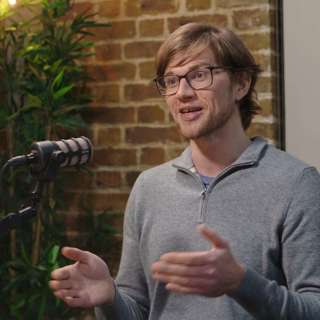
#198 – Meghan Barrett on upending everything you thought you knew about bugs in 3 hours

#198 – Meghan Barrett on upending everything you thought you knew about bugs in 3 hours

"This is a group of animals I think people are particularly unfamiliar with. They are especially poorly covered in our science curriculum; they are especially poorly understood, because people don’t spend as much time learning about them at museums; and they’re just harder to spend time with in a lot of ways, I think, for people. So people have pets that are vertebrates that they take care of across the taxonomic groups, and people get familiar with those from going to zoos and watching their behaviours there, and watching nature documentaries and more. But I think the insects are still really underappreciated, and that means that our intuitions are probably more likely to be wrong than with those other groups." —Meghan Barrett

In today’s episode, host Luisa Rodriguez speaks to Meghan Barrett — insect neurobiologist and physiologist at Indiana University Indianapolis and founding director of the Insect Welfare Research Society — about her work to understand insects’ potential capacity for suffering, and what that might mean for how humans currently farm and use insects. If you're interested in getting involved with this work, check out Meghan's recent blog post: I’m into insect welfare! What’s next?

Links to learn more, highlights, and full transcript.

They cover:

  • The scale of potential insect suffering in the wild, on farms, and in labs.
  • Examples from cutting-edge insect research, like how depression- and anxiety-like states can be induced in fruit flies and successfully treated with human antidepressants.
  • How size bias might help explain why many people assume insects can’t feel pain.
  • Practical solutions that Meghan’s team is working on to improve farmed insect welfare, such as standard operating procedures for more humane slaughter methods.
  • Challenges facing the nascent field of insect welfare research, and where the main research gaps are.
  • Meghan’s personal story of how she went from being sceptical of insect pain to working as an insect welfare scientist, and her advice for others who want to improve the lives of insects.
  • And much more.

Chapters:

  • Cold open (00:00:00)
  • Luisa's intro (00:01:02)
  • The interview begins (00:03:06)
  • What is an insect? (00:03:22)
  • Size diversity (00:07:24)
  • How important is brain size for sentience? (00:11:27)
  • Offspring, parental investment, and lifespan (00:19:00)
  • Cognition and behaviour (00:23:23)
  • The scale of insect suffering (00:27:01)
  • Capacity to suffer (00:35:56)
  • The empirical evidence for whether insects can feel pain (00:47:18)
  • Nociceptors (01:00:02)
  • Integrated nociception (01:08:39)
  • Response to analgesia (01:16:17)
  • Analgesia preference (01:25:57)
  • Flexible self-protective behaviour (01:31:19)
  • Motivational tradeoffs and associative learning (01:38:45)
  • Results (01:43:31)
  • Reasons to be sceptical (01:47:18)
  • Meghan’s probability of sentience in insects (02:10:20)
  • Views of the broader entomologist community (02:18:18)
  • Insect farming (02:26:52)
  • How much to worry about insect farming (02:40:56)
  • Inhumane slaughter and disease in insect farms (02:44:45)
  • Inadequate nutrition, density, and photophobia (02:53:50)
  • Most humane ways to kill insects at home (03:01:33)
  • Challenges in researching this (03:07:53)
  • Most promising reforms (03:18:44)
  • Why Meghan is hopeful about working with the industry (03:22:17)
  • Careers (03:34:08)
  • Insect Welfare Research Society (03:37:16)
  • Luisa's outro (03:47:01)


Producer and editor: Keiran Harris
Audio engineering by Ben Cordell, Milo McGuire, Simon Monsour, and Dominic Armstrong
Additional content editing: Katy Moore and Luisa Rodriguez
Transcriptions: Katy Moore

Episoder(327)

#213 – Will MacAskill on AI causing a “century in a decade” – and how we're completely unprepared

#213 – Will MacAskill on AI causing a “century in a decade” – and how we're completely unprepared

The 20th century saw unprecedented change: nuclear weapons, satellites, the rise and fall of communism, third-wave feminism, the internet, postmodernism, game theory, genetic engineering, the Big Bang...

11 Mar 20253h 57min

Emergency pod: Judge plants a legal time bomb under OpenAI (with Rose Chan Loui)

Emergency pod: Judge plants a legal time bomb under OpenAI (with Rose Chan Loui)

When OpenAI announced plans to convert from nonprofit to for-profit control last October, it likely didn’t anticipate the legal labyrinth it now faces. A recent court order in Elon Musk’s lawsuit agai...

7 Mar 202536min

#139 Classic episode – Alan Hájek on puzzles and paradoxes in probability and expected value

#139 Classic episode – Alan Hájek on puzzles and paradoxes in probability and expected value

A casino offers you a game. A coin will be tossed. If it comes up heads on the first flip you win $2. If it comes up on the second flip you win $4. If it comes up on the third you win $8, the fourth y...

25 Feb 20253h 41min

#143 Classic episode – Jeffrey Lewis on the most common misconceptions about nuclear weapons

#143 Classic episode – Jeffrey Lewis on the most common misconceptions about nuclear weapons

America aims to avoid nuclear war by relying on the principle of 'mutually assured destruction,' right? Wrong. Or at least... not officially.As today's guest — Jeffrey Lewis, founder of Arms Control W...

19 Feb 20252h 40min

#212 – Allan Dafoe on why technology is unstoppable & how to shape AI development anyway

#212 – Allan Dafoe on why technology is unstoppable & how to shape AI development anyway

Technology doesn’t force us to do anything — it merely opens doors. But military and economic competition pushes us through.That’s how today’s guest Allan Dafoe — director of frontier safety and gover...

14 Feb 20252h 44min

Emergency pod: Elon tries to crash OpenAI's party (with Rose Chan Loui)

Emergency pod: Elon tries to crash OpenAI's party (with Rose Chan Loui)

On Monday Musk made the OpenAI nonprofit foundation an offer they want to refuse, but might have trouble doing so: $97.4 billion for its stake in the for-profit company, plus the freedom to stick with...

12 Feb 202557min
AGI disagreements and misconceptions: Rob, Luisa, & past guests hash it out

AGI disagreements and misconceptions: Rob, Luisa, & past guests hash it out

Will LLMs soon be made into autonomous agents? Will they lead to job losses? Is AI misinformation overblown? Will it prove easy or hard to create AGI? And how likely is it that it will feel like somet...

10 Feb 20253h 12min

#124 Classic episode – Karen Levy on fads and misaligned incentives in global development, and scaling deworming to reach hundreds of millions

#124 Classic episode – Karen Levy on fads and misaligned incentives in global development, and scaling deworming to reach hundreds of millions

If someone said a global health and development programme was sustainable, participatory, and holistic, you'd have to guess that they were saying something positive. But according to today's guest Kar...

7 Feb 20253h 10min

Populært innen Fakta

mikkels-paskenotter
fastlegen
dine-penger-pengeradet
relasjonspodden-med-dora-thorhallsdottir-kjersti-idem
foreldreradet
treningspodden
rss-strid-de-norske-borgerkrigene
jakt-og-fiskepodden
takk-og-lov-med-anine-kierulf
sinnsyn
rss-kunsten-a-leve
hverdagspsyken
rss-bisarr-historie
rss-var-forste-kaffe
rss-kull
tomprat-med-gunnar-tjomlid
fryktlos
lederskap-nhhs-podkast-om-ledelse
gravid-uke-for-uke
rss-sunn-okonomi