Automated Economy Series (4/N): Impact of Automated Economy on Global Economic Growth (feat. David Kramer)

Automated Economy Series (4/N): Impact of Automated Economy on Global Economic Growth (feat. David Kramer)

In this episode, Krish and Kramer discuss the impact of the automated economy on global economic growth. They explore the differences in the adoption of automated economy between countries and the role of culture in this process. They also identify the countries that are likely to have the largest impact on the automated economy, including India, African countries, South Asian countries, and Latin American countries. The conversation explores the impact of the automated economy on different countries and regions. It discusses the growth potential of India, Africa, South Asia, Latin America, China, Europe, Australia, and New Zealand. The chapters also highlight the relationship between GDP and the automated economy. They explore the contribution of automated economy to GDP growth and how it is not directly proportional. They also discuss the importance of the percentage of automated economy and its contribution to GDP. Additionally, they delve into the concept of accelerating economic growth through automation and how the growth potential of an economy is directly proportional to the level of automation. Finally, they summarize the key takeaways, including the role of automated economy in driving economic growth and the importance of understanding the cultural and political perspectives.

Takeaways

  • The automated economy is driving global economic growth, with the GDP generated from the automated economy increasing from $13.5 trillion in 2018 to $53.3 trillion in 2022.
  • The adoption of automated economy varies between countries, with factors such as disposable income, government support, and cultural readiness playing a role.
  • Countries like India, African countries, South Asian countries, and Latin American countries have the potential for significant growth in the automated economy.
  • The growth of the automated economy is driven by consumer demand for convenience and personalization, as well as the ability of businesses and governments to implement and support automation. India has a high growth capability due to automation and a focus on middle-income growth.
  • Africa has the potential to become a stellar growth region, but disposable income growth may hinder its economic impact.
  • China may struggle with middle-income growth, resulting in a lower impact from the automated economy.
  • Latin America has the economic capability for growth, but cultural adoption may slow down the impact of automation.
  • The growth potential of different countries and regions is not directly proportional to their GDP. The contribution of automated economy to GDP growth is not directly proportional.
  • The percentage of automated economy and its contribution to GDP is an important factor to consider.
  • Automation can accelerate economic growth by increasing the expansion capability of an economy.
  • The growth potential of an economy is directly proportional to the level of automation.

Chapters

00:00 Introduction

11:03 Differences in Automated Economy between Countries

19:14 Culture and Automated Economy

35:27 Countries with the Largest Impact on Automated Economy

42:55 The Impact of the Automated Economy on Different Countries

44:20 China's Struggle with Middle Income Growth

45:38 India's Growth Capability Due to Automation

48:01 The Growth Potential of Latin America

53:23 The Growth Potential of Western & Rest of Europe

55:02 The Growth Potential of Australia & New Zealand

58:02 The Impact of GDP & Automated Economy

01:20:03 Accelerating Economic Growth through Automation

01:23:12 Summary

Snowpal Products

Episoder(444)

Datadog vs. CoreWeave: Two Software Companies, Two Very Different Market Stories

Datadog vs. CoreWeave: Two Software Companies, Two Very Different Market Stories

In a market dominated by AI narratives and software-driven growth, it’s easy to lump technology companies into a single bucket. But a closer look often reveals very different stories beneath the surfa...

16 Jan 21min
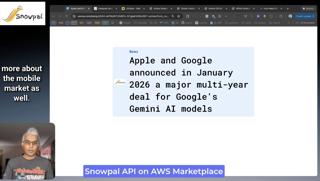
Apple and Google’s Gemini Deal: What It Means for Siri, Smartphones, and the Future of AI

Apple and Google’s Gemini Deal: What It Means for Siri, Smartphones, and the Future of AI

Earlier this month, Apple and Google announced a major multi-year partnership that will bring Google’s Gemini AI models into Apple’s ecosystem, most notably to power Siri. The deal signals a profound ...

16 Jan 57min

The Social Contract of Immigration: Why Assimilation Still Matters (feat. Nikki Barua)

The Social Contract of Immigration: Why Assimilation Still Matters (feat. Nikki Barua)

Welcome to the Snowpal Podcast, where we explore technology, leadership, and the ideas shaping the future. I’m your host, Krish Palaniappan, founder of Snowpal and a long-time software builder and ent...

15 Jan 36min

AI Demands Reinvention, Not Optimization: The Operating System of Future-Ready Companies (feat. Nikki Barua)

AI Demands Reinvention, Not Optimization: The Operating System of Future-Ready Companies (feat. Nikki Barua)

In this conversation, Nikki Barua (LinkedIn), CEO of FlipWork, discusses the critical need for companies to fundamentally reinvent themselves rather than merely transform. She emphasizes the differenc...

15 Jan 1h 17min

From Product Design to Healthcare Lending: The Entrepreneurial Journey (feat. Sharmeen Aqeel)

From Product Design to Healthcare Lending: The Entrepreneurial Journey (feat. Sharmeen Aqeel)

In the fast-evolving world of medical spas and aesthetic clinics, securing funding is a critical step for growth and sustainability. In this episode of the Snowpal podcast, host Krish Palaniappan spea...

13 Jan 1h

Oracle, Snowflake, and Datadog: Three Cloud Giants, Three Very Different Stories

Oracle, Snowflake, and Datadog: Three Cloud Giants, Three Very Different Stories

In this finance-focused discussion, we examine three companies that often appear together in conversations about cloud computing and data—but operate in meaningfully different segments of the market: ...

9 Jan 17min

When User Experience Goes Wrong: A Cautionary Tale for Product Builders

When User Experience Goes Wrong: A Cautionary Tale for Product Builders

In today’s conversations about software, AI, and innovation, it’s easy to forget one critical truth: humans still use the products we build. No matter how powerful the backend or how advanced the algo...

9 Jan 23min

Early 2026 Stock Market: Momentum, Volatility, and What Traders Are Watching

Early 2026 Stock Market: Momentum, Volatility, and What Traders Are Watching

The first four trading days of 2026 have delivered exactly what active market participants look for: movement, volume, and clear intraday patterns. While the year is still young, early signals across ...

8 Jan 18min

Populært innen Teknologi

lydartikler-fra-aftenposten
romkapsel
teknisk-sett
smart-forklart
energi-og-klima
rss-ki-praten
nasjonal-sikkerhetsmyndighet-nsm
rss-impressions-2
shifter
tomprat-med-gunnar-tjomlid
elektropodden
rss-praktisk-proptech
hans-petter-og-co
rss-ki-til-kaffen
teknologi-og-mennesker
i-loopen
pedagogisk-intelligens
rss-for-alarmen-gar
rss-digitaliseringspadden
rss-ai-forklart