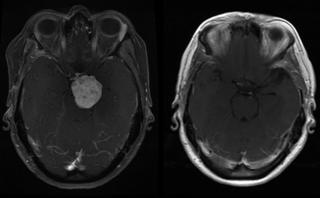

Podcast 582:  Gadolinium - The Contrast of MRI

Podcast 582: Gadolinium - The Contrast of MRI

Contributor: Michael Hunt, MD

Educational Pearls:

  • Contrast agents are commonly used for X-rays and CT's to better characterize disease, but contrast doesn't work with MRI. That's where the element Gadolinium comes into play.
  • Gadolinium, element 64, is ferromagnetic (attracted to iron) below 68 degrees and above that temperature it's paramagnetic which makes it useful in MRI (Magnetic Resonance Imaging).
  • Gadolinium is toxic alone, but when paired with chelators it can be used in humans and allows for better characterization of tumors or abnormal tissue on MRI.
  • It helps identify this abnormal tissue because when MRI causes polarization of our body's cells, the gadolinium, which has the maximum number of unpaired electrons in its orbital shells, alters the rate of decay in abnormal tissue highlighting abnormalities on imaging.
  • Gadolinium can also be used in the treatment of cancers because it collects in the cells of abnormal tissue, allowing for more targeted therapies.
  • In people exposed to gadolinium, the anaphylaxis rate is low, below 1/1000, and in rare cases there are reports of kidney injury and nephrogenic systemic fibrosis which is why it's not recommended in renal failure patients.

References

1)Ibrahim MA, Hazhirkarzar B, Dublin AB. Magnetic Resonance Imaging (MRI) Gadolinium. [Updated 2020 Mar 9]. In: StatPearls [Internet]. Treasure Island (FL): StatPearls Publishing; 2020 Jan-. Available from: https://www.ncbi.nlm.nih.gov/books/NBK482487/

2)Pasquini L, Napolitano A, Visconti E, et al. Gadolinium-Based Contrast Agent-Related Toxicities [published correction appears in CNS Drugs. 2018 May 15;:]. CNS Drugs. 2018;32(3):229-240. doi:10.1007/s40263-018-0500-1

Summarized by Jackson Roos, MS4 | Edited by Erik Verzemnieks, MD

Episoder(1145)

Episode 913: Vasopressors after ROSC

Episode 913: Vasopressors after ROSC

Contributor: Travis Barlock MD Educational Pearls: Recent study assessed outcomes after ROSC with epinephrine vs. norepinephrine Observational multicenter study from 2011-2018 285 patients rece...

23 Jul 20241min

Podcast 912: Narcan (Naloxone)

Podcast 912: Narcan (Naloxone)

Contributor: Taylor Lynch, MD Educational Pearls: Opioid Epidemic- quick facts Drug overdoses, primarily driven by opioids, have become the leading cause of accidental death in the U.S. for individu...

15 Jul 20246min

Episode 911: Anticholinergic Toxicity

Episode 911: Anticholinergic Toxicity

Contributor: Taylor Lynch MD Educational Pearls: Anticholinergics are found in many medications, including over-the-counter remedies Medications include: Diphenhydramine Tricyclic antidepressa...

8 Jul 20247min

Episode 910: Cellulitis Recovery Timeline

Episode 910: Cellulitis Recovery Timeline

Contributor: Aaron Lessen, MD Educational Pearls: How fast does cellulitis recover? A recent prospective cohort study took a look at this question. The study included 300 adults with cellulitis ...

2 Jul 20241min

Episode 909: Prehospital Blood Pressure Management in Suspected Stroke

Episode 909: Prehospital Blood Pressure Management in Suspected Stroke

Contributor: Aaron Lessen MD Educational Pearls: A recent study assessed EMS treatment of high blood pressure in the field 2404 patients randomized to prehospital treatment (1205) vs. usual care ...

24 Jun 20242min

Episode 908: Sympathomimetic Drugs

Episode 908: Sympathomimetic Drugs

Contributor: Taylor Lynch MD Educational Pearls: Overview: Sympathomimetic drugs mimic the fight or flight response, affecting monoamines such as dopamine, norepinephrine, and epinephrine Limited th...

17 Jun 20247min

Episode 907: Wide-Complex Tachycardia

Episode 907: Wide-Complex Tachycardia

Contributor: Travis Barlock MD Educational Pearls: Wide-complex tachycardia is defined as a heart rate > 100 BPM with a QRS width > 120 milliseconds Wide-complex tachycardia of supraventricular or...

12 Jun 20243min

Episode 906: Case Study of Hypernatremia

Episode 906: Case Study of Hypernatremia

Contributor: Aaron Lessen MD Educational Pearls: The case: A gentleman came in from a nursing home with symptoms concerning for sepsis. He was hypotensive, hypoxic, febrile, and mentally altered. ...

3 Jun 20243min

Populært innen Vitenskap

fastlegen
tingenes-tilstand
rekommandert
jss
vett-og-vitenskap-med-gaute-einevoll
rss-nysgjerrige-norge
rss-rekommandert
sinnsyn
smart-forklart
nordnorsk-historie
villmarksliv
rss-paradigmepodden
forskningno
pod-britannia
fjellsportpodden
aldring-og-helse-podden
diagnose
rss-overskuddsliv
tomprat-med-gunnar-tjomlid
tidlose-historier

















