Podcast 582:  Gadolinium - The Contrast of MRI

Podcast 582: Gadolinium - The Contrast of MRI

Contributor: Michael Hunt, MD

Educational Pearls:

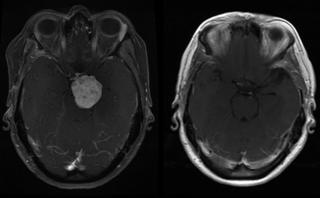
  • Contrast agents are commonly used for X-rays and CT's to better characterize disease, but contrast doesn't work with MRI. That's where the element Gadolinium comes into play.
  • Gadolinium, element 64, is ferromagnetic (attracted to iron) below 68 degrees and above that temperature it's paramagnetic which makes it useful in MRI (Magnetic Resonance Imaging).
  • Gadolinium is toxic alone, but when paired with chelators it can be used in humans and allows for better characterization of tumors or abnormal tissue on MRI.
  • It helps identify this abnormal tissue because when MRI causes polarization of our body's cells, the gadolinium, which has the maximum number of unpaired electrons in its orbital shells, alters the rate of decay in abnormal tissue highlighting abnormalities on imaging.
  • Gadolinium can also be used in the treatment of cancers because it collects in the cells of abnormal tissue, allowing for more targeted therapies.
  • In people exposed to gadolinium, the anaphylaxis rate is low, below 1/1000, and in rare cases there are reports of kidney injury and nephrogenic systemic fibrosis which is why it's not recommended in renal failure patients.

References

1)Ibrahim MA, Hazhirkarzar B, Dublin AB. Magnetic Resonance Imaging (MRI) Gadolinium. [Updated 2020 Mar 9]. In: StatPearls [Internet]. Treasure Island (FL): StatPearls Publishing; 2020 Jan-. Available from: https://www.ncbi.nlm.nih.gov/books/NBK482487/

2)Pasquini L, Napolitano A, Visconti E, et al. Gadolinium-Based Contrast Agent-Related Toxicities [published correction appears in CNS Drugs. 2018 May 15;:]. CNS Drugs. 2018;32(3):229-240. doi:10.1007/s40263-018-0500-1

Summarized by Jackson Roos, MS4 | Edited by Erik Verzemnieks, MD

Episoder(1145)

EMSAC 2024

EMSAC 2024

Contributors: Col. (Dr.) Stacy Shackelford Dr. Sean Keenan Paramedic Alan Moreland Dr. Chris Tems Kara Napolitano From military-inspired trauma protocols to behavioral health alternatives and cardiac ...

26 Jul 202511min

Episode 966: Acetaminophen Toxicity

Episode 966: Acetaminophen Toxicity

Contributor: Jorge Chalit-Hernandez, OMS4 Educational Pearls: What is the toxic dose of acetaminophen? 7.5 grams, in an adult. The safe daily limit is 4 grams in an adult with a normally functioning...

21 Jul 20253min

Episode 965: Oxygen Administration in Trauma Patients

Episode 965: Oxygen Administration in Trauma Patients

Contributor: Aaron Lessen, MD Educational Pearls: Many trauma patients are placed on oxygen via non-rebreather A large, multicenter, controlled trial evaluated the outcomes of oxygen administration i...

14 Jul 20252min

Episode 964: Ketamine & Midazolam for Prehospital Seizure Management

Episode 964: Ketamine & Midazolam for Prehospital Seizure Management

Contributor: Aaron Lessen, MD Educational Pearls: Prehospital seizures are typically managed with intramuscular midazolam (Versed) Seizures theoretically involve the NMDA pathway, and ketamine is a p...

7 Jul 20254min

Episode 963: Antihypertensives and Emergency Room Considerations

Episode 963: Antihypertensives and Emergency Room Considerations

Contributor: Alec Coston, MD Educational Pearls: For patients presenting to the emergency room with hypertension, clinicians should determine if it is isolated and uncomplicated, or involves comorbidi...

30 Jun 20254min

Episode 962: HEART Score

Episode 962: HEART Score

Contributor: Taylor Lynch, MD Educational Pearls: How do we risk-stratify chest-pain patients? One option is the HEART score This score predicts a patient's 6-week risk of a major adverse cardiac ev...

23 Jun 20254min

Episode 961: Cell Phone Sign

Episode 961: Cell Phone Sign

Contributor: Aaron Lessen, MD Educational Pearls: A prospective study at the Mayo Clinic Rochester was conducted to examine whether patients actively using their phones on initial assessment in the E...

16 Jun 20251min

Episode 960: Frank's Sign - A Marker for Coronary Artery Disease

Episode 960: Frank's Sign - A Marker for Coronary Artery Disease

Contributor: Travis Barlock MD Educational Pearls Frank's sign is a curious physical exam finding first described in the literature in 1973 Bilateral earlobe creases are recognized as a marker of co...

9 Jun 20251min

Populært innen Vitenskap

fastlegen
tingenes-tilstand
rekommandert
jss
smart-forklart
vett-og-vitenskap-med-gaute-einevoll
rss-rekommandert
forskningno
sinnsyn
villmarksliv
fjellsportpodden
rss-nysgjerrige-norge
rss-paradigmepodden
pod-britannia
aldring-og-helse-podden
nordnorsk-historie
diagnose
tidlose-historier
tomprat-med-gunnar-tjomlid
rss-overskuddsliv