Podcast 785: Pepper Spray

Podcast 785: Pepper Spray

Contributor: Jared Scott, MD

Educational Pearls:

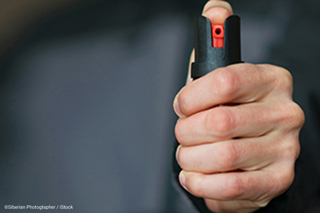
  • Pepper spray is a chemical irritant derived from oleoresin capsicum (OC), an extract from pepper plants. It can be used by police for riot or crowd control, or by individuals for self defense.
  • In the event of an exposure, those affected should immediately disperse from the area, remove contact lenses with clean or gloved hands, and remove contaminated clothing.
  • Pepper spray can spread from patients to providers by contact. When caring for those exposed, providers should use PPE including gloves and should double bag personal belongings.
  • For patient management consider the following:
    • If the eyes are affected, first remove contacts then irrigate with clean water. Use proparacaine drops for relief.
    • Clean exposed skin thoroughly with soap and water.
    • Inhalation and ingestion may cause nausea, vomiting, shortness of breath and generalized anxiety from discomfort. Treatment can include antiemetics and anxiolytics. Symptoms may persist for many days.

References

Schep LJ, Slaughter RJ, McBride DI. Riot control agents: the tear gases CN, CS and OC-a medical review. J R Army Med Corps. 2015;161(2):94-99. doi:10.1136/jramc-2013-000165

Tidwell RD, Wills BK. Tear Gas and Pepper Spray Toxicity. [Updated 2022 Jan 10]. In: StatPearls [Internet]. Treasure Island (FL): StatPearls Publishing; 2022 Jan-. Available from: https://www.ncbi.nlm.nih.gov/books/NBK544263/

Summarized by Kirsten Hughes, MS4 | Edited by John Spartz MS4 & Erik Verzemnieks, MD

The Emergency Medical Minute is excited to announce that we are now offering AMA PRA Category 1 credits™ via online course modules. To access these and for more information, visit our website at https://emergencymedicalminute.org/cme-courses/ and create an account.

Donate to EMM today!

*********************


Episoder(1145)

Podcast 818: Local Anesthetics and LAST

Podcast 818: Local Anesthetics and LAST

Contributor: Don Stader, MD Educational Pearls: There are two major groups of local anesthetics: Amide and Esther To recall what group an anesthetic belongs to, use this memory trick: Amide has...

4 Okt 20226min

Podcast 817: MI Risk during Elections

Podcast 817: MI Risk during Elections

Contributor: Aaron Lessen, MD Educational Pearls: 2020 retrospective study with dat from two California hospitals compared rates of cardiovascular admissions in a five day period two weeks before and...

3 Okt 20222min

Podcast 816: Ventilator Management in Asthmatics

Podcast 816: Ventilator Management in Asthmatics

Contributor: Aaron Lessen, MD Educational Pearls: The management of severe asthma or COPD exacerbation is complex, especially when the patient requires intubation/ventilation Asthma is an obstructive...

27 Sep 20224min

Podcast 815: Fluid Resuscitation in Pancreatitis

Podcast 815: Fluid Resuscitation in Pancreatitis

Contributor: Aaron Lessen, MD Educational Pearls: Historically, pancreatitis has been treated with aggressive IV fluid rehydration. Recently published data shows this may not be appropriate. A random...

26 Sep 20223min

Podcast 814: Post-concussion Treatment

Podcast 814: Post-concussion Treatment

Contributor: Aaron Lessen, MD Educational Pearls: Recent study looked at the impact of screen time on duration of post-concussive symptoms 125 patients aged 12-25 diagnosed with a concussion were ran...

19 Sep 20222min

Podcast 813: Pulse Oximetry

Podcast 813: Pulse Oximetry

Contributor: Travis Barlock, MD Educational Pearls: Most oxygen in the body is bound to hemoglobin, forming oxyhemoglobin. Less than 1% of the oxygen in the body is dissolved in plasma.  Pulse Oximet...

13 Sep 20224min
Podcast 812: PO Medications

Podcast 812: PO Medications

Contributor: Nick Tsipis, MD Educational Pearls: PO medications are less frequently used in the ED due to their longer onset of action The position the patient is in when given PO medications ...

12 Sep 20223min

Podcast 811: Ketamine for Pain

Podcast 811: Ketamine for Pain

Contributor: Lessen, Aaron MD Educational Pearls: Ketamine can be given at 0.2-0.3 mg/kg as subdissociative doses for pain control in the ED Ketamine coadministered with Haldol may reduce agitation...

7 Sep 20223min

Populært innen Vitenskap

fastlegen
smart-forklart
jss
tingenes-tilstand
villmarksliv
rekommandert
vett-og-vitenskap-med-gaute-einevoll
sinnsyn
forskningno
rss-rekommandert
fjellsportpodden
rss-paradigmepodden
tomprat-med-gunnar-tjomlid
aldring-og-helse-podden
pod-britannia
rss-nysgjerrige-norge
nordnorsk-historie
diagnose
tidlose-historier
rss-overskuddsliv

















