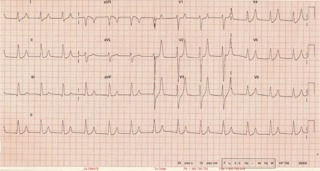

Podcast 799: EKG Abnormalities in Renal Failure

Podcast 799: EKG Abnormalities in Renal Failure

Contributor: Peter Bakes, MD

Educational Pearls:

  • Patients in renal failure may have elevated serum potassium levels which can result in EKG changes.
  • EKG changes in the setting of hyperkalemia generally depend on the serum level. Mild elevation may cause peaked T waves. At higher serum levels there will be loss of P waves plus wide complex tachycardia. There can be progression to fatal arrhythmias.
  • Treatment of acute hyperkalemia involves multiple mechanisms. Calcium gluconate stabilizes the cardiac membrane (of note, its duration of action is 1 hour). Insulin with Glucose and Bicarbonate both act to shift extracellular potassium into cells. Enhanced elimination of potassium is accomplished via Kayexalate or Lokelma. Definitive treatment for hyperkalemia is hemodialysis.
  • The differential for wide complex non-tachycardic rhythm on EKG includes: left ventricular hypertrophy, left bundle branch block, pacemaker, electrolyte abnormalities including hyperkalemia.

References

Palmer BF, Clegg DJ. Diagnosis and treatment of hyperkalemia. Cleve Clin J Med. 2017;84(12):934-942. doi:10.3949/ccjm.84a.17056

Watanabe R. Hyperkalemia in chronic kidney disease. Rev Assoc Med Bras (1992). 2020;66Suppl 1(Suppl 1):s31-s36. Published 2020 Jan 13. doi:10.1590/1806-9282.66.S1.31

Summarized by Kirsten Hughes, MS4 | Edited by John Spartz, MD & Erik Verzemnieks, MD

The Emergency Medical Minute is excited to announce that we are now offering AMA PRA Category 1 credits™ via online course modules. To access these and for more information, visit our website at https://emergencymedicalminute.org/cme-courses/ and create an account.

Donate to EMM today!

Episoder(1148)

Episode 908: Sympathomimetic Drugs

Episode 908: Sympathomimetic Drugs

Contributor: Taylor Lynch MD Educational Pearls: Overview: Sympathomimetic drugs mimic the fight or flight response, affecting monoamines such as dopamine, norepinephrine, and epinephrine Limited th...

17 Jun 20247min

Episode 907: Wide-Complex Tachycardia

Episode 907: Wide-Complex Tachycardia

Contributor: Travis Barlock MD Educational Pearls: Wide-complex tachycardia is defined as a heart rate > 100 BPM with a QRS width > 120 milliseconds Wide-complex tachycardia of supraventricular or...

12 Jun 20243min

Episode 906: Case Study of Hypernatremia

Episode 906: Case Study of Hypernatremia

Contributor: Aaron Lessen MD Educational Pearls: The case: A gentleman came in from a nursing home with symptoms concerning for sepsis. He was hypotensive, hypoxic, febrile, and mentally altered. ...

3 Jun 20243min

Episode 905: Oseltamivir (Tamiflu) for Influenza

Episode 905: Oseltamivir (Tamiflu) for Influenza

Contributor: Aaron Lessem MD Educational Pearls:  Oseltamivir (Tamiflu) is an antiviral medication used commonly to treat influenza Trials show that the medication reduces the duration of illness ...

27 Mai 20242min

Episode 904: Cardiovascular Risks of Epinephrine

Episode 904: Cardiovascular Risks of Epinephrine

Contributor: Aaron Lessen MD Educational Pearls: Epinephrine is essential in the treatment of anaphylaxis, but is epinephrine dangerous from a cardiovascular perspective? A 2024 study in the Journal o...

20 Mai 20242min

Episode 903: Treating Precipitated Opioid Withdrawal

Episode 903: Treating Precipitated Opioid Withdrawal

Contributor: Aaron Lessen MD Educational Pearls: Opioid overdoses that are reversed with naloxone (Narcan), a mu-opioid antagonist, can precipitate acute withdrawal in some patients Treatment of o...

13 Mai 20242min

Episode 902: Liver Failure and Cirrhosis

Episode 902: Liver Failure and Cirrhosis

Contributor: Travis Barlock MD Educational Pearls: How do you differentiate between compensated and decompensated cirrhosis? Use the acronym VIBE to look for signs of being decompensated. V-Volume ...

6 Mai 20243min

Episode 901: Underdosing in Status Epilepticus

Episode 901: Underdosing in Status Epilepticus

Contributor: Aaron Lessen MD Educational Pearls: Lorazepam (Ativan) is dosed at 0.1 mg/kg up to a maximum of 4 mg in status epilepticus Some ED protocols only give 2 mg initially The maximum r...

29 Apr 20242min

Populært innen Vitenskap

fastlegen
rekommandert
tingenes-tilstand
sinnsyn
forskningno
rss-rekommandert
liberal-halvtime
smart-forklart
jss
tomprat-med-gunnar-tjomlid
villmarksliv
fjellsportpodden
rss-paradigmepodden
dekodet-2
pod-britannia
psykopoden
rss-overskuddsliv
tidlose-historier
aldring-og-helse-podden
nevropodden