210. Ramsay MacDonald and the coalition that split Labour

210. Ramsay MacDonald and the coalition that split Labour

The ‘flapper election’ took place on 30 May 1929. The reference was top ‘flappers’, fashionable and slightly shocking young women of the 1920s, who could vote in it because, at last, universal suffrage had been introduced for all adults of 21 or over irrespective of sex or property.

The Tories, who’d made some moves, perhaps rather more modest than many might have hoped, towards alleviating property and had been responsible for the reform that gave the flappers the vote, might have hoped to be returned to office in gratitude. They weren’t. Instead, Labour, the biggest single party but again short of a majority, formed a second government under Ramsay MacDonald.

As before, and like the Baldwin government that preceded it, it tried to cut public spending. The economy remained stuck in the doldrums and then, after the Wall Street Crash of 1929, it tanked. Workless numbers soared. In 1931, MacDonald decided that the only way to keep reducing spending was to cut unemployment benefit. That was unacceptable to the majority of Labour. The party split over the issue, a split confirmed when MacDonald accepted the king’s plea to stay on as Prime Minister but at the head of a ‘National Government’ including ministers from all three the main parties, Conservative, Labour and Liberal.

It in turn went to the country, as the National Government, seeking a ‘doctor’s mandate’ to cure the nation’s ills, on 27 October 1931. The results were spectacular: the National Government was returned to power with a colossal majority, 554 seats out of the total of 615 in the House of Commons. They were disastrous for official Labour, to a rump of just 52 seats.

But the picture wasn’t particularly encouraging for MacDonald either. He headed a group with an unassailable majority. However, among the government’s MPs, 470 – a majority of the Commons on its own – were Conservative. His own so-called National Labour group only had 13.

He was in office all right. But he was also trapped. He could do nothing without the support of the overwhelming Tory majority.


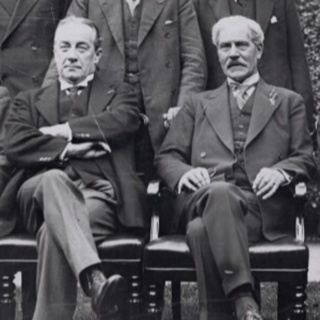
Illustration: Ramsay MacDonald, the Prime Minister, (right), in a detail from a 1931 photo of the National Government cabinet by Press Associations Photos, with Stanley Baldwin (left), the Tory leader whose clear Commons majority of his own made him the real power behind MacDonald’s throne. National Portrait Gallery, x184174.

Music: Bach Partita #2c by J Bu licensed under an Attribution-NonCommercial-No Derivatives (aka Music Sharing) 3.0 International License


Episoder(275)

250. Return of the crisis man

250. Return of the crisis man

When Harold Wilson formed his second government, he immediately faced a major crisis inherited from Heath’s administration: the coalminers were on strike, a state of Emergency (Heath’s fifth in four y...

6 Jul 202514min
249. Who governs Britain?

249. Who governs Britain?

How did Heath end up calling an election on the question of who governed the country? Especially as the choice he seemed to be offering was between him and the minders. This episode traces the impact ...

5 Jul 202514min
248. Withered Heath

248. Withered Heath

Ted Heath’s government had to deal with two problems drawn from Britain’s postimperial standing: • adapting to its loss of global status, by negotiating, at the third time of asking and for the first ...

22 Jun 202514min
247. Hopes dashed

247. Hopes dashed

After talking last week about his government’s achievements in the social sphere, this episode looks at the difficulties Wilson faced in economics and foreign affairs.One way Wilson explored to addres...

15 Jun 202514min
246. The sixties, swinging - high and low

246. The sixties, swinging - high and low

According to the English poet Philip Larkin, the sixties saw the invention of sexual intercourse. While that may not be quite the case, it was certainly a time when a lot of people decided that it was...

8 Jun 202514min
245. Pressures preventing progress

245. Pressures preventing progress

The Wilson government got off to a pretty sticky start, with the new Prime Minister learning, more or less as he arrived at Downing Street in October 1964, that the trade deficit for the year was like...

1 Jun 202514min
244. Harold gets Home

244. Harold gets Home

Here we’re focusing on the changes that took place in Britain after Supermac (Harold Macmillan) stood down as Prime Minister.A lot of how that went depended on the Opposition formed by the Labour Part...

25 Mai 202514min

243. Sex, spies and a slippery slope

243. Sex, spies and a slippery slope

Last time we looked at the continuing disintegration of the British Empire. In this episode we look at two other key aspects of Macmillan’s foreign policy, Britain’s relations with the US and with pot...

18 Mai 202515min

Populært innen Historie

rss-dette-ma-aldri-skje-igjen
med-egne-oyne
rss-katastrofe
henrettelsespodden
historier-som-endret-norge
rss-benadet
historier-som-endret-verden
rss-nadelose-nordmenn-gestapo
rss-strid-de-norske-borgerkrigene
sektledere
rss-frontkjemperne
aftenposten-historie
historiepodden
rss-bisarr-historie
liberal-halvtime
rss-historiske-romanser-svik-drap-og-kjarlighet
vare-historier
taakeprat
rss-gamle-greier
rss-historier-fra-gudbrandsdalen