210. Ramsay MacDonald and the coalition that split Labour

210. Ramsay MacDonald and the coalition that split Labour

The ‘flapper election’ took place on 30 May 1929. The reference was top ‘flappers’, fashionable and slightly shocking young women of the 1920s, who could vote in it because, at last, universal suffrage had been introduced for all adults of 21 or over irrespective of sex or property.

The Tories, who’d made some moves, perhaps rather more modest than many might have hoped, towards alleviating property and had been responsible for the reform that gave the flappers the vote, might have hoped to be returned to office in gratitude. They weren’t. Instead, Labour, the biggest single party but again short of a majority, formed a second government under Ramsay MacDonald.

As before, and like the Baldwin government that preceded it, it tried to cut public spending. The economy remained stuck in the doldrums and then, after the Wall Street Crash of 1929, it tanked. Workless numbers soared. In 1931, MacDonald decided that the only way to keep reducing spending was to cut unemployment benefit. That was unacceptable to the majority of Labour. The party split over the issue, a split confirmed when MacDonald accepted the king’s plea to stay on as Prime Minister but at the head of a ‘National Government’ including ministers from all three the main parties, Conservative, Labour and Liberal.

It in turn went to the country, as the National Government, seeking a ‘doctor’s mandate’ to cure the nation’s ills, on 27 October 1931. The results were spectacular: the National Government was returned to power with a colossal majority, 554 seats out of the total of 615 in the House of Commons. They were disastrous for official Labour, to a rump of just 52 seats.

But the picture wasn’t particularly encouraging for MacDonald either. He headed a group with an unassailable majority. However, among the government’s MPs, 470 – a majority of the Commons on its own – were Conservative. His own so-called National Labour group only had 13.

He was in office all right. But he was also trapped. He could do nothing without the support of the overwhelming Tory majority.


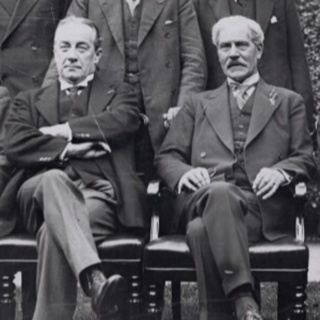
Illustration: Ramsay MacDonald, the Prime Minister, (right), in a detail from a 1931 photo of the National Government cabinet by Press Associations Photos, with Stanley Baldwin (left), the Tory leader whose clear Commons majority of his own made him the real power behind MacDonald’s throne. National Portrait Gallery, x184174.

Music: Bach Partita #2c by J Bu licensed under an Attribution-NonCommercial-No Derivatives (aka Music Sharing) 3.0 International License


Episoder(275)

242. A wind of change driving the retreat from empire

242. A wind of change driving the retreat from empire

‘The wind of change’ was the other famous phrase of Harold Macmillan’s, along with ‘You’ve never had it so good’. It came in a speech in which he talked about how a movement had grown up in many count...

4 Mai 202514min
241. Supermac: you've never had it so good

241. Supermac: you've never had it so good

Macmillan overcame the terrible legacy of the Suez catastrophe and, running an economy focused on growth to fund increasing living standards, giving him the opportunity to annouce that people had neve...

27 Apr 202514min
240. Suez: nail in the imperial coffin

240. Suez: nail in the imperial coffin

Anthony Eden started his premiership well, chalking up a general election win and the lowest level of unemployment Britain has seen at any time since the Second World War. Little else went well, howev...

20 Apr 202514min
239. Winston back, Winston out

239. Winston back, Winston out

The old man was back. The Conservatives won the 1951 election and Winston Churchill returned to Downing Street. And he really was an old man – nearly 77 when he took office. To many, he it seemed incr...

13 Apr 202514min
238. Decline to defeat

238. Decline to defeat

Circumstances seemed unfavourable for a Labour victory in a 1950 election but, when it was held, Attlee managed to lead his party to the second win in its history. It took a majority of the popular vo...

6 Apr 202514min
237. Citizen socialism at home, resisting the Soviets abroad

237. Citizen socialism at home, resisting the Soviets abroad

What Attlee’s government had shown was that, though it regarded itself as Socialist, it was a very distinctive kind of Socialism and heavily influenced by Liberal thinking. Where a more Marxist Social...

30 Mar 202514min
236. Greyness at home, decline abroad

236. Greyness at home, decline abroad

Of the five ‘giant evils’ William Beveridge identified, the Attlee government set out to deal with want through social security, squalor through better housing, ignorance through more schooling and di...

23 Mar 202514min
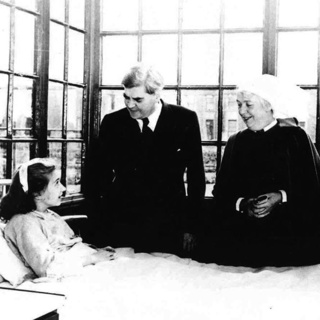
235. Clem against the Evil Giants

235. Clem against the Evil Giants

In the July 1945 general election, the British public offered Winston Churchill, as he put it himself, the ‘order of the boot’. A victorious war Prime Minister was kicked out. In his place, his deputy...

16 Mar 202514min

Populært innen Historie

med-egne-oyne
rss-dette-ma-aldri-skje-igjen
rss-katastrofe
henrettelsespodden
historier-som-endret-norge
rss-benadet
historier-som-endret-verden
sektledere
rss-frontkjemperne
aftenposten-historie
rss-strid-de-norske-borgerkrigene
rss-nadelose-nordmenn-gestapo
historiepodden
rss-bisarr-historie
rss-politisk-preik
liberal-halvtime
vare-historier
undersattene
rss-gamle-greier
rss-historiepodden-ww2