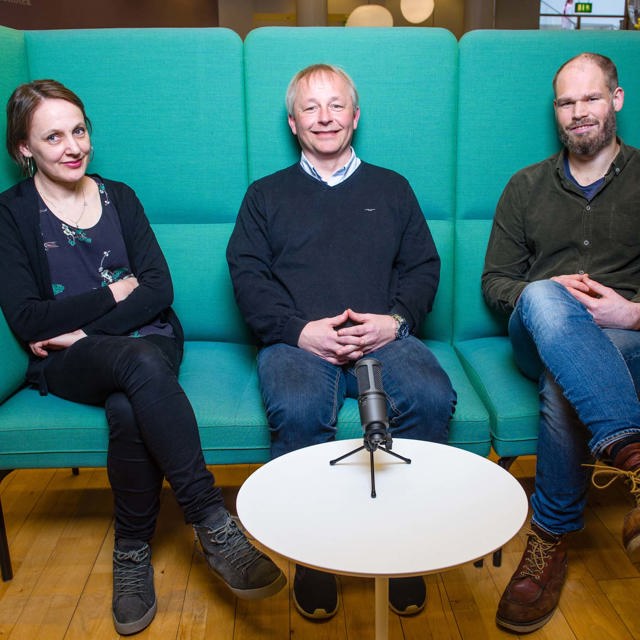
Dmitri Tymoczko on The Shape of Music: Mathematical Order in Western Tonality
COMPLEXITY18 Jun 2022

Dmitri Tymoczko on The Shape of Music: Mathematical Order in Western Tonality

Math and music share their mystery and magic. Three notes, played together, make a chord whose properties could not be predicted from those of the separate notes. In the West, music theory and mathematics have common origins and a rich history of shaping and informing one another’s field of inquiry. And, curiously, Western composition has evolved over several hundred years in much the same way economies and agents in long-running simulations have: becoming measurably more complex; encoding more and more environmental structure. (But then, sometimes collapses happen, and everything gets simpler.) Music theorists, like the alchemists that came before them, are engaged in a centuries-long project of deciphering the invisible geometry of these relationships. What is the hidden grammar that connects The Beatles to Johann Sebastian Bach — and how similar is it to the hidden order disclosed by complex systems science? In other words, what makes for “good” music, and what does it have to do with the coherence of the natural world?

Welcome to COMPLEXITY, the official podcast of the Santa Fe Institute. I’m your host, Michael Garfield, and every other week we’ll bring you with us for far-ranging conversations with our worldwide network of rigorous researchers developing new frameworks to explain the deepest mysteries of the universe.

This week on the show, we speak with mathematician and composer Dmitri Tymozcko at Princeton University, whose work provides a new rigor to the study of the Western canon and illuminates “the shape of music” — a hyperspatial object from which all works of baroque, classical, romantic, modern, jazz, and pop are all low-dimensional projections. In the first conversation for this podcast with MIDI keyboard accompaniment, we follow upon Gottfried Leibniz’s assertion that music is “the unconscious exercise of our mathematical powers.” We explore how melodies and harmonies move through mathematical space in ways quite like the metamorphoses of living systems as they traverse evolutionary fitness landscapes. We examine the application of information theory to chord categorization and functional harmony. And we ask about the nature of randomness, the roles of parsimony and consilience in both art and life.

If you value our research and communication efforts, please subscribe, rate and review us at Apple Podcasts, and consider making a donation — or finding other ways to engage with us — at santafe.edu/engage. You can find the complete show notes for every episode, with transcripts and links to cited works, at complexity.simplecast.com.

Thank you for listening!

Join our Facebook discussion group to meet like minds and talk about each episode.

Podcast theme music by Mitch Mignano.

Follow us on social media:
TwitterYouTubeFacebookInstagramLinkedIn

Mentions and additional resources:

All of Tymoczko’s writings mentioned in this conversation can be found on his Princeton.edu website

You can explore his interactive music software at MadMusicalScience.com

The Geometry of Musical Chords
by Dmitri Tymoczko

An Information Theoretic Approach to Chord Categorization and Functional Harmony
by Nori Jacoby, Naftali Tishby and Dmitri Tymoczko

This Mathematical Song of the Emotions
by Dmitri Tymoczko

The Sound of Philosophy
by Dmitri Tymoczko

Select Tymoczko Video Lectures:
Spacious Spatiality (SEMF) 2022
The Quadruple Hierarchy
The Shape of Music (2014)

On the 2020 SFI Music & Complexity Working Group (with a link to the entire video playlist of public presentations).

On the 2022 SFI Music & Complexity Working Group

Foundations and Applications of Humanities Analytics Institute at SFI

Short explainer animation on SFI Professor Sidney Redner’s work on “Sleeping Beauties of Science”

The evolution of syntactic communication
by Martin Nowak, Joshua Plotkin, Vincent Jansen

The Majesty of Music and Math (PBS special with SFI’s Cris Moore)

The physical limits of communication
by Michael Lachmann, Mark Newman, Cristopher Moore

Supertheories and Consilience from Alchemy to Electromagnetism
SFI Seminar by Simon DeDeo

Will brains or algorithms rule the kingdom of science?
by David Krakauer at Aeon Magazine

Scaling, Mirror Symmetries and Musical Consonances Among the Distances of the Planets of the Solar System
by Michael Bank and Nicola Scafetta

“The reward system for people who do a really wonderful job of extracting knowledge and understanding and wisdom…is skewed in the wrong way. If left to the so-called free market, it’s mainly skewed toward entertainment or something that’s narrowly utilitarian for some business firm or set of business firms.”
Murray Gell-Mann, A Crude Look at The Whole Part 180/200 (1997)

Related Episodes:

Complexity 81 - C. Brandon Ogbunu on Epistasis & The Primacy of Context in Complex Systems
Complexity 72 - Simon DeDeo on Good Explanations & Diseases of Epistemology
Complexity 70 - Lauren F. Klein on Data Feminism: Surfacing Invisible Labor
Complexity 67 - Tyler Marghetis on Breakdowns & Breakthroughs: Critical Transitions in Jazz & Mathematics
Complexity 46 - Helena Miton on Cultural Evolution in Music and Writing Systems
Complexity 29 - On Coronavirus, Crisis, and Creative Opportunity with David Krakauer

Denne episoden er hentet fra en åpen RSS-feed og er ikke publisert av Podme. Den kan derfor inneholde annonser.

Episoder(119)

Nature of Intelligence, Ep. 6: AI’s changing seasons

Nature of Intelligence, Ep. 6: AI’s changing seasons

Guest: Melanie Mitchell, Resident Professor, Santa Fe InstituteHosts: Abha Eli PhobooProducer: Katherine MoncurePodcast theme music by: Mitch MignanoFollow us on:Twitter • YouTube • Facebook • Instagr...

4 Des 202444min

Nature of Intelligence, Ep. 5: How do we assess intelligence?

Nature of Intelligence, Ep. 5: How do we assess intelligence?

Guests: Erica Cartmill, Professor, Anthropology and Cognitive Science, Indiana University BloomingtonEllie Pavlick, Assistant Professor, Computer Science and Linguistics, Brown UniversityHosts: Abha E...

20 Nov 202448min

Nature of Intelligence, Ep. 4: Babies vs Machines

Nature of Intelligence, Ep. 4: Babies vs Machines

Guests: Linda Smith, Distinguished Professor and Chancellor's Professor, Psychological and Brain Sciences, Department of Psychological and Brain Sciences, Indiana University BloomingtonMichael Frank, ...

6 Nov 202438min
Nature of Intelligence, Ep. 3: What kind of intelligence is an LLM?

Nature of Intelligence, Ep. 3: What kind of intelligence is an LLM?

Guests: Tomer Ullman, Assistant Professor, Department of Psychology, Harvard UniversityMurray Shanahan, Professor of Cognitive Robotics, Department of Computing, Imperial College London; Principal Res...

23 Okt 202445min

Nature of Intelligence, Ep. 2: The relationship between language and thought

Nature of Intelligence, Ep. 2: The relationship between language and thought

Guests: Evelina Fedorenko, Associate Professor, Department of Brain and Cognitive Sciences, and Investigator, McGovern Institute for Brain Research, MITSteve Piantadosi, Professor of Psychology and Ne...

9 Okt 202437min

Nature of Intelligence, Ep. 1: What is Intelligence

Nature of Intelligence, Ep. 1: What is Intelligence

Guests: Alison Gopnik, SFI External Faculty; Professor of Psychology and Affiliate Professor of Philosophy at University of California, Berkeley; Member of Berkeley AI Research GroupJohn Krakauer, SFI...

25 Sep 202443min

Trailer for The Nature of Intelligence

Trailer for The Nature of Intelligence

Right now, AI is having a moment — and it’s not the first time grand predictions about the potential of machines are being made. But, what does it really mean to say something like ChatGPT is “intelli...

19 Sep 20243min

Physics of Life, Ep 6: Multiple worlds, containing multitudes

Physics of Life, Ep 6: Multiple worlds, containing multitudes

Guests: Heather Graham, Research Associate at NASA Goddard Space Flight CenterHosts: Abha Eli Phoboo & Chris KempesProducer: Katherine MoncurePodcast theme music by: Mitch MignanoAdditional sound cred...

10 Apr 202440min

Populært innen Vitenskap

fastlegen
tingenes-tilstand
jss
dekodet-2
rekommandert
forskningno
sinnsyn
villmarksliv
liberal-halvtime
rss-paradigmepodden
rss-nysgjerrige-norge
rss-zahid-ali-hjelper-deg
tidlose-historier
rss-inn-til-kjernen-med-sunniva-rose
kvinnehelsepodden
rss-rekommandert
nordnorsk-historie
fjellsportpodden
rss-lundqvist-podden
vett-og-vitenskap-med-gaute-einevoll