224: The Physics Behind Land Seismic Noise (Christof Stork)

224: The Physics Behind Land Seismic Noise (Christof Stork)

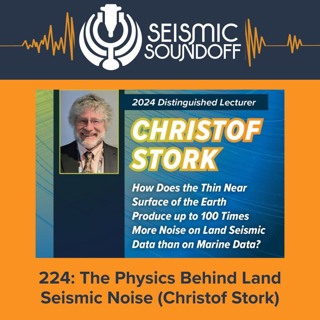
"With ​every ​new ​acquisition, ​spend ​2% ​of ​your ​budget ​to ​do ​research ​to ​understand the ​noise ​and ​signal ​drivers ​in ​your ​area. ​It ​might ​help ​any ​future ​neighboring ​acquisition, ​or ​it ​might ​just ​help ​the ​field ​in ​general, ​​which ​you ​and ​your ​career ​will ​benefit ​from." Dr. Christof Stork discusses his Distinguished Lecture, "How Does the Thin Near Surface of the Earth Produce up to 100 Times More Noise on Land Seismic Data than on Marine Data?". OVERVIEW > The significance of addressing noise in near-surface land seismic data > The interplay of theoretical and practical approaches in seismic noise reduction > The importance of coherent noise removal before statistical noise removal > The limitations and future potential of FWI in land seismic > The role of research and development in improving land seismic data quality > The impact of corporate and economic structures on seismic research investment Along with host Andrew Geary, Christof delves into the intricate world of land seismic noise. Noise is a significant challenge in land seismic data that has long been overlooked. Christof focuses on the complexities of land seismic noise and innovative methods to address it. Christof's journey into addressing land seismic noise began with his fascination for land data and its significant yet under-researched impact on seismic imaging. Despite the advancements in marine processing and pre-stack depth migration, land seismic methods have yet to see comparable progress. He emphasizes the need for more attention and funding in this area, highlighting how crucial it is for improving seismic data quality. Christof also illuminates the concept of "poor coupling," a term that describes the disconnect between surface geophones and the wave field at greater depths. He argues that understanding the physics behind poor coupling can lead to better signal extraction and improved seismic data quality. One key takeaway from Christof's discussion is the importance of combining theoretical and practical approaches to tackle land seismic noise. He explains that while traditional methods rely heavily on statistical noise removal, this is limited in effectiveness. Instead, Christof advocates for a focus on coherent noise removal, which can significantly enhance the effectiveness of statistical methods and reduce the need for excessive data collection. Christof's passion for land seismic research is evident as he calls for more investment in R&D from both the industry and academic communities. He stresses the potential benefits of dedicating a small percentage of acquisition budgets to research and creative experimentation, which could lead to significant advancements in seismic imaging. Listeners will better understand why land seismic noise remains a complex problem and the potential pathways to progress. LINKS * Visit https://seg.org/podcasts/episode-224-the-physics-behind-land-seismic-noise-christof-stork/ for the complete interview transcript and to register for the DL. GUEST BIO Christof Stork started as a theoretical academic with a PhD in geophysics from Caltech and a post-doc from Stanford 36 years ago. He performed early leading work in reflection tomography, PSDM, WEM, RTM, and FWI before they became mainstream technologies. Ten years ago, he decided to take on noisy land seismic data where more than theory is needed. Christof has been involved with four startup companies in his quest to avoid Houston and make theory commercially viable. He’s now on his fifth, last, and craziest startup company, a land seismic processing company so that he can get his hands on more land data. SHOW CREDITS Andrew Geary at TreasureMint hosted, edited, and produced this episode. The SEG podcast team comprises Jennifer Cobb, Kathy Gamble, and Ally McGinnis. If you have episode ideas or feedback for the show or want to sponsor a future episode, email the show at podcast@seg.org.

Denne episoden er hentet fra en åpen RSS-feed og er ikke publisert av Podme. Den kan derfor inneholde annonser.

Episoder(307)

Why SEG Is Building a Home for Mining Geophysics

Why SEG Is Building a Home for Mining Geophysics

"That’s what we’re trying to achieve with this forum: bringing all the people together with different backgrounds and create this community, which I don’t think fully exists right now.” Jiajia Sun an...

18 Jun 30min

The Human Side of Volcano Monitoring

The Human Side of Volcano Monitoring

"I feel like we are making a change in the way that people now see the volcanoes and see the earthquakes in El Salvador. So in that sense, I think we are making a a big change.” Adonay Martinez Coto ...

11 Jun 33min

How Geophysics Connects Curiosity, Science, and Career Opportunity

How Geophysics Connects Curiosity, Science, and Career Opportunity

“If you're curious about geophysics, there's definitely a place in geophysics for you. The field is so interdisciplinary.” Johanna Villagomez joins Andrew Geary to share how curiosity, fieldwork, stu...

4 Jun 23min

What Geophysicists Gain by Attending URTeC

What Geophysicists Gain by Attending URTeC

"Integration, literally, that's why the URTeC is successful.” Marianne Rauch joins Andrew Geary to explain why URTeC 2026 matters for geophysicists who want their work to shape real field decisions. ...

21 Mai 25min

Why Geophysicists Are Paying More Attention to Groundwater

Why Geophysicists Are Paying More Attention to Groundwater

“The concept of mapping the aquifer from the sky, that’s gigantic. It could change how aquifers are managed around the world.” Seogi Kang and Mike Wilt explain why groundwater is becoming one of the ...

14 Mai 28min

The Hidden Opportunity in Critical Minerals That Geophysicists Can’t Ignore

The Hidden Opportunity in Critical Minerals That Geophysicists Can’t Ignore

“We all realize that we need a lot more mineral resources in the next two decades. And we realized that geophysics can play a critical role.” Sarah Devriese and Jiajia Sun explain why demand for crit...

7 Mai 26min

OTC 2026 Emerging Leaders on the Future of Offshore Energy Collaboration

OTC 2026 Emerging Leaders on the Future of Offshore Energy Collaboration

“Nothing can happen in a vacuum anymore. We need to have the developers talking to the geoscientists, talking to the environmental professionals.” Two OTC 2026 Emerging Leaders share why the future o...

23 Apr 28min

Why Seismic Acquisition Is Making a Quiet Comeback

Why Seismic Acquisition Is Making a Quiet Comeback

"What has happened in the last few years is exploration overall has taken a little bit of a backseat. So they are starting to relook at seismic acquisition to explore new areas and solve more complex ...

16 Apr 27min

Populært innen Vitenskap

fastlegen
tingenes-tilstand
jss
liberal-halvtime
rekommandert
forskningno
villmarksliv
sinnsyn
tomprat-med-gunnar-tjomlid
rss-kunstig-intelligens-med-elisabeth-maren-og-morten
fjellsportpodden
rss-rekommandert
vett-og-vitenskap-med-gaute-einevoll
dekodet-2
rss-nysgjerrige-norge
smart-forklart
nevropodden
diagnose
rss-paradigmepodden
abels-tarn