Mutual Aid and the Anarchist Radical Imagination

Mutual Aid and the Anarchist Radical Imagination

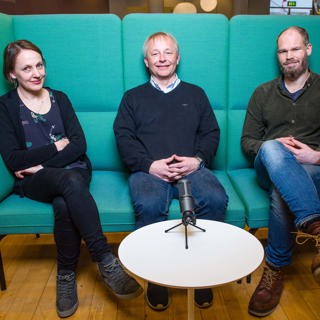
This episode of Darts and Letters examines the theory and practice of anti-statist organizing. There’s a story you can tell about the post-Occupy left gravitating towards a more state-oriented kind of politics, exemplified by the enthusiasm around Bernie Sanders, The Squad, and others. However, this misses autonomous and anarchist-inflected (and sometimes, explicitly anarchist) social movements that have brought enormous energy, and enormous change–from the movement for black lives, to organizing for Indigenous sovereignty, and so much more. In this episode, we look at the Kurdish movement, and mutual aid experiments across North America. First, we look at the work of the late libertarian socialist Murray Bookchin. Bookchin broke with Marxism, and later anarchism, and eventually developed an idiosyncratic ecological and revolutionary theory that said radical democracy could be achieved at the municipal level. This Vermont-based theorist has been enormously influential, including in an area formerly known as Rojava. There, the Kurdish people are making these ideas their own, and developing a radical feminist democracy–while fighting to survive. We speak with Elif Genc about these ideas, and about how the Kurdish diaspora implements them within Canada. Next, what is mutual aid? Peter Kropotkin’s Mutual Aid: A Factory of Evolution (1902) examines how cooperation and reciprocity are core to nature. To anarchists, this should be generalized to radical political program, and a radically new way of living. Darts and Letters producer Marc Apollonio speaks to Payton McDonald about how the theory and practice of mutual aid drives many social movements across North America. Payton is co-directing a four-part documentary series called the Elements of Mutual Aid: Experiments Towards Liberation. Finally, how do social movement scholars understand (or misunderstand) autonomous social movements? There’s a tendency to dismiss movements that do not make clear tangible demands, and deliver pragmatic policy victories (see: Occupy). However, Max Haiven and Alex Khasnabish say that this misses something key to radical social movements: their radical imagination. These movements do not want to just improve this system, they want to imagine, and create (or prefigure), a different system. We discuss their book the Radical Imagination: Social Movement Research in the Age of Austerity, the blind spots of social movement theory, and whether there might be a new style of organizing emerging that is somewhere between the the statist and the anti-statist. This episode received support from the Social Sciences and Humanities Research Council of Canada. It’s part of our mini-series that we are producing which looks at the radical imagination, in all its hopeful and its sometimes troubling manifestations. The scholarly leads are Professors Alex Khasnabish at Mount Saint Vincent University and Max Haiven at Lakehead University. They are providing research support and consulting to this series. For a full list of credits of Cited Media staff, visit our about page. Learn more about your ad choices. Visit megaphone.fm/adchoices Support our show by becoming a premium member! https://newbooksnetwork.supportingcast.fm/critical-theory

Episoder(2229)

Michaela Hulstyn, "Unselfing: Global French Literature at the Limits of Consciousness" (U Toronto Press, 2022)

Michaela Hulstyn, "Unselfing: Global French Literature at the Limits of Consciousness" (U Toronto Press, 2022)

Altered states of consciousness – including experiences of deprivation, pain, hallucination, fear, desire, alienation, and spiritual transcendence – can transform the ordinary experience of selfhood. ...

7 Apr 37min

Andrew Lister, "Justice and Reciprocity" (Oxford UP, 2024)

Andrew Lister, "Justice and Reciprocity" (Oxford UP, 2024)

Andrew Lister's Justice and Reciprocity (Oxford University Press, 2024) examines the place of reciprocity in egalitarianism, focusing on John Rawls's conception of "justice as fairness." Reciprocity w...

5 Apr 1h 11min

Eivind Røssaak, "The Cory Arcangel Hack: Digital Culture and Aesthetic Practice" (MIT Press, 2025)

Eivind Røssaak, "The Cory Arcangel Hack: Digital Culture and Aesthetic Practice" (MIT Press, 2025)

The first in-depth exploration of the work of artist Cory Arcangel, a pioneer of DIY-new media art whose influential “hacks” subvert the confines of Big Tech. Cory Arcangel (b. 1978)—perhaps best kno...

4 Apr 43min

Amir Saemi, "Morality and Revelation in Islamic Thought and Beyond: A New Problem of Evil" (Oxford UP, 2024)

Amir Saemi, "Morality and Revelation in Islamic Thought and Beyond: A New Problem of Evil" (Oxford UP, 2024)

Amir Saemi’s exciting book Morality and Revelation in Islamic Thought and Beyond: A New Problem of Evil (Oxford UP, 2024) is a fascinating and deeply thought-provoking study that challenges how we thi...

4 Apr 1h 29min

Daniel Rachel, "This Ain't Rock 'n' Roll: Pop Music, the Swastika, and the Third Reich" (Akashic Books, 2026)

Daniel Rachel, "This Ain't Rock 'n' Roll: Pop Music, the Swastika, and the Third Reich" (Akashic Books, 2026)

Over the last seven decades, some of rock 'n' roll's most celebrated figureheads have flirted with the imagery and theater of the Third Reich. From Keith Moon and Vivian Stanshall kitting themselves o...

4 Apr 57min
Pre-Reading

Pre-Reading

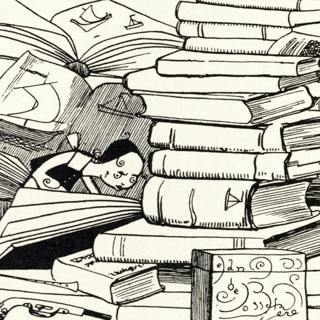
In this episode of High Theory, Milan Terlunen talks to Kim about Pre-Reading. There are many books we will never read and films we will never watch, but it turns out we know quite a bit about them in...

30 Mar 20min

Mark Pennington, "Foucault and Liberal Political Economy: Power, Knowledge, and Freedom" (Oxford UP, 2025)

Mark Pennington, "Foucault and Liberal Political Economy: Power, Knowledge, and Freedom" (Oxford UP, 2025)

Foucault and Liberal Political Economy: Power, Knowledge, and Freedom by Mark Pennington This highly original and innovative book is the first to comprehensively engage the ideas of the French social...

30 Mar 58min

Ainehi Edoro, "Forest Imaginaries: How African Novels Think" (Columbia UP, 2026)

Ainehi Edoro, "Forest Imaginaries: How African Novels Think" (Columbia UP, 2026)

Forests in fiction are often understood simply as settings, symbols, or remnants of a premodern past. Yet many African novelists have turned to the forest to experiment with worldbuilding and to imagi...

30 Mar 1h 2min

Populært innen Vitenskap

fastlegen
jss
tingenes-tilstand
forskningno
rekommandert
sinnsyn
rss-paradigmepodden
villmarksliv
liberal-halvtime
rss-nysgjerrige-norge
diagnose
fjellsportpodden
nevropodden
tomprat-med-gunnar-tjomlid
rss-inn-til-kjernen-med-sunniva-rose
tidlose-historier
kvinnehelsepodden
psykopoden
dekodet-2
smart-forklart