Sarah Lockhart: Choosing Motivating Therapy Targets to Maximize Spontaneous Language (Part 2)

Sarah Lockhart: Choosing Motivating Therapy Targets to Maximize Spontaneous Language (Part 2)

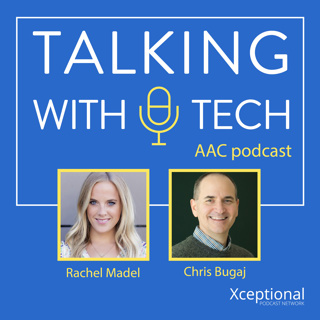
This week, we share Part 2 of Rachel’s interview with SLP and host of the SLP Happy Hour podcast, Sarah Lockhart! They continue their discussion of Sarah’s clients, including a nonverbal client who uses lots of scripts to communicate. Rachel shares ideas for how to choose targets for therapy, why we should be modeling language that is important to the AAC user, and how motivating materials during AAC assessment can help get a better picture of his or her true ability.

Before the interview, Chris and Rachel finish answering the question from last week about a student with a complex medical history that includes cortical visual impairment (CVI). Chris and Rachel discuss ideas for using books and TV shows the student loves to make therapy more fun, including watching YouTube and eliciting language from the video. They also talk about what to look at when the student isn’t making progress, including whether or not the activity they are doing is fun.

Key ideas this week:

🔑 When modeling, are you showing them language they might want to use? For example, it may be better to model “I don’t want to wake up” for a teenager than “Good Morning Mom”. Both are important, but, in this case, a modeled protest may be used spontaneously more readily than a greeting.

🔑 The most valid assessment is one in which the AAC user is motivated to engage - if we are assessing but forcing the student to label something uninteresting, they may not demonstrate their true skills.

🔑 How can we figure out where to start teaching language? One idea is to look at how AAC users are communicating nonverbally. If a child is already demonstrating non-verbal communication, it is an easy transition to giving them language to use instead of that gesture or action.

🔑 What are other ideas for choosing targets? Ask the communication partners - what does the student do all the time when no one is around? It can give us insight into what they are motivated by, such as sensory seeking behavior or refusal, which can then give you insight into targets and activities.

Links from this week’s episode:

Talking with Tech Episodes related to CVI: https://www.talkingwithtech.org/search?q=CVI

For resources related to coding, go to Code.org

Denne episoden er hentet fra en åpen RSS-feed og er ikke publisert av Podme. Den kan derfor inneholde annonser.

Episoder(357)

Episode 356: The State of the Podcast

Episode 356: The State of the Podcast

Rachel and Chris reconnect to share a candid update on what’s been happening behind the scenes with Talking With Tech including changes to the production team, why episodes have been less frequent, an...

21 Mai 24min

Episode 355: Building an Inclusive Playground and Community

Episode 355: Building an Inclusive Playground and Community

In this episode, Rachel Madel interviews Jesse and Holly Erickson, parents of Bedford, a young child with Schwartz-Jampel syndrome. They share their journey to diagnosis, what it’s like navigating a r...

16 Mai 43min

Episode 354: Brie Norton & Lynsey Phillips: Creating a Culture of Learning Language Using Augmentative/Alternative Communication

Episode 354: Brie Norton & Lynsey Phillips: Creating a Culture of Learning Language Using Augmentative/Alternative Communication

Chris talks with Lynsey Phillips and Brie Norton, two AAC leaders in Northwest Arkansas who have built a powerful, practical framework for AAC implementation across settings. They share how their part...

28 Feb 1h

Bob Sagoo: Celebrating the Life and Legacy of Harchie Sagoo

Bob Sagoo: Celebrating the Life and Legacy of Harchie Sagoo

In this episode, Chris & Rachel talk with Bob Sagoo a longtime assistive technology professional and parent advocate. Bob shares the story of his son Harchie, his path from low-tech communication supp...

12 Feb 47min

Britton Payne: Promoting Authentic Autistic Representation in Pop Culture

Britton Payne: Promoting Authentic Autistic Representation in Pop Culture

This episode, Chris & Rachel interview Britton Payne! Britton Payne is an entertainment attorney who has worked with major studios like Nickelodeon and Warner Bros., and he is also the father of an au...

11 Des 202528min

Quinn Kelly: Connecting AAC and ASL to Support Deaf & Hard of Hearing Communicators

Quinn Kelly: Connecting AAC and ASL to Support Deaf & Hard of Hearing Communicators

This week, we share Rachel’s interview with Quinn Kelly! Quinn Kelly is a bilingual speech-language pathologist who specializes in working with children who use both AAC and American Sign Language (AS...

15 Okt 20251h 5min

Brian Whitmer: Measuring Progress and Purpose in the AAC Community

Brian Whitmer: Measuring Progress and Purpose in the AAC Community

This week, we share Chris's interview with Brian Whitmer! Brian is the founder of the AAC app CoughDrop and Open AAC, a nonprofit organization dedicated to improving the AAC field through collaboratio...

11 Okt 20251h 14min

Katie Roettele: STEM, AAC, and the Power of "Making" for Inclusion

Katie Roettele: STEM, AAC, and the Power of "Making" for Inclusion

This week, Chris interviews Katie Roettele! Katie Roettele is an occupational therapist and assistive technology consultant based in Michigan, specializing in AAC and universal design for learning. Sh...

2 Okt 202549min

Populært innen Fakta

fastlegen
dine-penger-pengeradet
relasjonspodden-med-dora-thorhallsdottir-kjersti-idem
treningspodden
foreldreradet
jakt-og-fiskepodden
rss-orjasater
rss-kunsten-a-leve
rss-strid-de-norske-borgerkrigene
tomprat-med-gunnar-tjomlid
mikkels-paskenotter
sinnsyn
hverdagspsyken
gravid-uke-for-uke
rss-var-forste-kaffe
fryktlos
smart-forklart
hagespiren-podcast
dopet
kvallm