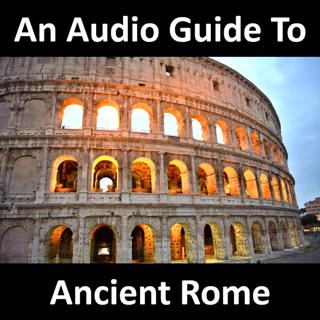
19: Black Stone, Rostra and Phocas

19: Black Stone, Rostra and Phocas

You’re listening to an Audio Guide to Ancient Rome. This episode is one in a series of short descriptions of monuments in the Roman Forum. In this episode I’m describing the Black Stone, Rostra and the Column of Phocas.

The Roman Forum sits in a saddle between the Capitoline and Palatine Hills. Originally a marshy area, successive improvements to the land’s drainage allowed this to eventually become the center of power for the city.

As its armies conquered new territories and money flowed into Rome, the Forum’s original meat and produce sellers were pushed out, to be replaced by majestic temples and monumental structures that accommodated the key societal, political and judicial systems needed for the empire to function. This area served as a central market and meeting place over many centuries although the nature of the proprietors and clientele changed significantly over time.

The Forum and its surrounding buildings grew to be the focal point for nearly everything associated with the lives of the people of Rome including political discussions, legislative processes, civic entertainment, as well as a logical place to hold a riot or even a cremation.

The area was first surfaced with gravel in 7th Century BCE around the time of the establishment of the Comitium and Senate House (or Curia). Although lost for many centuries and no longer recognizable other than through its archaeological footprint, the Comitium was sited in front of where you now see the meeting house of the Roman Senate (which is often called the Curia Julia). If you’re having trouble locating this, it is to the south east of the Arch of Septimius Severus and hidden underneath a low sloping temporary roof that covers ongoing excavation work.

Also the location of the sanctuary for the fire god Vulcan, this was an important cult center from the very beginning of Rome’s development. The sanctuary consisted of an open-air U-shaped altar, a column which was probably for a cult statue, and an inscribed stela, known as the Lapis Niger (or Black Stone).

Denne episoden er hentet fra en åpen RSS-feed og er ikke publisert av Podme. Den kan derfor inneholde annonser.

Episoder(36)

28: Trajan's Column

28: Trajan's Column

Trajan’s Column is a monument to Emperor Trajan’s victory in the wars with Dacia that took place between the years 101 and 106.  It was part of a sequence of constructions built by or dedicated to Tra...

25 Feb 20218min

35: The Column of Marcus Aurelius

35: The Column of Marcus Aurelius

This monument celebrates Marcus Aurelius’ two successful military campaigns against tribes north of the Danube in what is modern day Germany.  The first campaign ran from the year 172-173 and was wage...

17 Okt 202011min

34: The Mausoleum of Augustus

34: The Mausoleum of Augustus

Augustus started building the mausoleum following his victory over Anthony and Cleopatra in 31 BCE at the naval battle on the west coast of Greece close to the promontory of Actium – his success broug...

10 Okt 202010min

33: The Theater of Marcellus

33: The Theater of Marcellus

The Theater was named after Emperor Augustus’ nephew Marcus Claudius Marcellus however the building was originally commissioned by Julius Caesar who bought and cleared the land in a space to the south...

3 Okt 202010min

32: The Pyramid of Cestius

32: The Pyramid of Cestius

The Pyramid of Cestius was built during the reign of the emperor Augustus, probably between 18 and 12 BCE. It’s surface is white Carrara marble and the tip is exactly 100 Roman feet (30 meters) high. ...

26 Sep 20207min

12: The Temple of Vesta

12: The Temple of Vesta

The Temple of Vesta was integrated into the adjacent House and Sanctuary of the Vestal Virgins. The only remains of the temple itself are a modest mound of concrete however there is a reconstruction o...

20 Sep 20204min

13: Temple of Divus Romulus

13: Temple of Divus Romulus

The Temple of Divus Romulus is recognizable as a tall round building on the North side of the Via Sacra. From the name you can be forgiven for thinking that this temple is dedicated to Romulus the leg...

20 Sep 20205min

14: Temple of Antoninus and Faustina

14: Temple of Antoninus and Faustina

The Temple of Antoninus and Faustina is easily recognized by the six columns that dominate its front – these are topped by an entablature that carries the dedication to “Divo Antonino et Divae Faustin...

20 Sep 20205min

Populært innen Fakta

fastlegen
dine-penger-pengeradet
relasjonspodden-med-dora-thorhallsdottir-kjersti-idem
foreldreradet
jakt-og-fiskepodden
rss-bisarr-historie
treningspodden
rss-strid-de-norske-borgerkrigene
mikkels-paskenotter
rss-kunsten-a-leve
sinnsyn
hverdagspsyken
gravid-uke-for-uke
hagespiren-podcast
lederskap-nhhs-podkast-om-ledelse
dopet
rss-sunn-okonomi
uroskolen
rss-mind-body-podden
rss-kull