104 | David Rosen and Scott Miles on the Neuroscience of Music and Creativity

104 | David Rosen and Scott Miles on the Neuroscience of Music and Creativity

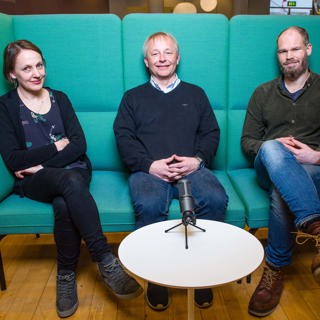
Creativity is one of those things that we all admire but struggle to define or make concrete. Music provides a useful laboratory in which to examine what creativity is all about — how do people become creative, what is happening in their brains during the creative process, and what kinds of creativity does the audience actually enjoy? David Rosen and Scott Miles are both neuroscientists and musicians who have been investigating this question from the perspective of both listeners and performers. They have been performing neuroscientific experiments to understand how the brain becomes creative, and founded Secret Chord Laboratories to develop software that will predict what kinds of music people will like.

Support Mindscape on Patreon.

David S. Rosen received his Ph.D. in cognitive psychology from Drexel University. He is currently a co-founder and the chief operations officer at Secret Chord Laboratories, a music-tech startup company. His interdisciplinary research program covers an array of topics: creative cognition, peak experiences, the neuroscience of music production and perception, psychedelics and STEAM education. David began playing the piano at the age of 8 and bass at age 15. He is the co-creator and bassist of sci-fi transmedia band, Chronicles of Sound, and instrumental progressive rock band, NAKAMA.

Scott Miles received his Ph.D. in neuroscience from Georgetown University. He is currently the CEO and innovation leader of Secret Chord Laboratories. He has been performing and producing music since the age of 10. In his doctoral work he investigated how music preference is formed in the brain. He secured funding through the National Science Foundation Graduate Research Fellowship to support this work. With David Rosen, Ph.D., he found support for two hypotheses about how the structure of music leads to purchase decisions. Miles then coded an algorithm to generate new music, and in a behavioral experiment, music featuring these properties was indeed preferred. He formed and has overseen the development of Secret Chord laboratories since it was incorporated in June 2018.


Episoder(423)

291 | Venki Ramakrishnan on the Biology of Death and Aging

291 | Venki Ramakrishnan on the Biology of Death and Aging

Aging and death happen to the best of us, but there are increasing efforts to do something about it. That effort requires that we have some reasonable understanding of why aging happens, and what proc...

30 Sep 20241h 20min

290 | Hahrie Han on Making Multicultural Democracy Work

290 | Hahrie Han on Making Multicultural Democracy Work

It's a wonder democracy works at all -- a collection of people with potentially different interests have to agree to abide by majority vote even when it goes against their desires. But as we know, it ...

23 Sep 20241h 15min

289 | Cari Cesarotti on the Next Generation of Particle Experiments

289 | Cari Cesarotti on the Next Generation of Particle Experiments

As an experimental facility, the Large Hadron Collider at CERN in Geneva has been extraordinarily successful, discovering the Higgs boson and measuring multiple features of particle-physics interactio...

16 Sep 20241h 21min

288 | Max Richter on the Meaning of Classical Music Today

288 | Max Richter on the Meaning of Classical Music Today

It wasn't that long ago, historically speaking, that you might put on your tuxedo or floor-length evening gown to go out and hear a live opera or symphony. But today's world is faster, more technologi...

9 Sep 20241h 6min

AMA | September 2024

AMA | September 2024

Welcome to the September 2024 Ask Me Anything episode of Mindscape! These monthly excursions are funded by Patreon supporters (who are also the ones asking the questions). We take questions asked by P...

2 Sep 20243h 50min

287 | Jean-Paul Faguet on Institutions and the Legacy of History

287 | Jean-Paul Faguet on Institutions and the Legacy of History

One common feature of complex systems is sensitive dependence on initial conditions: a small change in how systems begin evolving can lead to large differences in their later behavior. In the social s...

26 Aug 20241h 32min

286 | Blaise Agüera y Arcas on the Emergence of Replication and Computation

286 | Blaise Agüera y Arcas on the Emergence of Replication and Computation

Understanding how life began on Earth involves questions of chemistry, geology, planetary science, physics, and more. But the question of how random processes lead to organized, self-replicating, info...

19 Aug 20241h 20min

285 | Nate Silver on Prediction, Risk, and Rationality

285 | Nate Silver on Prediction, Risk, and Rationality

Being rational necessarily involves engagement with probability. Given two possible courses of action, it can be rational to prefer the one that could possibly result in a worse outcome, if there's al...

12 Aug 20241h 11min

Populært innen Vitenskap

fastlegen
tingenes-tilstand
jss
rekommandert
forskningno
sinnsyn
tomprat-med-gunnar-tjomlid
villmarksliv
rss-paradigmepodden
rss-nysgjerrige-norge
liberal-halvtime
nevropodden
fjellsportpodden
kvinnehelsepodden
diagnose
tidlose-historier
rss-inn-til-kjernen-med-sunniva-rose
psykopoden
nordnorsk-historie
rss-hoyt-lavt-med-ida-tonseth