99 | Scott Aaronson on Complexity, Computation, and Quantum Gravity

99 | Scott Aaronson on Complexity, Computation, and Quantum Gravity

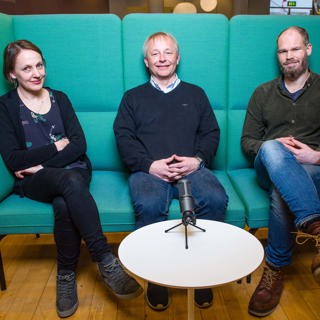
There are some problems for which it's very hard to find the answer, but very easy to check the answer if someone gives it to you. At least, we think there are such problems; whether or not they really exist is the famous P vs NP problem, and actually proving it will win you a million dollars. This kind of question falls under the rubric of "computational complexity theory," which formalizes how hard it is to computationally attack a well-posed problem. Scott Aaronson is one of the world's leading thinkers in computational complexity, especially the wrinkles that enter once we consider quantum computers as well as classical ones. We talk about how we quantify complexity, and how that relates to ideas as disparate as creativity, knowledge vs. proof, and what all this has to do with black holes and quantum gravity.

Support Mindscape on Patreon.

Scott Aaronson received his Ph.D. in computer science from the University of California, Berkeley. He is currently the David J. Bruton Jr. Centennial Professor of Computer Science at the University of Texas at Austin, and director of the Quantum Information Center there. He specializes in quantum computing and computational complexity theory, but has written on topics from free will to the nature of consciousness. Among his awards are the Tomassoni-Chisesi Prize in Physics (Italy) and the Alan T. Waterman Award from the National Science Foundation. His blog Shtetl-Optimized is known both for its humor and as the most reliable source of information on news in quantum computing. He is the author of Quantum Computing Since Democritus.


Episoder(423)

29 | Raychelle Burks on the Chemistry of Murder

29 | Raychelle Burks on the Chemistry of Murder

Sometimes science is asking esoteric questions about the fundamental nature of reality. Other times, it just wants to solve a murder. Today's guest, Raychelle Burks, is an analytical chemist at St. Ed...

14 Jan 20191h 15min

28 | Roger Penrose on Spacetime, Consciousness, and the Universe

28 | Roger Penrose on Spacetime, Consciousness, and the Universe

Sir Roger Penrose has had a remarkable life. He has contributed an enormous amount to our understanding of general relativity, perhaps more than anyone since Einstein himself -- Penrose diagrams, sing...

7 Jan 20191h 35min

Holiday Message 2018

Holiday Message 2018

There won't be any regular episodes of Mindscape this week or next, as we take a holiday break. Regular service will resume on Monday January 7, 2019. In the meantime, here is a special Holiday Messag...

24 Des 201844min

27 | Janna Levin on Black Holes, Chaos, and the Narrative of Science

27 | Janna Levin on Black Holes, Chaos, and the Narrative of Science

It's a big universe out there, full of an astonishing variety of questions and puzzles. Today's guest, Janna Levin, is a physicist who has delved into some of the trippiest aspects of cosmology and gr...

17 Des 20181h 8min

26 | Ge Wang on Artful Design, Computers, and Music

26 | Ge Wang on Artful Design, Computers, and Music

Everywhere around us are things that serve functions. We live in houses, sit on chairs, drive in cars. But these things don't only serve functions, they also come in particular forms, which may be emo...

10 Des 20181h 10min

25 | David Chalmers on Consciousness, the Hard Problem, and Living in a Simulation

25 | David Chalmers on Consciousness, the Hard Problem, and Living in a Simulation

The "Easy Problems" of consciousness have to do with how the brain takes in information, thinks about it, and turns it into action. The "Hard Problem," on the other hand, is the task of explaining our...

3 Des 20181h 22min

24 | Kip Thorne on Gravitational Waves, Time Travel, and Interstellar

24 | Kip Thorne on Gravitational Waves, Time Travel, and Interstellar

I remember vividly hosting a colloquium speaker, about fifteen years ago, who talked about the LIGO gravitational-wave observatory, which had just started taking data. Comparing where they were to whe...

26 Nov 20181h 19min

23 | Lisa Aziz-Zadeh on Embodied Cognition, Mirror Neurons, and Empathy

23 | Lisa Aziz-Zadeh on Embodied Cognition, Mirror Neurons, and Empathy

Brains are important things; they're where thinking happens. Or are they? The theory of "embodied cognition" posits that it's better to think of thinking as something that takes place in the body as a...

19 Nov 20181h 7min

Populært innen Vitenskap

fastlegen
tingenes-tilstand
jss
rekommandert
forskningno
sinnsyn
tomprat-med-gunnar-tjomlid
villmarksliv
rss-paradigmepodden
rss-nysgjerrige-norge
liberal-halvtime
nevropodden
fjellsportpodden
kvinnehelsepodden
diagnose
tidlose-historier
rss-inn-til-kjernen-med-sunniva-rose
psykopoden
nordnorsk-historie
rss-hoyt-lavt-med-ida-tonseth