19 | Tyler Cowen on Maximizing Growth and Thinking for the Future

19 | Tyler Cowen on Maximizing Growth and Thinking for the Future

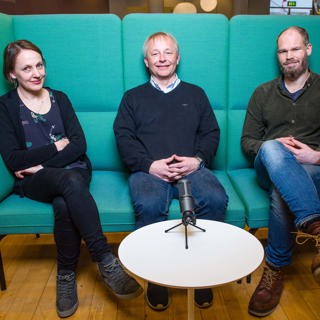
Economics, like other sciences (social and otherwise), is about what the world does; but it's natural for economists to occasionally wander out into the question of what we should do as we live in the world. A very good example of this is a new book by economist Tyler Cowen, Stubborn Attachments. Tyler will be well-known to many listeners for his long-running blog Marginal Revolution (co-created with his colleague Alex Tabarrok) and his many books and articles. Here he offers a surprising new take on how society should arrange itself, based on the simple idea that the welfare of future generations counts for just as much as the welfare of the current one. From that starting point, Tyler concludes that the most moral thing for us to do is to work to maximize economic growth right now, as that's the best way to ensure that future generations are well-off. We talk about this idea, as well as the more general idea of how to think like an economist. (In the second half of the podcast we veer off into talking about quantum mechanics and the multiverse, to everyone's benefit.) Tyler Cowen is the Holbert C. Harris professor of economics and General Director of the Mercatus Center at George Mason University. He is the author of over a dozen books and many journal articles, and writes frequently for the popular press. His blog Marginal Revolution is one of the leading economics blogs on the internet. He is widely recognized for his eclectic interests, from chess to music to ethnic dining. Website Home page at George Mason Mercatus Center web page Marginal Revolution Marginal Revolution University Twitter Bloomberg Opinion columns Tyler Cowen's Ethnic Dining Guide Wikipedia page Amazon books

Episoder(418)

AMA | May 2024

AMA | May 2024

Welcome to the May 2024 Ask Me Anything episode of Mindscape! These monthly excursions are funded by Patreon supporters (who are also the ones asking the questions). We take questions asked by Patreon...

6 Mai 20243h 35min

274 | Gizem Gumuskaya on Building Robots from Human Cells

274 | Gizem Gumuskaya on Building Robots from Human Cells

Modern biology is advancing by leaps and bounds, not only in understanding how organisms work, but in learning how to modify them in interesting ways. One exciting frontier is the study of tiny "robot...

29 Apr 20241h 10min

273 | Stefanos Geroulanos on the Invention of Prehistory

273 | Stefanos Geroulanos on the Invention of Prehistory

Humanity itself might be the hardest thing for scientists to study fairly and accurately. Not only do we come to the subject with certain inevitable preconceptions, but it's hard to resist the temptat...

22 Apr 20241h 19min

272 | Leslie Valiant on Learning and Educability in Computers and People

272 | Leslie Valiant on Learning and Educability in Computers and People

Science is enabled by the fact that the natural world exhibits predictability and regularity, at least to some extent. Scientists collect data about what happens in the world, then try to suggest "law...

15 Apr 20241h 8min

AMA | April 2024

AMA | April 2024

Welcome to the April 2024 Ask Me Anything episode of Mindscape! These monthly excursions are funded by Patreon supporters (who are also the ones asking the questions). We take questions asked by Patre...

8 Apr 20243h 14min

271 | Claudia de Rham on Modifying General Relativity

271 | Claudia de Rham on Modifying General Relativity

Einstein's theory of general relativity has been our best understanding of gravity for over a century, withstanding a variety of experimental challenges of ever-increasing precision. But we have to be...

1 Apr 20241h 21min

270 | Solo: The Coming Transition in How Humanity Lives

270 | Solo: The Coming Transition in How Humanity Lives

Technology is changing the world, in good and bad ways. Artificial intelligence, internet connectivity, biological engineering, and climate change are dramatically altering the parameters of human lif...

25 Mar 20242h 9min

269 | Sahar Heydari Fard on Complexity, Justice, and Social Dynamics

269 | Sahar Heydari Fard on Complexity, Justice, and Social Dynamics

When it comes to social change, two questions immediately present themselves: What kind of change do we want to see happen? And, how do we bring it about? These questions are distinct but related; the...

18 Mar 20241h 11min

Populært innen Vitenskap

fastlegen
tingenes-tilstand
rekommandert
forskningno
rss-nysgjerrige-norge
sinnsyn
rss-rekommandert
vett-og-vitenskap-med-gaute-einevoll
smart-forklart
pod-britannia
fjellsportpodden
liberal-halvtime
jss
villmarksliv
nevropodden
aldring-og-helse-podden
rss-overskuddsliv
psykopoden
tomprat-med-gunnar-tjomlid
dekodet-2