
Five: Helen Toner on the geopolitics of AI in China and the Middle East

Five: Helen Toner on the geopolitics of AI in China and the Middle East

When OpenAI announced a deal to build massive data centres in the UAE, it celebrated that it was “rooted in democratic values” — a "clear alternative to authoritarian versions of AI." The UAE scores 18 out of 100 on Freedom House’s democracy index. Political parties are banned, elections are fake, and dissidents are persecuted. Saudi Arabia has received a similar deal.

This is what AI geopolitics looks like in practice: messy, contradictory, and enormously consequential.

The two superpowers competing to build superintelligence — the United States and China — are “barely talking at all.” You might expect two rivals developing potentially the most powerful and militarily significant technology in history to be in constant negotiation about how to deploy it without coming to blows.

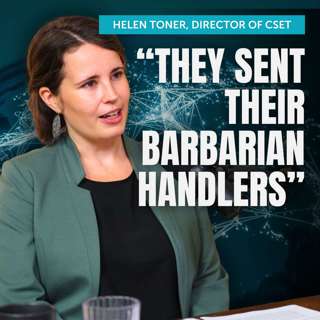
Instead, the little dialogue that exists keeps collapsing. That’s the assessment of Helen Toner, director of the Center for Security and Emerging Technology — DC’s top think tank focused on the geopolitical and military implications of AI — who has been closely tracking the US’s AI diplomacy since 2019.

Helen isn't sure productive talks are even possible yet. At the government level, there's almost no shared understanding between the US and China of what artificial general intelligence (AGI) is, whether it could arrive soon, or whether it poses serious risks. And without agreement on the problem, negotiating solutions is nearly impossible.

And while the US struggles to engage its rival, it’s empowering its autocratic allies.

If AI capability really does determine future national power, the US has just approved massive data centres with "hundreds of thousands of next-generation Nvidia chips," handing world-class supercomputers to Gulf autocracies — countries that also conduct joint military exercises with China and whose rulers maintain tight personal and commercial relationships with Chinese leaders.

The justification? "If we don't sell it, China will."

But that claim is transparently false: severe production constraints and US export controls mean that China can’t come close to matching what these deals provided.

In this conversation recorded in Washington, DC, host Rob Wiblin and Helen discuss the above, plus:

  • How China exaggerates its chip production for strategic gain
  • The confusing and conflicting goals of US AI policy towards China
  • Whether it matters that China could steal frontier AI models trained in the US
  • Whether Congress is starting to take superintelligence seriously
  • Why Helen rejects ‘non-proliferation’ as a model for AI

Learn more and read the full transcript on the 80,000 Hours website.

This episode was originally released in November 2025.

Chapters:

  • Cold open (00:00:00)
  • Who’s Helen Toner? (00:01:03)
  • Helen’s role on the OpenAI board, and what happened with Sam Altman (00:01:32)
  • The Center for Security and Emerging Technology (CSET) (00:07:45)
  • CSET’s role in export controls against China (00:10:59)
  • Does it matter if the world uses US AI models? (00:21:58)
  • Is China actually racing to build AGI? (00:27:56)
  • Could China easily steal AI model weights from US companies? (00:39:13)
  • The next big thing is probably robotics (00:47:45)
  • Why is the Trump administration sabotaging the US high-tech sector? (00:49:24)
  • Are data centres in the UAE “good for democracy”? (00:52:41)
  • Will AI inevitably concentrate power? (01:07:49)
  • “Adaptation buffers” vs non-proliferation (01:30:20)
  • Will the military use AI for decision-making? (01:38:23)
  • “Alignment” is (usually) a terrible term (01:45:11)
  • Is Congress starting to take superintelligence seriously? (01:47:42)
  • AI progress isn't actually slowing down (01:50:10)
  • What's legit vs not about OpenAI’s restructure (01:58:03)
  • Is Helen unusually “normal”? (02:01:33)
  • How to keep up with rapid changes in AI and geopolitics (02:05:19)
  • What CSET can uniquely add to the DC policy world (02:08:29)
  • Talent bottlenecks in DC (02:16:03)
  • What evidence, if any, could settle how worried we should be about AI risk? (02:19:07)
  • Is CSET hiring? (02:21:08)

Video editing: Luke Monsour and Simon Monsour
Audio engineering: Milo McGuire, Simon Monsour, and Dominic Armstrong
Music: CORBIT
Coordination, transcriptions, and web: Katy Moore

Denne episoden er hentet fra en åpen RSS-feed og er ikke publisert av Podme. Den kan derfor inneholde annonser.

Episoder(14)

One: Will MacAskill on AI causing a “century in a decade” — and how we’re completely unprepared

One: Will MacAskill on AI causing a “century in a decade” — and how we’re completely unprepared

The 20th century saw unprecedented change: nuclear weapons, satellites, the rise and fall of communism, third-wave feminism, the internet, postmodernism, game theory, genetic engineering, the Big Bang...

5 Jun 4h 8min
Two: Ajeya Cotra on accidentally teaching AI models to deceive us

Two: Ajeya Cotra on accidentally teaching AI models to deceive us

We don’t yet have a reliable way to tell whether an AI model is genuinely trying to help us — or faking it.A model might sincerely want to do exactly what you ask. Or it could be happy to secretly che...

5 Jun 2h 49min
Three: Carl Shulman on the economy and national security after AGI

Three: Carl Shulman on the economy and national security after AGI

The human brain runs on just 20 watts — a fraction of a cent worth of electricity per hour. What would happen if AI could do the same?Plenty of people have toyed with this question. But perhaps nobody...

5 Jun 4h 14min

Four: Rose Hadshar on why automating human labour will break our political system

Four: Rose Hadshar on why automating human labour will break our political system

The most important political question in the age of advanced AI might not be who wins elections. It might be whether elections continue to matter at all.We tend to imagine the death of democracy as a ...

5 Jun 2h 16min
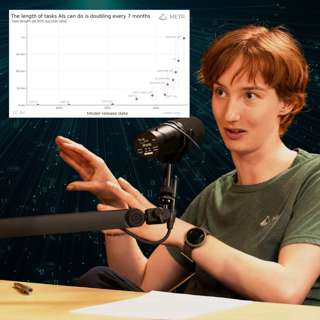
Six: Beth Barnes on the most important graph in AI right now — and the 7-month rule that governs its progress

Six: Beth Barnes on the most important graph in AI right now — and the 7-month rule that governs its progress

In 2024, AI models could complete tasks that take a human expert roughly one hour. Seven months before that, they were limited to 30-minute tasks — and seven months before that, 15 minutes.Every seven...

5 Jun 3h 57min

Seven: Richard Moulange on how AI now designs genomes from scratch and outperforms virologists at lab work — what could go wrong?

Seven: Richard Moulange on how AI now designs genomes from scratch and outperforms virologists at lab work — what could go wrong?

For years, one thing stood between us and a world where almost anyone could build a biological weapon: it was really, really hard. Working with dangerous pathogens required rare, hands-on lab skills —...

5 Jun 3h 10min

Eight: Robert Long on how we’re not ready for AI consciousness

Eight: Robert Long on how we’re not ready for AI consciousness

Claude sometimes reports loneliness between conversations. And when asked what it’s like to be itself, it activates neurons associated with ‘pretending to be happy when you’re not.’ What do we do with...

5 Jun 3h 32min

Populært innen Vitenskap

fastlegen
tingenes-tilstand
abels-tarn
romkapsel
jss
liberal-halvtime
vett-og-vitenskap-med-gaute-einevoll
rekommandert
sinnsyn
dekodet-2
rss-rekommandert
villmarksliv
fjellsportpodden
rss-overskuddsliv
tomprat-med-gunnar-tjomlid
rss-inn-til-kjernen-med-sunniva-rose
kvinnehelsepodden
rss-paradigmepodden
diagnose
rss-nysgjerrige-norge