
Four: Rose Hadshar on why automating human labour will break our political system

Four: Rose Hadshar on why automating human labour will break our political system

The most important political question in the age of advanced AI might not be who wins elections. It might be whether elections continue to matter at all.

We tend to imagine the death of democracy as a dramatic event: a coup, tanks in the streets, a strongman tearing up the constitution. But Rose Hadshar, researcher at Forethought Research, believes AI-enabled power concentration could be far quieter — and far harder to stop.

She foresees something insidious: an elite group with access to such powerful AI capabilities that the normal mechanisms for checking power — law, elections, public pressure, the threat of strikes — cease to have much effect. They might continue to exist on paper, but become ineffectual in a world where humans are no longer needed for even the largest-scale projects.

Almost nobody wants this to happen, but we may find ourselves unable to prevent it:

  • If AI disrupts our ability to make sense of things, will we even notice power being concentrated?
  • If AI replaces human labour, what leverage will citizens have left to resist?

And what does all of this imply for the institutions we’re relying on to prevent the worst outcomes?

Rose has answers, and they’re not all reassuring.

But she’s also hopeful we can make society more robust against these dynamics. We’ve got literally centuries of thinking about checks and balances to draw on. And there are some interventions she’s excited about — like building sophisticated AI tools for making sense of the world, or ensuring multiple branches of government have access to the best AI systems.

In this conversation, Rose and host Zershaaneh Qureshi discuss all of this, and more:

  • Three dynamics that could reshape political power in the AI era
  • Why AI-powered tyranny would be uniquely difficult to topple
  • How power concentration compares to ‘gradual disempowerment’ by AI
  • Slower-moving scenarios that could still get scary
  • Which interventions could genuinely work — and which might backfire
  • Rose's most promising approaches to fighting back
  • Why a ‘Manhattan Project’ approach to AI should worry you — and why international projects aren’t automatically safe either

Learn more and read the full transcript on the 80,000 Hours website.

This episode was originally released in March 2026.

Chapters:

  • Cold open (00:00:00)
  • Who’s Rose Hadshar? (00:01:02)
  • Three dynamics that could reshape political power in the AI era (00:02:38)
  • AI gives small groups the productive power of millions (00:13:07)
  • Dynamic 1: When a software update becomes a power grab (00:21:13)
  • Dynamic 2: When AI labour means governments no longer need their citizens (00:32:06)
  • How democracy could persist in name but not substance (00:46:18)
  • Dynamic 3: When AI filters our reality (00:56:13)
  • Good intentions won’t stop power concentration (01:09:52)
  • Slower-moving worlds could still get scary (01:25:32)
  • Why AI-powered tyranny will be tough to topple (01:33:40)
  • How power concentration compares to “gradual disempowerment” (01:40:16)
  • Some interventions are cross-cutting — and others could backfire (01:46:03)
  • What fighting back actually looks like (01:57:33)
  • Why power concentration researchers should avoid getting too “spicy” (02:06:36)
  • Why the “Manhattan Project” approach should worry you — but truly international projects might not be safe either (02:11:46)
  • Rose wants to keep humans around! (02:14:40)

Video and audio editing: Dominic Armstrong, Milo McGuire, Luke Monsour, and Simon Monsour
Music: CORBIT
Coordination, transcripts, and web: Nick Stockton and Katy Moore

Denne episoden er hentet fra en åpen RSS-feed og er ikke publisert av Podme. Den kan derfor inneholde annonser.

Episoder(14)

One: Will MacAskill on AI causing a “century in a decade” — and how we’re completely unprepared

One: Will MacAskill on AI causing a “century in a decade” — and how we’re completely unprepared

The 20th century saw unprecedented change: nuclear weapons, satellites, the rise and fall of communism, third-wave feminism, the internet, postmodernism, game theory, genetic engineering, the Big Bang...

5 Jun 4h 8min
Two: Ajeya Cotra on accidentally teaching AI models to deceive us

Two: Ajeya Cotra on accidentally teaching AI models to deceive us

We don’t yet have a reliable way to tell whether an AI model is genuinely trying to help us — or faking it.A model might sincerely want to do exactly what you ask. Or it could be happy to secretly che...

5 Jun 2h 49min
Three: Carl Shulman on the economy and national security after AGI

Three: Carl Shulman on the economy and national security after AGI

The human brain runs on just 20 watts — a fraction of a cent worth of electricity per hour. What would happen if AI could do the same?Plenty of people have toyed with this question. But perhaps nobody...

5 Jun 4h 14min

Five: Helen Toner on the geopolitics of AI in China and the Middle East

Five: Helen Toner on the geopolitics of AI in China and the Middle East

When OpenAI announced a deal to build massive data centres in the UAE, it celebrated that it was “rooted in democratic values” — a "clear alternative to authoritarian versions of AI." The UAE scores 1...

5 Jun 2h 23min
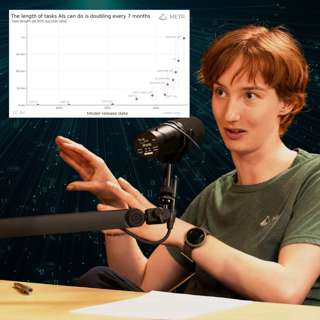
Six: Beth Barnes on the most important graph in AI right now — and the 7-month rule that governs its progress

Six: Beth Barnes on the most important graph in AI right now — and the 7-month rule that governs its progress

In 2024, AI models could complete tasks that take a human expert roughly one hour. Seven months before that, they were limited to 30-minute tasks — and seven months before that, 15 minutes.Every seven...

5 Jun 3h 57min

Seven: Richard Moulange on how AI now designs genomes from scratch and outperforms virologists at lab work — what could go wrong?

Seven: Richard Moulange on how AI now designs genomes from scratch and outperforms virologists at lab work — what could go wrong?

For years, one thing stood between us and a world where almost anyone could build a biological weapon: it was really, really hard. Working with dangerous pathogens required rare, hands-on lab skills —...

5 Jun 3h 10min

Eight: Robert Long on how we’re not ready for AI consciousness

Eight: Robert Long on how we’re not ready for AI consciousness

Claude sometimes reports loneliness between conversations. And when asked what it’s like to be itself, it activates neurons associated with ‘pretending to be happy when you’re not.’ What do we do with...

5 Jun 3h 32min

Populært innen Vitenskap

fastlegen
tingenes-tilstand
abels-tarn
romkapsel
jss
liberal-halvtime
vett-og-vitenskap-med-gaute-einevoll
rekommandert
sinnsyn
dekodet-2
rss-rekommandert
villmarksliv
fjellsportpodden
rss-overskuddsliv
tomprat-med-gunnar-tjomlid
rss-inn-til-kjernen-med-sunniva-rose
kvinnehelsepodden
rss-paradigmepodden
diagnose
rss-nysgjerrige-norge