James Robert Brown: Thought Experiments Reveal Mathematical Reality

James Robert Brown: Thought Experiments Reveal Mathematical Reality

James Robert Brown (University of Toronto) argues for mathematical Platonism and examines the Continuum Hypothesis He examines moral realism, the nature of mathematical objects, and debates free will versus physics while probing Platonism and alternative foundations.- 00:00:00 - Introduction- 00:01:17 - The connection between mathematics and ethics- 00:03:05 - Mathematical concepts that are interpreted solely physically (thick and thin concepts)- 00:16:33 - The continuum hypothesis- 00:19:23 - A counter proof to the continuum hypothesis- 00:24:45 - What's possible can have probability of zero (measure zero, technically)- 00:33:50 - Platonism and "thick" mathematical concepts- 00:34:39 - Moral realism / objectivity, without God- 00:36:59 - Does 2+2=5?- 00:40:43 - Moral intuitions as serving a marker for what's "correct"?- 00:46:42 - What's makes some theory correct beside its ability to predict / explain?- 00:47:54 - Does libertarian Free Will exist, and how is it coexistent with physics?- 00:53:13 - VIEWER TEST: Platonism test for the audience- 00:54:53 - Did Shakespeare invent Hamlet, or discover it?- 00:56:09 - What created the Platonic world?- 00:57:42 - Eternal vs Sempiternal- 00:59:12 - Thought experiments as a tool of probing physics, without experiment- 01:00:39 - Galileo's thought experiment demonstrating objects fall at the same rate despite different masses / heaviness- 01:03:39 - Thought experiment demonstrating relative motion (invariance of physical laws given uniform motion)- 01:05:01 - The Tower thought experiment demonstrating the opposite of the above- 01:09:43 - VIEWER TEST: Are you a Newtonian absolutist, or a Leibnizian relationalist?- 01:12:45 - Why did Prof Brown go into the philosophy of math, instead of directly into mathematics (or physics)?- 01:13:20 - Have any philosophical problems ever been solved?- 01:14:47 - Is God good? Or is goodness independent of God?- 01:15:41 - Descartes vs Leibniz on God's power (God can do anything -- except what's logically impossible)- 01:18:43 - The parochial view of physicists / mathematicians to dismiss what they can't define- 01:22:31 - Thought experiment from Newton regarding the necessity of space- 01:24:45 - Einstein's variation on the above thought experiment- 01:28:17 - How to classify thought experiments- 01:31:35 - Prof. Brown's thoughts on Wolfram's TOE and Eric Weinstein's TOE- 01:32:40 - Nicholas Gisin's thoughts on real numbers, and free will- 01:33:02 - What other foundations are there to physics, other than classical logic?- 01:39:05 - What does Mathematical Realism look like when it's NOT Platonic?- 01:45:31 - The physical laws themselves as abstract entities, which have causal power- 01:55:55 - Lee Smolin's Principle of Precedence as a bridge between Platonism and non-Platonism- 01:59:01 - Deriving an "ought" from an "is"- 02:03:29 - What does James not like about Sam Harris?- 02:06:45 - Is Math discovered or invented?- 02:10:18 - Does Platonism entail some idea of a God?- 02:14:49 - Theism vs Deism- 02:16:34 - On the Sokal Affair and the trouble with Postmodernism- 02:22:01 - Limits of free speech?- 02:27:41 - The problem of commercializing research- 02:33:09 - On Jordan Peterson's "Darwinian" definition of truthSPONSORS:- Patreon: https://patreon.com/curtjaimungal- PayPal: https://bit.ly/2EOR0M4- Twitter: https://twitter.com/TOEwithCurt- iTunes: https://podcasts.apple.com/ca/podcast/better-left-unsaid-with-curt-jaimungal/id1521758802- Pandora: https://pdora.co/33b9lfP- Spotify: https://open.spotify.com/show/4gL14b92xAErofYQA7bU4e- Google Podcasts: https://play.google.com/music/listen?u=0#/ps/Id3k7k7mfzahfx2fjqmw3vufb44RESOURCES:- Graphics are included in the YouTube version to make it easier to comprehend: https://www.youtube.com/watch?v=NV7BQZy1A6o- http://betterleftunsaidfilm.com Theories of Everything with Curt Jaimungal features long-form, technically detailed interviews with leading researchers in physics, mathematics, consciousness, and philosophy, exploring topics at the level of active research. For academics, graduate students, and anyone seeking depth beyond popular science. FOLLOW: Substack | Spotify | YouTube | Twitter Learn more about your ad choices. Visit megaphone.fm/adchoices Learn more about your ad choices. Visit megaphone.fm/adchoices Learn more about your ad choices. Visit megaphone.fm/adchoices

Episoder(342)

Gerard 't Hooft: Why the Universe Is a Deterministic Machine

Gerard 't Hooft: Why the Universe Is a Deterministic Machine

Gerard 't Hooft (Nobel laureate) argues quantum mechanics is wrong—the universe is a deterministic machine. He explores superdeterminism, cellular automata, and the implications for black hole informa...

12 Aug 20251h 33min
Felix Finster: How Dirac's 90-Year-Old Error Unifies All of Physics

Felix Finster: How Dirac's 90-Year-Old Error Unifies All of Physics

Felix Finster proposes causal fermion systems unify physics by building spacetime from quantum correlations. The conversation covers the Dirac sea, emergence of geometry, the Born rule, and implicatio...

29 Jul 20252h 12min
Elan Barenholtz and William Hahn: Your Thoughts Were Never Your Own

Elan Barenholtz and William Hahn: Your Thoughts Were Never Your Own

Elan Barenholtz and William Hahn argue that language functions as a self‑generating organism that writes its own software into our minds, shaping cognition and behavior. Drawing on large language mode...

22 Jul 20251h 13min
Nikita Nekrasov: Why Physicists Still Don't Understand QFT

Nikita Nekrasov: Why Physicists Still Don't Understand QFT

Nikita Nekrasov explains why quantum field theory remains mysterious despite experimental success. We explore his solution to the Cyberg‑Witten puzzle, the Nekrasov partition function, and the role of...

14 Jul 20251h 48min
Jenann Ismael: Why Free Will Is Written Into the Laws of Physics

Jenann Ismael: Why Free Will Is Written Into the Laws of Physics

Physicist and philosopher Jenann Ismael argues that free will is a physical reality grounded in thermodynamics and relativity. She explains why no system, not even a perfect computer, can predict its ...

10 Jul 20252h 18min
Eva Miranda: Fluid Motion Is Turing-Complete (Proving Penrose Right)

Eva Miranda: Fluid Motion Is Turing-Complete (Proving Penrose Right)

Mathematician Eva Miranda reveals a new proof that fluid motion can be Turing‑complete, making certain fluid paths undecidable. The episode explores the consequences for chaos theory, the Navier‑Stoke...

7 Jul 20251h 52min
Jacob Barandes: The Mathematical Accident That Rewrites Quantum Theory

Jacob Barandes: The Mathematical Accident That Rewrites Quantum Theory

Jacob Barandes challenges a hidden assumption in quantum theory, linking classical probability to quantum mechanics through a so‑called mathematical accident. The episode explores how this view reshap...

1 Jul 20252h 12min
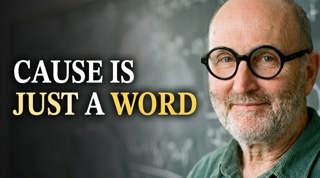
John Norton: The 300-Year-Old Physics Mistake No One Noticed

John Norton: The 300-Year-Old Physics Mistake No One Noticed

Professor John Norton dismantles long‑standing assumptions in physics, from Newtonian determinism to the myth of Landauer’s principle. He argues that causation may be illusory, explores the breakdown ...

27 Jun 20251h 53min

Populært innen Vitenskap

fastlegen
tingenes-tilstand
jss
rekommandert
rss-nysgjerrige-norge
forskningno
sinnsyn
liberal-halvtime
fjellsportpodden
tomprat-med-gunnar-tjomlid
rss-paradigmepodden
villmarksliv
kvinnehelsepodden
rss-rekommandert
rss-overskuddsliv
nordnorsk-historie
rss-bondevennen
tidlose-historier
nevropodden
rss-inn-til-kjernen-med-sunniva-rose