Andy Bondy on PECS, Speech Generation Devices, and More: Session 56

Andy Bondy on PECS, Speech Generation Devices, and More: Session 56

I'm going to cut to the chase: Dr. Andy Bondy and I had such a fun conversation about all things PECS, SGD's, Cues vs. Prompts, and so forth, that I can't wait to hear your feedback on it. Additionally, he was very gracious with his time (fitting me in between babysitting his grandchildren no less!), and so informative on a wide variety of issues we face as practitioners. I would also be remiss if I didn't give a shout out to Andy's daughter (who also happens to be a newly minted BCBA) Lexi for connecting the two of us. Lexi, thanks for sharing the podcast with your Dad!!! If you want to learn more about PECS, you can check out their website here. In the meantime, Andy was kind enough to share a treasure trove of resources that he mentioned in our interview. So in no particular order, here you go: "Considering the overall quality of the available research we would suggest that there are insufficient data to advocate for the use of sign language either alone or in combination with oral language as a method for substantially improving communication in children with autism. "SCHWARTZ, J., & NYE, C. (2006). Improving communication for children with autism: Does sign language work? Evidence-Based Practice Briefs, 1, 1–17. Summarizing 25 years of research on teaching sign-language to those with ASD, Layton and Watson (1995) conclude that "even after intensive training with signs, a significant number of nonverbal children continue to be mute and acquire only a few useful signs" (p. 81). LAYTON, T., & WATSON, L. (1995). Enhancing communication in non-verbal children with autism. In K. A. Quill (Ed.), Teaching children with autism: Strategies to enhance communication and socialization (pp. 73–101). New York, NY: Delmar Publishers. Bonvillian, J. D., & Blackbum. D. W (1991). Manual communication and factors relating to sign language acquisition. In P Siple & S. Fischer (Eds.). Theoretical issues in sign language research: Vol. 2, Psychology (pp. 255-277). Chicago: The University of Chicago Press. Lori Frost's two published guidelines on transitioning from PECS to SGDs: Frost, L., & McGowan, J. (2011). Strategies for Transitioning From PECS to SGD. Part I: Overview and Device Selection. Perspectives on Augmentative and Alternative Communication, 20, 114-120. Frost, L., & McGowan, J. (2012). Strategies for Transitioning From PECS to SGD. Part 2: Maintaining Communication Competency. Perspectives on Augmentative and Alternative Communication, 21, 3-10. Recent SGD review: Gilroy, S., McCleery, J. & Leader, G. (2017). Systematic Review of Methods for Teaching Social and Communicative Behavior with High-Tech Augmentative and Alternative Communication Modalities, Review Journal of Autism and Developmental Disorders, 4, 307-320. Looked at transitioning from PECS to SGD Hill, D. & Flores, M. (2014). Comparing the Picture Exchange Communication System and the iPad™ for communication of students with autism spectrum disorder and developmental delay, TechTrends, 58, 45-53. Concluded: "The authors recommend that PECS™ phases I-III be mastered before the iPad™ is introduced, to ensure the students master these prerequisite skills since they are more difficult to scaffold (break into smaller units for teaching and then build additional skills) using the iPad™. This session of The Behavioral Observations Podcast is supported by the following: Clinical Behavior Analysis, Kentucky's leading provider of Applied Behavior Analysis (ABA), counseling and direct support services to individuals with intellectual and developmental disabilities, acquired brain injury and autism.They are about to open The Center for Behavior Analysis, a 13,000 square foot, state of art facility in Louisville, KY, and they're looking for a clinical director to lead a highly motivated team of clinicians and technicians.If you're not familiar with Louisville, it's been rated by US News & World Report as one of the nation's best places to live. With a low cost of living, your industry-leading salary and signing bonus will go a lot farther. And with an abundance of cultural and recreational activities, you will not lack for fun things to do.So to learn more, go to cbacares.com/careers and set up your confidential interview today! HRIC, which brings 30 years of recruiting experience to help BCBA's find their dream jobs. Click here to schedule your confidential inquiry. The Behavioral Observations Podcast merchandise store. Need a gift for that behavior-nerd friend of yours? I have you covered. From T-shirts, to coffee mugs, from totes to even onesies, we have something for everyone. A great discount on BOP CE's for Newly Minted BCBA's can be found here. For the rest of us, check these out. If you're in the New England area this fall (and it's a great place to visit, just saying...) come check out the NH ABA conference in downtown Manchester, NH. Details are here. If you want to see a short interview I did with conference organizer and mentor extraordinaire, Dr. Le'Ann Milinder, in which we talk all things NH ABA 2018, you can check that out here.

Denne episoden er hentet fra en åpen RSS-feed og er ikke publisert av Podme. Den kan derfor inneholde annonser.

Episoder(338)

What is Facilitated Communication? BOP Rewind | Session 199/336 | Jason Travers

What is Facilitated Communication? BOP Rewind | Session 199/336 | Jason Travers

Welcome to Session 336 The Behavioral Observations Podcast. Well technically, this is actually Session 199, and I wanted to take a minute to explain why you're hearing a rebroadcast. This conversation...

24 Jul 0s
Conducta Verbal: Cultura, Contexto y Comunicación Funcional | BOP en ESP 18 con Janet Enriquez

Conducta Verbal: Cultura, Contexto y Comunicación Funcional | BOP en ESP 18 con Janet Enriquez

En este episodio, Miguel conversa con Janet sobre la conducta verbal desde una perspectiva práctica y cultural. A lo largo de la conversación, exploran por qué la conducta verbal sigue siendo una de l...

14 Jul 1h 23min
Essential for Living in Action: Building Meaningful Skills Through Everyday Events | Session 334 with Kristina Montgomery and Emily Beal Wilkinson

Essential for Living in Action: Building Meaningful Skills Through Everyday Events | Session 334 with Kristina Montgomery and Emily Beal Wilkinson

Many behavior analysts have experienced the frustration of teaching a skill successfully in one setting only to discover that it doesn't transfer to the situations where it actually matters. In this e...

30 Jun 1h 24min
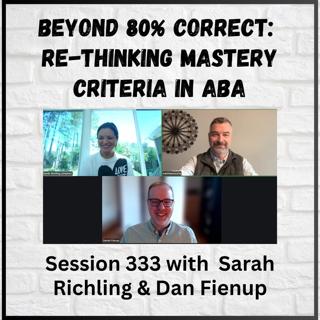
Beyond 80% Correct: Rethinking Mastery Criteria in ABA: Session 333 with Sarah Richling & Dan Fienup

Beyond 80% Correct: Rethinking Mastery Criteria in ABA: Session 333 with Sarah Richling & Dan Fienup

How do we determine when a learner has truly mastered a skill? In behavior analysis, performance criteria such as "80% correct across two sessions" have become nearly ubiquitous. Yet despite their wid...

12 Jun 1h 12min
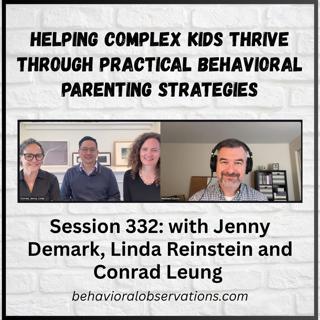
Helping Complex Kids Thrive Through Practical Behavioral Parenting Strategies: Jenny Demark, Linda Reinstein and Conrad Leung | Session 332

Helping Complex Kids Thrive Through Practical Behavioral Parenting Strategies: Jenny Demark, Linda Reinstein and Conrad Leung | Session 332

In this episode, I'm joined by Dr. Jenny Demark, Conrad Leung, and Dr. Linda Reinstein to talk about their new book, Complex Kids, Simple Solutions: How to Raise Resilient, Confident, Likable Kids. Th...

27 Mai 1h 9min
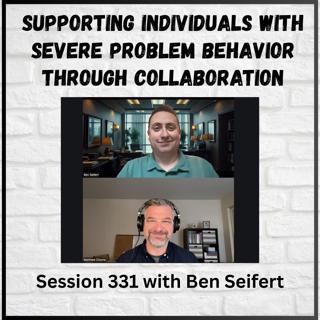
Supporting Individuals With Severe Problem Behavior Through Collaboration: Session 331 with Ben Seifert

Supporting Individuals With Severe Problem Behavior Through Collaboration: Session 331 with Ben Seifert

In Session 331, I sat down with Dr. Ben Seifert to talk about some of the most challenging — and important — work happening in applied behavior analysis today: supporting individuals with severe probl...

14 Mai 1h 3min
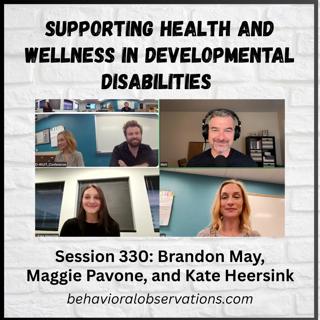
Supporting Health and Wellness in Developmental Disabilities: Session 330: Brandon May, Maggie Pavone, and Kate Heersink

Supporting Health and Wellness in Developmental Disabilities: Session 330: Brandon May, Maggie Pavone, and Kate Heersink

In this episode, I'm joined by Drs. Brandon May and Maggie Pavone, and Kate Heersink to talk about how we can better support healthier lifestyles for individuals with developmental disabilities. We st...

25 Apr 1h 13min
Train Smarter, Not Harder: Heart Rate Zones, VO2 Max, and Better Fitness: Session 329 with Nick Green

Train Smarter, Not Harder: Heart Rate Zones, VO2 Max, and Better Fitness: Session 329 with Nick Green

In Session 329, I'm joined once again by Dr. Nick Green, Ph.D., BCBA-D, who's been doing some really interesting work at the intersection of fitness and behavior science. In this episode, Nick walks u...

8 Apr 1h 1min

Populært innen Vitenskap

fastlegen
tingenes-tilstand
forskningno
jss
liberal-halvtime
rekommandert
sinnsyn
dekodet-2
abels-tarn
villmarksliv
rss-nysgjerrige-norge
tomprat-med-gunnar-tjomlid
fjellsportpodden
hva-er-greia-med
mer-enn-hjerne
rss-rekommandert
rss-kunstig-intelligens-med-elisabeth-maren-og-morten
diagnose
vett-og-vitenskap-med-gaute-einevoll
rss-inn-til-kjernen-med-sunniva-rose