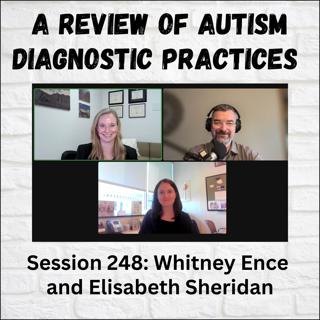
A Review of Autism Diagnostic Practices: Session 248: Whitney Ence and Elisabeth Sheridan

A Review of Autism Diagnostic Practices: Session 248: Whitney Ence and Elisabeth Sheridan

Drs. Whitney Ence and Elisabeth Sheridan joined me to talk about the diagnosis of Autism. You might be thinking that this sounds like an impossibly broad topic... and you're right.

But in this show, we tried to narrow it down a bit to discuss the various routes in which people can acquire an Autism diagnosis, which of these routes represent best practice, the critical diagnostic features of Autism, severity levels in Autism (and the extent to which these terms are useful), the role of intense interests, specific assessment instruments and techniques, and the importance of working with interdisciplinary teams.

We also talk about how the diagnosis has changed over the years, including the retirement of terms such as Pervasive Developmental Disorder and Asperger's Syndrome. During this part of the conversation, we also discussed self-diagnosis of Autism, and how clinics sometimes triage screening for individuals seeking diagnoses.

Towards the end of the podcast, we did touch on a few terms and topics that are relatively new to the Autism discourse.

Specifically, we discussed the term Neurodiversity, the social model of disability, "Severe Autism" as a separate diagnosis, and Pathological Demand Avoidance. It's important to note that his part of the podcast should not be construed as a deep exploration of these topics, as I really wanted to initially focus on what the current state of the science has to say about the diagnosis of Autism as a condition requiring medically-necessary treatment.

I also want to draw your attention to what could be considered a companion podcast about the diagnostic characteristics of Autism. I'm in the middle of listening to a long episode from the Huberman Lab Podcast, in which Dr. Andrew Huberman interviews Dr. Karen Parker from Stanford University about the causes of, and treatments for Autism. This is from a more neuro-biological perspective, and thus far, quite interesting.

Here are links to the topics we discussed:

If you'd like to support the show or its sponsors, check out the following:

  • To receive Behavioral Observations episodes ad and commentary-free, that is, just the interviews themselves, consider supporting the show with a Patreon subscription.
  • Consider Behavioral Observations as a source for your continuing education. I have almost 50 events that span a variety of topics, all from your favorite podcast guests. So if you want catch up on your professional development while walking the dog, commuting to work, making dinner, or whatever else you do while listening to podcasts, go to behavioralobservations.com/get-ceus to learn more.
  • The Verbal Behavior Conference is right around the corner. If you haven't heard me talk about it before, the VBC is a 2 day event that is available both virtually and in-person in Austin, Texas. It's happening on February 29th and 30th, and will feature speakers like Drs. Pat McGreevy, Alice Shillingsburg, Barbara Esch, and more. There's even a full-day pre conference workshop by Dr. Lina Slim. This is a really fun event that provides many opportunities for individual interactions with the speakers, and there's even a panel discussion moderated by yours truly. To learn more, go to behaviorlive.com/vbc, or simply hit the shownotes for this episode to learn more.
  • The University of Cincinnati Online. UC Online designed a Master of Education in Behavior Analysis program that is 100% online and asynchronous, meaning you log on when it works for you. Want to learn more? Go to online.uc.edu and click the "request info" button.

Denne episoden er hentet fra en åpen RSS-feed og er ikke publisert av Podme. Den kan derfor inneholde annonser.

Episoder(338)

What is Facilitated Communication? BOP Rewind | Session 199/336 | Jason Travers

What is Facilitated Communication? BOP Rewind | Session 199/336 | Jason Travers

Welcome to Session 336 The Behavioral Observations Podcast. Well technically, this is actually Session 199, and I wanted to take a minute to explain why you're hearing a rebroadcast. This conversation...

24 Jul 0s

Conducta Verbal: Cultura, Contexto y Comunicación Funcional | BOP en ESP 18 con Janet Enriquez

Conducta Verbal: Cultura, Contexto y Comunicación Funcional | BOP en ESP 18 con Janet Enriquez

En este episodio, Miguel conversa con Janet sobre la conducta verbal desde una perspectiva práctica y cultural. A lo largo de la conversación, exploran por qué la conducta verbal sigue siendo una de l...

14 Jul 1h 23min
Essential for Living in Action: Building Meaningful Skills Through Everyday Events | Session 334 with Kristina Montgomery and Emily Beal Wilkinson

Essential for Living in Action: Building Meaningful Skills Through Everyday Events | Session 334 with Kristina Montgomery and Emily Beal Wilkinson

Many behavior analysts have experienced the frustration of teaching a skill successfully in one setting only to discover that it doesn't transfer to the situations where it actually matters. In this e...

30 Jun 1h 24min
Beyond 80% Correct: Rethinking Mastery Criteria in ABA: Session 333 with Sarah Richling & Dan Fienup

Beyond 80% Correct: Rethinking Mastery Criteria in ABA: Session 333 with Sarah Richling & Dan Fienup

How do we determine when a learner has truly mastered a skill? In behavior analysis, performance criteria such as "80% correct across two sessions" have become nearly ubiquitous. Yet despite their wid...

12 Jun 1h 12min
Helping Complex Kids Thrive Through Practical Behavioral Parenting Strategies: Jenny Demark, Linda Reinstein and Conrad Leung | Session 332

Helping Complex Kids Thrive Through Practical Behavioral Parenting Strategies: Jenny Demark, Linda Reinstein and Conrad Leung | Session 332

In this episode, I'm joined by Dr. Jenny Demark, Conrad Leung, and Dr. Linda Reinstein to talk about their new book, Complex Kids, Simple Solutions: How to Raise Resilient, Confident, Likable Kids. Th...

27 Mai 1h 9min
Supporting Individuals With Severe Problem Behavior Through Collaboration: Session 331 with Ben Seifert

Supporting Individuals With Severe Problem Behavior Through Collaboration: Session 331 with Ben Seifert

In Session 331, I sat down with Dr. Ben Seifert to talk about some of the most challenging — and important — work happening in applied behavior analysis today: supporting individuals with severe probl...

14 Mai 1h 3min

Supporting Health and Wellness in Developmental Disabilities: Session 330: Brandon May, Maggie Pavone, and Kate Heersink

Supporting Health and Wellness in Developmental Disabilities: Session 330: Brandon May, Maggie Pavone, and Kate Heersink

In this episode, I'm joined by Drs. Brandon May and Maggie Pavone, and Kate Heersink to talk about how we can better support healthier lifestyles for individuals with developmental disabilities. We st...

25 Apr 1h 13min

Train Smarter, Not Harder: Heart Rate Zones, VO2 Max, and Better Fitness: Session 329 with Nick Green

Train Smarter, Not Harder: Heart Rate Zones, VO2 Max, and Better Fitness: Session 329 with Nick Green

In Session 329, I'm joined once again by Dr. Nick Green, Ph.D., BCBA-D, who's been doing some really interesting work at the intersection of fitness and behavior science. In this episode, Nick walks u...

8 Apr 1h 1min

Populært innen Vitenskap

fastlegen
tingenes-tilstand
forskningno
jss
liberal-halvtime
rekommandert
sinnsyn
dekodet-2
abels-tarn
villmarksliv
rss-nysgjerrige-norge
tomprat-med-gunnar-tjomlid
fjellsportpodden
hva-er-greia-med
mer-enn-hjerne
rss-rekommandert
rss-kunstig-intelligens-med-elisabeth-maren-og-morten
diagnose
vett-og-vitenskap-med-gaute-einevoll
rss-inn-til-kjernen-med-sunniva-rose