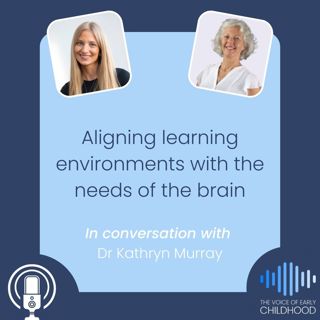
Aligning learning environments with the needs of the brain

Aligning learning environments with the needs of the brain

Dr Kathryn Murray talks us through the Brain-SET Environments Formula, which is all about creating a calm learning environment through a skills based pedagogy. Dr Murray explains that it is much more than where you put the furniture; she shares with us a deeper look at creating learning environments with brain development at the centre.

Some of the thought-provoking points discussed are:

00:30 - Dr Kathryn Murray's background
02:25 - The beginnings of Brain-SET
05:58 - Aesthetics of the learning environment
07:20 - Considering furniture in designing a learning environment
07:50 - Brain development as a big part in creating environments
10:00 - The environment is the 3rd teacher
12:13 - The structure of the brain
15:00 - What is 'foggy brain'?
16:00 - A calm brain is a thinking brain
17:09 - Multiple defined spaces are less threatening
19:20 - Using the language of learning
21:10 - Impacts of training in a 2-year-old room
23:50 - The brain doesn't do boring!
25:00 - Small spaces teach self-regulation/soft skills
27:15 - Decrease in behaviour issues
28:00 - Using interests to pull children into learning spaces
31:00 - Environments underpinned by research
52:58 - Freeflow rather than carouselling/rotation
36:11 - Brain-SET is a skills-based formula
37:35 - Learning ocurring naturally
38:15 - Continuous provision for repeating learning behaviours
39:50 - Carefully curating spaces to encourage skill development
42:52 - Seeing Brain-SET in action: The Astrea Academy Trust action research project

Read Dr Kathryn Murray's article and find out more about Brain-SET here:

https://thevoiceofearlychildhood.com/aligning-learning-environments-with-the-needs-of-the-brain/

You can find more podcast episodes and articles on The Voice of Early Childhood website: https://www.thevoiceofearlychildhood.com

Denne episoden er hentet fra en åpen RSS-feed og er ikke publisert av Podme. Den kan derfor inneholde annonser.

Episoder(172)

Are our expectations of children in early childhood evidence informed?

Are our expectations of children in early childhood evidence informed?

What does it really mean for a child to be 'school ready', and are the expectations we place on children actually informed by evidence? Adam Marycz explores how policy, accountability and long-held as...

22 Sep 46min
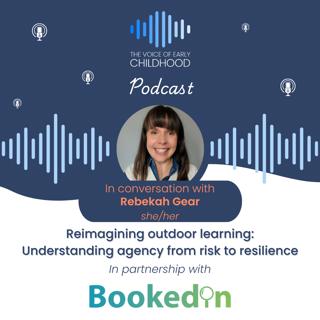
Reimagining outdoor learning: Understanding agency from risk to resilience

Reimagining outdoor learning: Understanding agency from risk to resilience

This podcast episode and article are a research-informed exploration of how outdoor environments, adult language and risk narratives shape children's agency. Drawing on the Reimagining Outdoor Learni...

14 Sep 42min

Marketing your early childhood setting is an investment, not a cost

Marketing your early childhood setting is an investment, not a cost

This article and podcast episode explore why marketing should be viewed as an investment rather than a cost, why profitability matters for sustainability, the role a setting's website plays in both oc...

7 Sep 39min
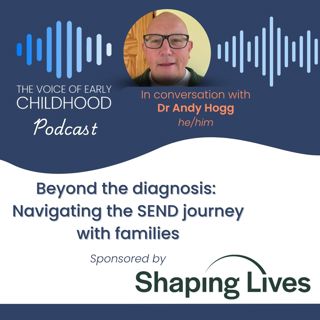
Beyond the diagnosis: Navigating the SEND journey with families

Beyond the diagnosis: Navigating the SEND journey with families

Receiving a SEND diagnosis is a transformative moment for families. This podcast episode and article explore how practitioners bridge the gap between statutory requirements and empathetic support, emp...

31 Aug 24min
Early childhood safeguarding changes 2026: Moving beyond compliance to a culture of safety

Early childhood safeguarding changes 2026: Moving beyond compliance to a culture of safety

Maggie Bolger and Ann Marie Christian explore the changing safeguarding landscape in early childhood, including KCSIE, the EYFS, safer recruitment, reporting concerns and the September changes. They a...

24 Aug 1h 2min
From Behaviour to signal: A different way to understand children

From Behaviour to signal: A different way to understand children

Many childhood behaviours labelled as difficult, oppositional or defiant may make far more sense than we realise. This article and podcast episode explore a biological perspective on defiance, screens...

18 Aug 56min
The brain that loves to laugh

The brain that loves to laugh

Laughter is often treated as a pleasant extra, or even a distraction from learning. Drawing on their work across psychology, education, health and community contexts, Dr Jacqueline Harding and Dr Jawa...

17 Aug 46min
The hidden hearing crisis in early years – and the free solution every nursery can use

The hidden hearing crisis in early years – and the free solution every nursery can use

Too many children are quietly struggling to hear in early years settings, and it is often missed until their speech, learning and behaviour are already affected. This article and podcast episode share...

3 Aug 34min

Populært innen Fakta

fastlegen
dine-penger-pengeradet
relasjonspodden-med-dora-thorhallsdottir-kjersti-idem
rss-strid
foreldreradet
treningspodden
rss-bisarr-historie
jakt-og-fiskepodden
rss-orjasater
rss-kunsten-a-leve
takk-og-lov-med-anine-kierulf
hverdagspsyken
mikkels-paskenotter
sinnsyn
smart-forklart
level-up-med-anniken-binz
branncast
gravid-uke-for-uke
rss-var-forste-kaffe
hr-podden-2