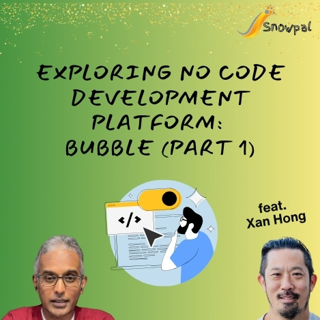

(Part 1) Exploring No Code Development Platform: Bubble (feat. Xan Hong)

(Part 1) Exploring No Code Development Platform: Bubble (feat. Xan Hong)

In this episode, ⁠Xan Hong⁠ shares his journey into the world of no-code development, highlighting the challenges faced by non-technical founders and the flexibility offered by platforms like Bubble. The conversation explores the evolving landscape of software development, the importance of creativity in problem-solving, and the impact of no-code solutions on traditional development roles. San emphasizes the need for adaptability in a rapidly changing technological environment and discusses the value of a well-rounded skill set in today’s market.

They delve into the intricacies of no-code platforms, particularly focusing on Bubble. They discuss backend workflows, API integration, and the advantages of no-code solutions for MVP development. The conversation also explores how no-code platforms can be utilized in various business contexts, from startups to large enterprises, and the future landscape of software development in relation to AI-generated code. Xan shares real-life case studies demonstrating the effectiveness of no-code solutions, while Krish raises thought-provoking questions about the evolving role of coding in the tech industry.

Takeaways

• No-code platforms like Bubble can save significant development costs.

• Learning data structuring is crucial for using no-code tools effectively.

• Bubble offers flexibility but has a steeper learning curve than other platforms.

• Creativity is essential in problem-solving with no-code solutions.

• Developers may feel threatened by the rise of no-code tools.

• Adaptability is key in the fast-changing tech landscape.

• A combination of business and technical skills is valuable in development.

• Clients appreciate understanding their needs during the development process.

• Problem-solving skills are more important than technical skills alone.

• No-code platforms can expose backends as APIs.

• No backend server is needed for user management.

• No-code solutions can significantly reduce development time.

• Enterprises can save millions by transitioning to no-code.

• Startups can validate ideas quickly using no-code tools.

• No-code platforms are more accessible for non-technical users.

• AI-generated code may not always be the best solution for MVPs.

• The perception of no-code limitations is often exaggerated.

• Education in tech is shifting towards practical problem-solving.

• No-code tools can complement traditional coding practices.

Chapters

00:00 Introduction to No-Code Development 02:57 San's Journey into No-Code Development 06:02 Challenges of Starting Without a Technical Background 08:54 Exploring No-Code Platforms: Bubble vs Others 11:57 The Flexibility and Limitations of No-Code Solutions 14:54 Creativity in Problem Solving with No-Code 17:56 The Impact of No-Code on Traditional Development 21:01 Navigating the Future of Software Development 23:53 The Value of a Well-Rounded Skill Set 27:07 Client Perspectives on No-Code Development 30:04 Hands-On with Bubble: Features and Functionality 38:41 Exploring Backend Workflows and API Integration 45:10 Understanding No-Code Solutions for MVP Development 50:14 No-Code Platforms in Different Business Contexts 54:47 The Future of No-Code vs. AI-Generated Code 01:08:56 Closing Thoughts on No-Code and Personal Insights

Episoder(408)

From Product Design to Healthcare Lending: The Entrepreneurial Journey (feat. Sharmeen Aqeel)

From Product Design to Healthcare Lending: The Entrepreneurial Journey (feat. Sharmeen Aqeel)

In the fast-evolving world of medical spas and aesthetic clinics, securing funding is a critical step for growth and sustainability. In this episode of the Snowpal podcast, host Krish Palaniappan speaks with Sharmeen Aqeel, founder of Lyyvora, a lending platform tailored for healthcare businesses. Sharmeen shares her journey, the challenges faced by clinic owners, and how her platform is revolutionizing the lending process for medical spas across North America.

13 Jan 1h

Oracle, Snowflake, and Datadog: Three Cloud Giants, Three Very Different Stories

Oracle, Snowflake, and Datadog: Three Cloud Giants, Three Very Different Stories

In this finance-focused discussion, we examine three companies that often appear together in conversations about cloud computing and data—but operate in meaningfully different segments of the market: Oracle, Snowflake, and Datadog.

9 Jan 17min

When User Experience Goes Wrong: A Cautionary Tale for Product Builders

When User Experience Goes Wrong: A Cautionary Tale for Product Builders

In today’s conversations about software, AI, and innovation, it’s easy to forget one critical truth: humans still use the products we build. No matter how powerful the backend or how advanced the algorithms, a poor user experience can render a product nearly unusable.

9 Jan 23min

Early 2026 Stock Market: Momentum, Volatility, and What Traders Are Watching

Early 2026 Stock Market: Momentum, Volatility, and What Traders Are Watching

The first four trading days of 2026 have delivered exactly what active market participants look for: movement, volume, and clear intraday patterns. While the year is still young, early signals across indices, semiconductors, hyperscalers, and financials are already shaping trader sentiment and short-term strategies .

8 Jan 18min

What AI Is Forcing Every Founder to Rethink (feat. Suri Nagarajan)

What AI Is Forcing Every Founder to Rethink (feat. Suri Nagarajan)

In this engaging conversation, Krish Palaniappan and Suri Nagarajan delve into the intricacies of investing, particularly in the tech sector versus non-tech industries. They discuss the importance of financial literacy, the risks associated with high-risk investments, and the significance of diversification for new investors. Suri shares insights on industry allocation for a hypothetical $100 investment, emphasizing stable sectors like healthcare and energy. The discussion also touches on the cyclical nature of markets, the risks of entrepreneurship versus employment, and personal reflections on career choices and cultural opportunities in the US. Ultimately, the conversation highlights the importance of pursuing one’s passions and the unique educational experiences available in America.

4 Jan 1h 57min

Happy New Year 2026: The Boring Path to an Interesting Life

Happy New Year 2026: The Boring Path to an Interesting Life

Only take vacations you can afford—debt and relaxation should never meet. If it needs installments and isn’t food or medicine, you don’t need it. Credit card debt is just regret charging interest—kill it first. Don’t enroll in college by muscle memory; 2026 doesn’t care about tradition. If you switch careers, pick a role that actually matters—vibes don’t pay rent. Skipping AI in 2026 is like skipping email in 1999—bold, but stupid. Invest real money if you can, fake money if you can’t, ignorance is not an option. Park far away—walking is free cardio and cheaper than therapy. Eat because you’re hungry, not because the fridge made eye contact. There is no perfect time—there’s only now and a lot of excuses. Build a side hustle so layoffs don’t decide your personality. If every year feels the same, congratulations—you’re on career autopilot. Social media isn’t real life—it’s a heavily filtered lie with Wi-Fi. Comparison kills joy, and titles won’t fix insecurity. Everything important takes longer than promised—welcome to reality. Ignore naysayers—they’re deeply committed to being comfortable. One focused person with AI can now replace a small team—choose wisely. If your car works, keep it—nobody’s impressed by your loan balance. Be selfish enough to protect your time, energy, and sanity. Nothing is saturated—most people just quit early.

2 Jan 31min

What Paper Trading Teaches You About Risk and Discipline: Practice First, Profit Later

What Paper Trading Teaches You About Risk and Discipline: Practice First, Profit Later

As 2025 comes to a close, it’s a good time to reflect, experiment, and learn—especially if you’re interested in investing, trading, or building fintech products. On the final trading day of the year, I spent some time walking through live paper trades using a desktop trading platform, sharing practical insights along the way. This article distills those lessons into a beginner-friendly guide for anyone curious about trading, risk, and tools.

31 Des 202534min

Why We’re Building Our Next API in FinTech — And Why Timing Matters More Than Ever

Why We’re Building Our Next API in FinTech — And Why Timing Matters More Than Ever

At Snowpal, we’ve spent years building and running production-grade software products across multiple domains. Most recently, our focus has been on B2B APIs — tools designed to help teams move faster, build reliably, and scale without reinventing the wheel. As we head into 2026, we’re starting work on our next API product. It will begin life as an API, but over time, it will grow into something broader — firmly rooted in the fintech space.

30 Des 202514min

Populært innen Teknologi

lydartikler-fra-aftenposten
romkapsel
rss-avskiltet
teknisk-sett
tomprat-med-gunnar-tjomlid
rss-impressions-2
shifter
energi-og-klima
fornybaren
elektropodden
smart-forklart
pedagogisk-intelligens
rss-digitaliseringspadden
rss-alt-som-gar-pa-strom
nasjonal-sikkerhetsmyndighet-nsm
i-loopen
hans-petter-og-co
teknologi-og-mennesker
kunstig-intelligens-med-morten-goodwin
rss-universelt-utformet