Global Weather Connected to Sea Ice, Extreme Weather Affects Education

Global Weather Connected to Sea Ice, Extreme Weather Affects Education

1. How significantly did extreme weather events disrupt global education in 2024?

In 2024, extreme weather events such as heat waves, storms, and floods caused disruptions to schooling for at least 242 million students worldwide. Low-income countries were disproportionately affected by these climate-related school closures.

2. What are the potential long-term consequences for students who miss school due to climate-related disasters?

Missing school due to climate-related disasters can lead to significant long-term academic setbacks, particularly for middle and high school students. These disruptions can also create mental and economic challenges for students in vulnerable regions, making it difficult for them to return to school and potentially deepening educational inequality due to learning gaps.

3. How is the melting of Arctic sea ice influencing global weather patterns?

The rapid melting of Arctic sea ice disrupts its crucial role in regulating Earth’s climate. This includes its ability to reflect sunlight, maintain ocean salinity, and insulate the ocean from the atmosphere. The loss of ice alters atmospheric circulation, affecting jet streams and oceanic currents, which in turn leads to shifts in weather patterns thousands of miles away, such as drier winters in California and wetter conditions in parts of Europe.

4. According to recent research, what specific regional climate changes are linked to Arctic sea ice loss?

A recent study highlights a link between the loss of Arctic sea ice and drier winters in the southwestern United States, particularly California. Conversely, the study suggests that regions like Spain and Portugal may experience increased winter humidity due to shifts in air currents caused by the melting ice.

5. What is novel about the methodology used in the recent study connecting Arctic ice loss to global weather?

Unlike previous studies that often focused on long-term changes over centuries or introduced artificial heat sources into climate models, this new research directly compared historical Arctic ice levels with significantly reduced ice cover in their models without artificial variables. This approach allowed researchers to isolate the effects of ice loss on atmospheric patterns over shorter, decadal timescales.

6. Why is the United States considered "vital" for global weather forecasting?

The United States, through agencies like NOAA, provides a significant amount of meteorological data and expertise that are crucial for global weather predictions. This includes up to 25% of global meteorological satellite data, 3% of globally-shared land surface observations, and 12% of upper air radiosonde profiles. This data, combined with contributions from other nations, forms the basis for accurate forecasts that help protect lives and livelihoods worldwide.

7. What concerns have been raised regarding the US's ability to continue providing these vital forecasting services?

Concerns have arisen due to reported mass layoffs at NOAA and potential termination of leases for properties housing vital weather service operations. These actions are seen as potentially jeopardizing the US's ability to maintain accurate and comprehensive weather forecasting services, which are essential for both domestic and global well-being.

8. How does international cooperation play a role in global weather forecasting?

While the United States makes significant contributions to global weather forecasting, it also relies on international cooperation. The sharing of meteorological data and expertise across countries is a "win-win" situation, as it creates a comprehensive global system that allows for more accurate predictions from local to global scales. This collaborative effort is essential because weather, climate, and water patterns do not respect geopolitical boundaries.

Denne episoden er hentet fra en åpen RSS-feed og er ikke publisert av Podme. Den kan derfor inneholde annonser.

Episoder(234)

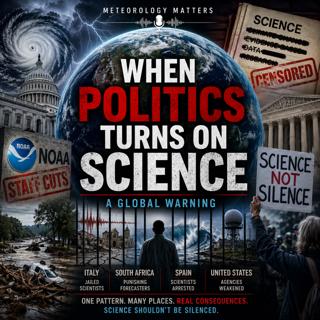
When Politics Turns on Science Globally

When Politics Turns on Science Globally

Weather scientists are increasingly being ignored, censored, arrested, or pushed aside by political movements around the world. From NOAA staffing cuts in the United States to jailed earthquake scient...

15 Mai 45min
2026 Weather Shock: Super El Niño, Record Heat, and a Planet Running Hot

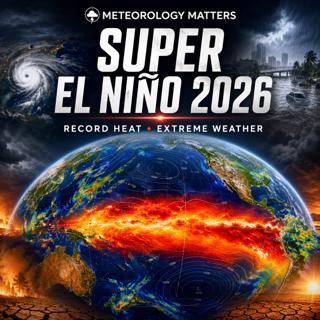
2026 Weather Shock: Super El Niño, Record Heat, and a Planet Running Hot

A Super El Niño may be forming for 2026, and it could push global heat, extreme weather, flooding, drought, and hurricane impacts into dangerous new territory.A Super El Niño may be forming for 2026, ...

8 Mai 33min
AI Weather Forecasts Are Getting Smarter. So Why Are We Weakening NOAA?

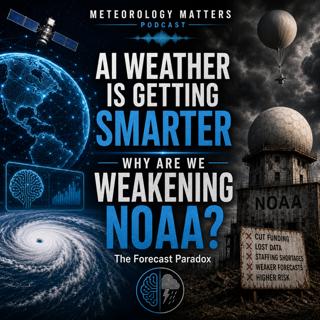
AI Weather Forecasts Are Getting Smarter. So Why Are We Weakening NOAA?

AI is revolutionizing weather forecasting. New models like Google DeepMind’s GraphCast and GenCast, ECMWF’s AIFS, and NOAA’s experimental AI-GEFS are producing faster, cheaper, and increasingly accura...

5 Mai 42min
AI Just Beat Hurricane Forecasting… Should We Be Worried?

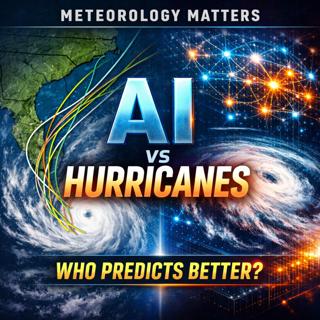
AI Just Beat Hurricane Forecasting… Should We Be Worried?

AI just changed hurricane forecasting forever. In 2025, it outperformed traditional models and even challenged official NHC forecasts. Artificial Intelligence is no longer experimental in meteorology ...

21 Apr 53min
Will Hurricane Forecasts Get Worse? Inside the NOAA Budget Cuts

Will Hurricane Forecasts Get Worse? Inside the NOAA Budget Cuts

Could hurricane forecasts actually get worse? A deep dive into the proposed 2027 budget cuts to NOAA and how eliminating key research could impact storm prediction, safety, and future forecast accurac...

13 Apr 32min
Fired, Sued, and Still Forecasting: The Matt Devitt vs WINK News Battle

Fired, Sued, and Still Forecasting: The Matt Devitt vs WINK News Battle

Fired. Sued. And still forecasting.The sudden termination of longtime Southwest Florida meteorologist Matt Devitt has exploded into one of the most fascinating media and legal battles in recent years....

4 Apr 37min
“It Only Takes One”: Why 2026’s Hurricane Season Could Be Worse Than It Looks

“It Only Takes One”: Why 2026’s Hurricane Season Could Be Worse Than It Looks

The 2026 hurricane season warning nobody is talking about. The numbers may be average but the risk is anything but because “It only takes one”.The 2026 Atlantic hurricane season may look average on pa...

28 Mar 40min
This Should NOT Be Happening in March… 112° Heat + Hawaii Flood Disaster

This Should NOT Be Happening in March… 112° Heat + Hawaii Flood Disaster

In this episode of Meteorology Matters, we break down two extreme and highly unusual weather events happening right now:🔥 Record-shattering March heat reaching 112°F🌊 Dangerous flooding impacting pa...

21 Mar 38min

Populært innen Politikk og nyheter

giver-og-gjengen-vg
aftenpodden
stopp-verden
forklart
aftenpodden-usa
popradet
fotballpodden-2
det-store-bildet
dine-penger-pengeradet
rss-gukild-johaug
lydartikler-fra-aftenposten
hanna-de-heldige
nokon-ma-ga
rss-ness
rss-espen-lee-usensurert
rss-penger-polser-og-politikk
rss-utenrikskomiteen-med-bogen-og-grasvik
aftenbla-bla
e24-podden
rss-dannet-uten-piano