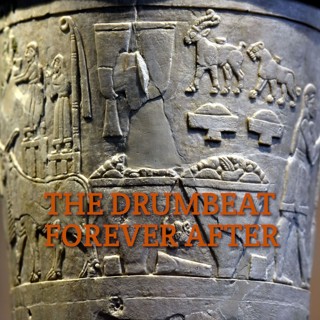
37: The decline & fall of Kish, 2600-2300 BCE (Hymn to Shamash, Kesh temple hymn)

37: The decline & fall of Kish, 2600-2300 BCE (Hymn to Shamash, Kesh temple hymn)

(Sorry I disappeared for three months! I burned myself out working on rewriting old episodes and had to focus on other stuff for a couple months. I'm back in the saddle now, with episodes written up to the end of the Sargonic / Old Akkadian period! Also, I switched my scripts from bullet-point outlines to full paragraphs written out, in hopes that it will take less time to edit audio. Let me know if you think it sounds too robotic.)

First, a hymn to the Semitic sun god Shamash, possibly the earliest known work of literature written in the Akkadian language, produced by the culture centered on the kingdom of Kish during the 2500s BCE. The TI.URU.DA is the SHU.AG of prince Ea, the god of rejoicing!

Then, we return to Kish now that we have more documentary evidence to make sense of its kingdom. During the Fara period (2600-2450 BCE, named after the site of Shuruppak), texts from the so-called "Kish tradition" appear to reflect Kish's hegemony over much of central Mesopotamia. We take a look at the List of Geographic Names, which may be a list of the settlements in this kingdom.

Then, we look at the geological differences between Kish (and the delta plain in the northern alluvium) and the Sumerian cities (situated in the floodplain in the southern alluvium), and the resulting differences in settlement hierarchy and political organization.

Then, we look at the city of Kish itself: its two major temple complexes (the Hursang-kalama of Ishtar and the E-kishib-ba of Zababa), its cemeteries (including the cart burials, with parallels at Ur and Susa), and its palace complex, which was sacked late in the Early Dynastic IIIB period.

Then, we examine our scanty evidence of Kish's political history during this period: two kings of Kish known from their own inscriptions, various Sumerian kings who called themselves Kings of Kish, the elusive queen Ku-Baba (alias Kug-Bau), and a few foreign kings who may have actually ruled Kish before Sargon.

Finally, we finish up with the Kesh temple hymn. Earlier versions of this text refer to a ritual performed in Kesh (with an E) by the king of Kish; later versions (produced after Kish's heyday) remove this explicit reference. Will anyone else bring forth something as great as Kesh (with an E)?

Questions? Feedback? Email us at drumbeatforeverafter@gmail.com.

Follow us on Twitter and Instagram @drumbeatforever

Works cited

Denne episoden er hentet fra en åpen RSS-feed og er ikke publisert av Podme. Den kan derfor inneholde annonser.

Episoder(42)

41: Presargonic Lagash & Girsu, 2500-2300 BCE (Hymns to Nanshe)

41: Presargonic Lagash & Girsu, 2500-2300 BCE (Hymns to Nanshe)

Guest: Annika We've never been more back! We start off this new miniseries on Presargonic Lagash with a series of hymns to Nanshe, patron goddess of Ningen near the Gulf Coast and sister of Ningirsu, ...

13 Mai 20251h 17min

40: Royal Tombs of Ur, 2600-2400 BCE (The death of Gilgamesh)

40: Royal Tombs of Ur, 2600-2400 BCE (The death of Gilgamesh)

Guest: Sheila We're so back! First, a Sumerian poem about Gilgamesh which mentions his trip to see Ziusudra (also known as Atrahasis, Utnapishtim, and/or Noah), which some have interpreted as evidence...

26 Jan 202556min

Update on the show & beveled-rim bowls

Update on the show & beveled-rim bowls

Check out episodes 17-28, most of which I re-recorded and reuploaded recently. New episodes on Early Dynastic Sumer coming soon.

7 Des 20245min

39: Temples of Early Dynastic Nippur, 2900-2300 BCE (Enlil & Ninlil)

39: Temples of Early Dynastic Nippur, 2900-2300 BCE (Enlil & Ninlil)

Guest: Stacy First, a story about Enlil, the Sumerian god of kingship, and his future wife Ninlil; he sees her bathing in a canal in their hometown of Nippur, and the narrative isn't especially concer...

23 Jun 202345min

38: Abu Salabikh and the first Semitic-language literature, 2600-2500 BCE (Debate between two women, Lugalbanda & Ninsuna)

38: Abu Salabikh and the first Semitic-language literature, 2600-2500 BCE (Debate between two women, Lugalbanda & Ninsuna)

Guests: Lily, Annika First: a literary debate between two women (much of its meaning hidden beneath several layers of abstraction). It tells us a lot about public expectations of Sumerian housewives, ...

21 Mai 202354min

36: Interviews: Karrar Sabah on Eridu, Malath Feadha & Jaafar Jotheri on the geology of the Sumerian wetlands

36: Interviews: Karrar Sabah on Eridu, Malath Feadha & Jaafar Jotheri on the geology of the Sumerian wetlands

Two interviews with three Iraqi academics! I interviewed Karrar Sabah Al Ramahi, then a PhD student at Baghdad University, about his research on the city of Eridu! Furqan Salam helped with the transla...

23 Jan 202358min

35: Shuruppak & the first Sumerian literature, 2600-2500 BCE (Instructions of Shuruppak)

35: Shuruppak & the first Sumerian literature, 2600-2500 BCE (Instructions of Shuruppak)

Guest: Lily First: the world's oldest known wisdom literature, in the form of a series of proverbs delivered from the eponymous Shuruppak (king of Shuruppak) to his son Zi-ud-sura (alias Utnapishtim, ...

23 Des 202259min

Populært innen Vitenskap

fastlegen
tingenes-tilstand
jss
dekodet-2
rekommandert
forskningno
sinnsyn
liberal-halvtime
villmarksliv
rss-paradigmepodden
rss-nysgjerrige-norge
rss-zahid-ali-hjelper-deg
tidlose-historier
nevropodden
rss-rekommandert
rss-inn-til-kjernen-med-sunniva-rose
kvinnehelsepodden
rss-lundqvist-podden
hva-er-greia-med
tomprat-med-gunnar-tjomlid