
#052: Sequencing and Escalation in MS. Navigating Treatment & Progression with Prof. Tomas Kalincik

#052: Sequencing and Escalation in MS. Navigating Treatment & Progression with Prof. Tomas Kalincik

Prof. Kalincik gives insights into the statistical results of treatment regimens and why most PwMS benefit from highly effective therapies.

You can find the transcript of the interview to read through on my blog: https://ms-perspektive.com/52-tomas-kalincik

Tomas Kalincik is Professor of Neurology and Applied Statistics at the University of Melbourne and the Royal Melbourne Hospital in Australia and is concerned with treatment sequences in order to choose the strategy that offers the best long-term prognosis for MS patients. In the interview, he explains how complex and difficult this is and why it nevertheless usually makes sense to opt for a highly effective treatment. He also provides many positive arguments for looking to the future, as the understanding of multiple sclerosis is improving rapidly, enabling ever better therapeutic success.

Introduction – Who is Prof. Tomas Kalincik?

Dear Ladies and gentlemen, my name is Thomas Kalincik. I'm a neurologist in Australia, in Melbourne. I'm the Director of the Neuroimmunology Centre at the Royal Melbourne Hospital, which is a dedicated neuroimmunology centre, which looks after people with MS, but also with other neuroimmunological conditions. And also, I am the Head of Clinical Outcomes Research Unit, also known as CORE at the University of Melbourne, whose focus is on analysis of observational data and translating data into evidence.

Finally, what message of hope or encouragement would you like to share with the listeners?

That we are very close. It's exciting times, as I mentioned several times during this interview, and hopefully I have justified those claims with some mentions of research that has recently been completed, literally in the last two or three years, where we are becoming much more apt in understanding the pathogenesis of MS and how that understanding feeds into the development of new therapies or use of the currently available therapies. So, stay tuned.

How and where can interested people follow your research activities?

We have a website, the Core Clinical Outcomes Research Unit at the University of Melbourne. We have a website where we highlight publications that come from the team. The Neuroimmunology Centre at the Royal Melbourne Hospital also has its own website where we sometimes feature research and we also communicate through channels such as MS Translate, the ECTRIMS platform and MS Australia.

---

See you soon and try to make the best out of your life,
Nele

For more information and positive thoughts, subscribe to my newsletter for free.

Click here for an overview of all podcast episodes published so far.

Denne episoden er hentet fra en åpen RSS-feed og er ikke publisert av Podme. Den kan derfor inneholde annonser.

Episoder(192)

#190: Living with multiple sclerosis. Gabriela's story and the "(un)seen faces of MS" Art Project

#190: Living with multiple sclerosis. Gabriela's story and the "(un)seen faces of MS" Art Project

https://ms-perspektive.de/en/190-unseen-faces-of-ms/Living with multiple sclerosis often means experiencing symptoms that others cannot see. Austrian artist Gabriela Romagna shares her journey to an M...

4 Nov 32min

#189: New imaging in MS: understanding progression and finding better treatments | ECTRIMS 2026

#189: New imaging in MS: understanding progression and finding better treatments | ECTRIMS 2026

How could new imaging in MS help us understand progression and develop better treatments? In this episode, I explore key insights from Daniel Reich's MSToronto2026 lecture and related research. Learn ...

28 Okt 15min
#188: Jan Van Amstel on EMSP's Four-Year Presidency and the Future of MS Advocacy in Europe

#188: Jan Van Amstel on EMSP's Four-Year Presidency and the Future of MS Advocacy in Europe

"Get rid of MS as soon as possible and make ourselves superfluous." — Jan van Amstel What can a stronger European voice achieve for people living with MS? In episode #188, EMSP President Jan van Amste...

21 Okt 31min
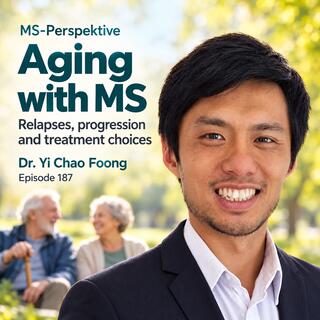
#187: Aging in multiple sclerosis: relapses, progression and treatment choices with Dr. Yi Chao Foong

#187: Aging in multiple sclerosis: relapses, progression and treatment choices with Dr. Yi Chao Foong

Aging in multiple sclerosis brings new questions about relapses, gradual progression and treatment choices. In episode 187, Dr. Yi Chao Foong, an MS neurologist and researcher in Tasmania, explains wh...

14 Okt 29min
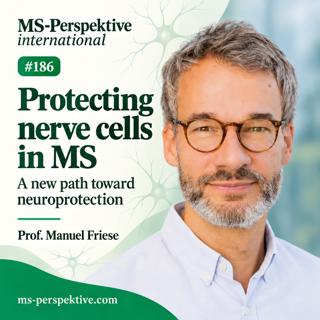
#186: Protecting nerve cells in multiple sclerosis: A new path toward neuroprotection with Prof. Manuel Friese

#186: Protecting nerve cells in multiple sclerosis: A new path toward neuroprotection with Prof. Manuel Friese

Why can multiple sclerosis progress even when relapses are well controlled? In episode 186, I speak with Prof. Manuel Friese about the next challenge in MS research: protecting nerve cells from damage...

7 Okt 43min

#185: Living with MS in Mexico – who gets diagnosed, who gets treated, and who gets left behind?

#185: Living with MS in Mexico – who gets diagnosed, who gets treated, and who gets left behind?

An MS diagnosis can depend on where you live, whether you can reach a neurologist and how quickly you can get an MRI. In this episode, Nele speaks with neurologist and neuroimmunologist Dr. Enrique Go...

30 Sep 36min

#184: MS treatment across the disease course – treat early, think long-term, don't give up too soon with Prof. Klaus Schmierer

#184: MS treatment across the disease course – treat early, think long-term, don't give up too soon with Prof. Klaus Schmierer

Read the full blog post and interview here: https://ms-perspektive.de/en/184-klaus-schmierer/ How early should MS treatment start, how strongly should we treat, and is there ever a point when it becom...

23 Sep 41min

#183: Silent progression in MS. Can we really detect it early?

#183: Silent progression in MS. Can we really detect it early?

Can we detect gradual MS progression before it becomes obvious? In this episode, I look at what current research can — and cannot — tell us about subtle worsening without an obvious relapse. The key d...

16 Sep 34min

Populært innen Fakta

fastlegen
dine-penger-pengeradet
fryktlos
relasjonspodden-med-dora-thorhallsdottir-kjersti-idem
rss-strid
foreldreradet
treningspodden
rss-bisarr-historie
rss-ekteskapet
jakt-og-fiskepodden
rss-kunsten-a-leve
rss-kull
mikkels-paskenotter
rss-orjasater
sinnsyn
gravid-uke-for-uke
rss-flydilla
rss-mind-body-podden
hverdagspsyken
branncast