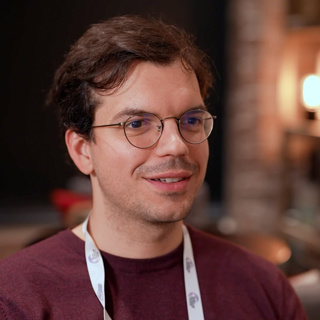

Prof. Randall Balestriero - LLMs without pretraining and SSL

Prof. Randall Balestriero - LLMs without pretraining and SSL

Randall Balestriero joins the show to discuss some counterintuitive findings in AI. He shares research showing that huge language models, even when started from scratch (randomly initialized) without massive pre-training, can learn specific tasks like sentiment analysis surprisingly well, train stably, and avoid severe overfitting, sometimes matching the performance of costly pre-trained models. This raises questions about when giant pre-training efforts are truly worth it.


He also talks about how self-supervised learning (where models learn from data structure itself) and traditional supervised learning (using labeled data) are fundamentally similar, allowing researchers to apply decades of supervised learning theory to improve newer self-supervised methods.


Finally, Randall touches on fairness in AI models used for Earth data (like climate prediction), revealing that these models can be biased, performing poorly in specific locations like islands or coastlines even if they seem accurate overall, which has important implications for policy decisions based on this data.


SPONSOR MESSAGES:

***

Tufa AI Labs is a brand new research lab in Zurich started by Benjamin Crouzier focussed on o-series style reasoning and AGI. They are hiring a Chief Engineer and ML engineers. Events in Zurich.


Goto https://tufalabs.ai/

***


TRANSCRIPT + SHOWNOTES:

https://www.dropbox.com/scl/fi/n7yev71nsjso71jyjz1fy/RANDALLNEURIPS.pdf?rlkey=0dn4injp1sc4ts8njwf3wfmxv&dl=0


TOC:

1. Model Training Efficiency and Scale

[00:00:00] 1.1 Training Stability of Large Models on Small Datasets

[00:04:09] 1.2 Pre-training vs Random Initialization Performance Comparison

[00:07:58] 1.3 Task-Specific Models vs General LLMs Efficiency


2. Learning Paradigms and Data Distribution

[00:10:35] 2.1 Fair Language Model Paradox and Token Frequency Issues

[00:12:02] 2.2 Pre-training vs Single-task Learning Spectrum

[00:16:04] 2.3 Theoretical Equivalence of Supervised and Self-supervised Learning

[00:19:40] 2.4 Self-Supervised Learning and Supervised Learning Relationships

[00:21:25] 2.5 SSL Objectives and Heavy-tailed Data Distribution Challenges


3. Geographic Representation in ML Systems

[00:25:20] 3.1 Geographic Bias in Earth Data Models and Neural Representations

[00:28:10] 3.2 Mathematical Limitations and Model Improvements

[00:30:24] 3.3 Data Quality and Geographic Bias in ML Datasets


REFS:

[00:01:40] Research on training large language models from scratch on small datasets, Randall Balestriero et al.

https://openreview.net/forum?id=wYGBWOjq1Q

[00:10:35] The Fair Language Model Paradox (2024), Andrea Pinto, Tomer Galanti, Randall Balestriero

https://arxiv.org/abs/2410.11985

[00:12:20] Muppet: Massive Multi-task Representations with Pre-Finetuning (2021), Armen Aghajanyan et al.

https://arxiv.org/abs/2101.11038

[00:14:30] Dissociating language and thought in large language models (2023), Kyle Mahowald et al.

https://arxiv.org/abs/2301.06627

[00:16:05] The Birth of Self-Supervised Learning: A Supervised Theory, Randall Balestriero et al.

https://openreview.net/forum?id=NhYAjAAdQT

[00:21:25] VICReg: Variance-Invariance-Covariance Regularization for Self-Supervised Learning, Adrien Bardes, Jean Ponce, Yann LeCun

https://arxiv.org/abs/2105.04906

[00:25:20] No Location Left Behind: Measuring and Improving the Fairness of Implicit Representations for Earth Data (2025), Daniel Cai, Randall Balestriero, et al.

https://arxiv.org/abs/2502.06831

[00:33:45] Mark Ibrahim et al.'s work on geographic bias in computer vision datasets, Mark Ibrahim

https://arxiv.org/pdf/2304.12210

Denne episoden er hentet fra en åpen RSS-feed og er ikke publisert av Podme. Den kan derfor inneholde annonser.

Episoder(271)

What Most People Get Wrong About Evolution | Akarsh Kumar

What Most People Get Wrong About Evolution | Akarsh Kumar

A lot of people in AI treat evolution as a dumb fallback, basically random search for when you can't take a gradient. Akarsh Kumar thinks that is wrong. Selection hangs on to partial solutions, so mut...

10 Okt 47min

How a Voice Agent Learns the Rhythm of Conversation — Shawn Wen

How a Voice Agent Learns the Rhythm of Conversation — Shawn Wen

Tsung-Hsien (Shawn) Wen, CTO of PolyAI, tells Tim Scarfe why voice agents are harder than text agents. Voice adds time, and a good conversation depends on adapting to the person on the line, not just ...

1 Okt 1h 10min

Who Checks a Proof No Human Can Read? — Leo de Moura

Who Checks a Proof No Human Can Read? — Leo de Moura

Leonardo de Moura created Lean and co-created Z3. ---This episode is sponsored by Parallel.Parallel, where agents find answers: web search, extraction and deep research APIs built for AI agents.Start ...

30 Sep 1h 14min

When AI Research Starts Moving Faster Than Human Research - Zhengyao Jiang

When AI Research Starts Moving Faster Than Human Research - Zhengyao Jiang

Weco let an AI coding agent rewrite the harness around another agent for eight days: its code, prompts and tools, while the underlying language model stayed fixed. Tim Scarfe asks Weco co-founder Zhen...

26 Sep 43min

How Deep Learning Finally Cracked Messy Tables - Frank Hutter

How Deep Learning Finally Cracked Messy Tables - Frank Hutter

Frank Hutter, co-founder of Prior Labs, talks about TabPFN, a tabular foundation model that makes predictions in a single forward pass, and the research behind it.TabPFN is pre-trained on synthetic da...

23 Sep 1h 53min

Why Scaling Prediction Cannot Create Intelligence - Alexander Mattick

Why Scaling Prediction Cannot Create Intelligence - Alexander Mattick

Alexander Mattick is a researcher at Fraunhofer IIS and a PhD researcher at the University of Technology Nuremberg (UTN), and a regular on Yannic Kilcher's Discord. He first came on MLST in 2022, afte...

21 Sep 2h 14min

How Physical AI Learns Across Language, Video and Action — Ming-Yu Liu

How Physical AI Learns Across Language, Video and Action — Ming-Yu Liu

The car making a left turn at the start of this episode was never filmed. Cosmos 3 generated it. Ming-Yu Liu, who leads the Cosmos research at NVIDIA, explains how one model can describe a video, gene...

15 Sep 25min

Speech Recognition Is Not a Solved Problem — Pavan Kumar Reddy

Speech Recognition Is Not a Solved Problem — Pavan Kumar Reddy

Pavan Kumar Reddy leads audio research at Mistral AI. He joins Tim Scarfe for a deep technical tour of Voxtral — and explains why the frontier of deployed voice is still a cascade of specialised model...

14 Sep 1h 42min

Populært innen Teknologi

teknisk-sett
energi-og-klima
lydartikler-fra-aftenposten
nasjonal-sikkerhetsmyndighet-nsm
elektropodden
tomprat-med-gunnar-tjomlid
rss-ai-forklart
rss-kunstig-intelligens-med-elisabeth-maren-og-morten
shifter
smart-forklart
fornybaren
pedagogisk-intelligens
rss-alt-som-gar-pa-strom
rss-bak-skyen
rss-alt-vi-kan
teknologimagasinet-aftenposten
rss-hvorfor-ble-det-sann
rss-romnasjonen
kortslutning
rss-ki-praten