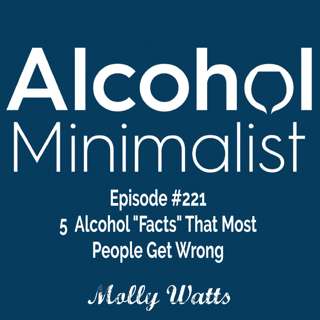
5 Alcohol "Facts" That Most People Get Wrong

5 Alcohol "Facts" That Most People Get Wrong

In this episode, Molly kicks off Alcohol Awareness Month by shining a light on five pervasive myths about alcohol that many people still believe—and why they matter. These aren’t opinion-based takes or moralistic warnings. They’re data-backed truths designed to help you reassess your relationship with alcohol through the lens of science, compassion, and practicality.

Molly revisits commonly held beliefs like “red wine is good for your heart” and the idea that there’s a universally “safe” level of drinking. She also unpacks the misconceptions surrounding alcohol dependence, the blurred line between moderate and excessive drinking, and why conscious choice—not unconscious habit—is the cornerstone of peaceful drinking.

If you’re someone who’s been “justifying” your nightly pour with old headlines or fuzzy statistics, this episode is your call to reframe, recalibrate, and realign your drinking decisions with facts—not feelings.

What You’ll Learn in This Episode:

  • The truth behind the red wine “heart health” narrative
  • Why “moderate” drinking might not be as safe as you think
  • What the data says about alcohol and disease risk
  • The reality that 9 out of 10 excessive drinkers are not alcohol dependent
  • Why the language we use around alcohol can keep us stuck
  • How science supports self-awareness over abstinence mandates

Key Quote:
"It’s not about shame or absolutes. It’s about awareness, choice, and a willingness to meet yourself where you are—without pretending alcohol is something it’s not." —Molly Watts


Mentioned in This Episode:

Take It Further:

→ Download the Alcohol Core Beliefs guide to uncover the unconscious thoughts keeping your drinking stuck.
→ For deeper change, explore the Making Peace with Alcohol 12-month coaching group program.

Let’s Connect:
Website: www.mollywatts.com
Instagram: @alcoholminimalist
Facebook: Join the Alcohol Minimalists Group

Low risk drinking guidelines from the NIAAA:

Healthy men under 65:

No more than 4 drinks in one day and no more than 14 drinks per week.

Healthy women (all ages) and healthy men 65 and older:
No more than 3 drinks in one day and no more than 7 drinks per week.

One drink is defined as 12 ounces of beer, 5 ounces of wine, or 1.5 ounces of 80-proof liquor. So remember that a mixed drink or full glass of wine are probably more than one drink.

Abstinence from alcohol
Abstinence from alcohol is the best choice for people who take medication(s) that interact with alcohol, have health conditions that could be exacerbated by alcohol (e.g. liver disease), are pregnant or may become pregnant or have had a problem with alcohol or another substance in the past.

Benefits of “low-risk” drinking
Following these guidelines reduces the risk of health problems such as cancer, liver disease, reduced immunity, ulcers, sleep problems, complications of existing conditions, and more. It also reduces the risk of depression, social problems, and difficulties at school or work.

★ Support this podcast ★

Denne episoden er hentet fra en åpen RSS-feed og er ikke publisert av Podme. Den kan derfor inneholde annonser.

Episoder(375)

"The Urge: Our History Of Addiction" with Dr. Carl Erik Fisher

"The Urge: Our History Of Addiction" with Dr. Carl Erik Fisher

This week on the podcast, I'm speaking to Dr. Carl Erik Fisher.  Carl Erik Fisher, M.D., is an addiction psychiatrist, bioethics scholar, and author. He is an assistant professor of clinical psychiatr...

27 Apr 202241min
Believing you can CHANGE Your Drinking

Believing you can CHANGE Your Drinking

This week on the podcast I'm talking about believing that you can CHANGE your drinking. We get stuck in past patterns because we don't believe change is possible for us. Our evidence seems to prove to...

20 Apr 202226min
Alcohol Awareness: How Can We Build It?

Alcohol Awareness: How Can We Build It?

Did you know that April is Alcohol Awareness Month?  That's ok...most people don't know either. The initiative, started in 1987, is not widely promoted and illustrates how far we have to go as a socie...

13 Apr 202220min
Drinking Habits and the Reptilian Brain

Drinking Habits and the Reptilian Brain

This week on  the podcast I'm diving into the Triune Brain Model and why I'm changing  how I talk about the "lower" brain.  Learn why the Triune Model isn't accurate with regards to evolutionary proce...

6 Apr 202228min
"How to Be Happy, Dammit" with Karen Salmansohn

"How to Be Happy, Dammit" with Karen Salmansohn

This week on the podcast I'm talking with author, designer and personal development coach Karen Salmansohn. Hear about her own journey to overcome anxiety, emotional eating and use her extraordinary c...

30 Mar 202232min
Alcohol & Relationships

Alcohol & Relationships

This week on the podcast, a new addition to the "Alcohol &" series. I'm talking about Alcohol & Relationships.  How does your relationship with alcohol impact your other relationships?  Do you feel li...

23 Mar 202227min
Mythbusting: Moderation Management

Mythbusting: Moderation Management

This week on the podcast I'm speaking to Mary Hickey Reid, Executive Director of Moderation Management. We're busting some of the myths surrounding Moderation, as well as talking about some of the tru...

16 Mar 202245min
"Habits of a Happy Brain" with Loretta Breuning, PhD

"Habits of a Happy Brain" with Loretta Breuning, PhD

This week on the podcast I'm diving deep into the subconscious brain, with Loretta Bruening, PhD. Loretta is the author of "Habits of a Happy Brain". Learn how our brains evolved and how to use your c...

9 Mar 202232min

Populært innen Fakta

fastlegen
dine-penger-pengeradet
relasjonspodden-med-dora-thorhallsdottir-kjersti-idem
rss-bisarr-historie
foreldreradet
rss-strid-de-norske-borgerkrigene
jakt-og-fiskepodden
treningspodden
rss-sunn-okonomi
rss-kunsten-a-leve
mikkels-paskenotter
sinnsyn
rss-bak-luftfarten
hverdagspsyken
gravid-uke-for-uke
tomprat-med-gunnar-tjomlid
rss-mind-body-podden
rss-kull
fryktlos
rss-sarbar-med-lotte-erik