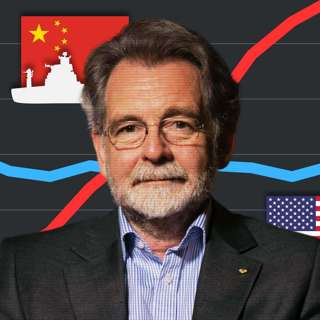

#218 – Hugh White on why Trump is abandoning US hegemony – and that’s probably good

#218 – Hugh White on why Trump is abandoning US hegemony – and that’s probably good

For decades, US allies have slept soundly under the protection of America’s overwhelming military might. Donald Trump — with his threats to ditch NATO, seize Greenland, and abandon Taiwan — seems hell-bent on shattering that comfort.

But according to Hugh White — one of the world's leading strategic thinkers, emeritus professor at the Australian National University, and author of Hard New World: Our Post-American Future — Trump isn't destroying American hegemony. He's simply revealing that it's already gone.

Links to learn more, video, highlights, and full transcript: https://80k.info/hw

“Trump has very little trouble accepting other great powers as co-equals,” Hugh explains. And that happens to align perfectly with a strategic reality the foreign policy establishment desperately wants to ignore: fundamental shifts in global power have made the costs of maintaining a US-led hegemony prohibitively high.

Even under Biden, when Russia invaded Ukraine, the US sent weapons but explicitly ruled out direct involvement. Ukraine matters far more to Russia than America, and this “asymmetry of resolve” makes Putin’s nuclear threats credible where America’s counterthreats simply aren’t. Hugh’s gloomy prediction: “Europeans will end up conceding to Russia whatever they can’t convince the Russians they’re willing to fight a nuclear war to deny them.”

The Pacific tells the same story. Despite Obama’s “pivot to Asia” and Biden’s tough talk about “winning the competition for the 21st century,” actual US military capabilities there have barely budged while China’s have soared, along with its economy — which is now bigger than the US’s, as measured in purchasing power. Containing China and defending Taiwan would require America to spend 8% of GDP on defence (versus 3.5% today) — and convince Beijing it’s willing to accept Los Angeles being vaporised.

Unlike during the Cold War, no president — Trump or otherwise — can make that case to voters.

Our new “multipolar” future, split between American, Chinese, Russian, Indian, and European spheres of influence, is a “darker world” than the golden age of US dominance. But Hugh’s message is blunt: for better or worse, 35 years of American hegemony are over.

Recorded 30/5/2025.

Chapters:

  • 00:00:00 Cold open
  • 00:01:25 US dominance is already gone
  • 00:03:26 US hegemony was the weird aberration
  • 00:13:08 Why the US bothered being the 'new Rome'
  • 00:23:25 Evidence the US is accepting the multipolar global order
  • 00:36:41 How Trump is advancing the inevitable
  • 00:43:21 Rubio explicitly favours this outcome
  • 00:45:42 Trump is half-right that the US was being ripped off
  • 00:50:14 It doesn't matter if the next president feels differently
  • 00:56:17 China's population is shrinking, but it doesn't matter
  • 01:06:07 Why Hugh disagrees with other realists like Mearsheimer
  • 01:10:52 Could the US be persuaded to spend 2x on defence?
  • 01:16:22 A multipolar world is bad, but better than nuclear war
  • 01:21:46 Will the US invade Panama? Greenland? Canada?!
  • 01:32:01 What should everyone else do to protect themselves in this new world?
  • 01:39:41 Europe is strong enough to take on Russia
  • 01:44:03 But the EU will need nuclear weapons
  • 01:48:34 Cancel (some) orders for US fighter planes
  • 01:53:40 Taiwan is screwed, even with its AI chips
  • 02:04:12 South Korea has to go nuclear too
  • 02:08:08 Japan will go nuclear, but can't be a regional leader
  • 02:11:44 Australia is defensible but needs a totally different military
  • 02:17:19 AGI may or may not overcome existing nuclear deterrence
  • 02:34:24 How right is realism?
  • 02:40:17 Has a country ever gone to war over morality alone?
  • 02:44:45 Hugh's message for Americans
  • 02:47:12 Why America temporarily stopped being isolationist

Tell us what you thought! https://forms.gle/AM91VzL4BDroEe6AA

Video editing: Simon Monsour
Audio engineering: Ben Cordell, Milo McGuire, Simon Monsour, and Dominic Armstrong
Music: Ben Cordell
Transcriptions and web: Katy Moore

Episoder(332)

#105 – Alexander Berger on improving global health and wellbeing in clear and direct ways

#105 – Alexander Berger on improving global health and wellbeing in clear and direct ways

The effective altruist research community tries to identify the highest impact things people can do to improve the world. Unsurprisingly, given the difficulty of such a massive and open-ended project,...

12 Jul 20212h 54min

#104 – Pardis Sabeti on the Sentinel system for detecting and stopping pandemics

#104 – Pardis Sabeti on the Sentinel system for detecting and stopping pandemics

When the first person with COVID-19 went to see a doctor in Wuhan, nobody could tell that it wasn’t a familiar disease like the flu — that we were dealing with something new. How much death and destru...

29 Jun 20212h 20min
#103 – Max Roser on building the world's best source of COVID-19 data at Our World in Data

#103 – Max Roser on building the world's best source of COVID-19 data at Our World in Data

History is filled with stories of great people stepping up in times of crisis. Presidents averting wars; soldiers leading troops away from certain death; data scientists sleeping on the office floor t...

21 Jun 20212h 22min

#102 – Tom Moynihan on why prior generations missed some of the biggest priorities of all

#102 – Tom Moynihan on why prior generations missed some of the biggest priorities of all

It can be tough to get people to truly care about reducing existential risks today. But spare a thought for the longtermist of the 17th century: they were surrounded by people who thought extinction w...

11 Jun 20213h 56min

#101 – Robert Wright on using cognitive empathy to save the world

#101 – Robert Wright on using cognitive empathy to save the world

In 2003, Saddam Hussein refused to let Iraqi weapons scientists leave the country to be interrogated. Given the overwhelming domestic support for an invasion at the time, most key figures in the U.S. ...

28 Mai 20211h 36min

#100 – Having a successful career with depression, anxiety and imposter syndrome

#100 – Having a successful career with depression, anxiety and imposter syndrome

Today's episode is one of the most remarkable and really, unique, pieces of content we’ve ever produced (and I can say that because I had almost nothing to do with making it!). The producer of this ...

19 Mai 20212h 51min

#99 – Leah Garcés on turning adversaries into allies to change the chicken industry

#99 – Leah Garcés on turning adversaries into allies to change the chicken industry

For a chance to prevent enormous amounts of suffering, would you be brave enough to drive five hours to a remote location to meet a man who seems likely to be your enemy, knowing that it might be an a...

13 Mai 20212h 26min

#98 – Christian Tarsney on future bias and a possible solution to moral fanaticism

#98 – Christian Tarsney on future bias and a possible solution to moral fanaticism

Imagine that you’re in the hospital for surgery. This kind of procedure is always safe, and always successful — but it can take anywhere from one to ten hours. You can’t be knocked out for the operati...

5 Mai 20212h 38min

Populært innen Fakta

fastlegen
dine-penger-pengeradet
relasjonspodden-med-dora-thorhallsdottir-kjersti-idem
mikkels-paskenotter
rss-strid-de-norske-borgerkrigene
rss-bisarr-historie
foreldreradet
treningspodden
jakt-og-fiskepodden
takk-og-lov-med-anine-kierulf
ukast
rss-sunn-okonomi
rss-bak-luftfarten
sinnsyn
lederskap-nhhs-podkast-om-ledelse
fryktlos
hverdagspsyken
rss-kull
gravid-uke-for-uke
level-up-med-anniken-binz