Searching for Exoplanets with Jackie Villadsen

Searching for Exoplanets with Jackie Villadsen

What can exoplanets teach us about our own solar system? Dr. Charles Liu explores the furthest reaches of our galaxy with the help of Vassar College astrophysicist Jackie Villadsen and co-host Allen Liu.

As always, our episode starts with the day’s cosmically cool thing: a weird and fun exoplanet system called K2-290 that’s exhibiting some crazy celestial mechanics. Find out what a K2 designation means, how the Kepler space telescope overcame a mechanical disaster, and why reaction wheels are really important! (Plus, we geek out a little bit about Star Wars and Tatooine!)

Our first student question, from Jean from New York City, “Is life possible on exoplanets?” kicks off a discussion of why we don’t know the answer yet. Jackie sums up the efforts of tens of thousands of scientists all around the globe involved in the search for life on extra-solar planets, including the different signals solar system scientists look for compared to extrasolar astronomers. You’ll hear how many exoplanets we’ve discovered already – get an update from “Future Allen” that you won’t want to miss!

Jackie shares her experiences using – and climbing all over – the Very Large Array radio telescope, the same ground-based telescope system that Jodie Foster was sitting in the movie Contact. You’ll learn about the birth of radio astronomy, coronagraphs, and why radio bursts from the sun are so intriguing. The trio talks about red dwarf stars and coronal mass ejections, including what they can tell us about our own solar system and why CMEs from our own sun could be responsible for the arid Mars we see now.

We also get to know more about Ruby Payne-Scott, the groundbreaking astronomer who, along with her colleagues, first found and categorized radio bursts from our sun in Australia after WWII. You’ll discover why she had to hide her marriage from the government in order to pursue her career. We also take one of our more interesting pop culture diversions so far, when Jackie tells us about her guilty pleasure: romance novels, including “The Ladies Guide to Celestial Mechanics” by Olivia Waite, set in the 1800s.

Finally, we grapple with a philosophical question from Walter T., one of our Patreon Patrons, that ponders existence and whether true nothingness could be possible. The answer takes us from the edge of the Big Bang to the implications of Einstein’s Theory of General Relativity and the ever-increasing space between galaxies.

We hope you enjoy this episode of The LIUniverse, and, if you do, please support us on Patreon.

Credits for Images Used in this Episode:

The Kepler satellite before launch – Credit: NASA, public domain

The Very Large Array – Credit: Wikipedia user Hajor, CC BY-SA 3.0

Total Solar Eclipse – Credit: Stephen Rahn, Public Domain

Ruby Payne-Scott – Credit: Peter Gavin Hall (Payne-Scott’s son), CC BY-SA 3.0

Denne episoden er hentet fra en åpen RSS-feed og er ikke publisert av Podme. Den kan derfor inneholde annonser.

Episoder(78)

ChuckGPT - Patreon Question Edition

ChuckGPT - Patreon Question Edition

It’s time for the Season 5 finale of The LIUniverse, which means another episode of ChuckGPT where we answer our audience’s most vexing questions – this time via video from our Patreon Patrons. And to...

13 Jun 38min
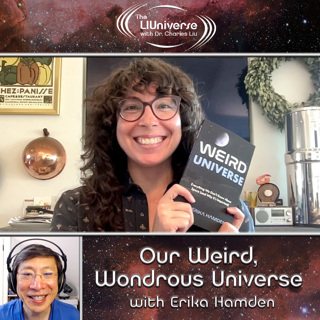
Our Weird, Wondrous Universe with Erika Hamden

Our Weird, Wondrous Universe with Erika Hamden

How do distant galaxies form? If you have two distant clouds of hydrogen, why does one turn into a star and another doesn’t? To find out, Dr. Charles Liu and co-host Allen Liu welcome Dr. Erika Hamden...

30 Mai 43min
Ruby Raindrops and Painted Peacocks with Munazza Alam

Ruby Raindrops and Painted Peacocks with Munazza Alam

Are there really exoplanets with where it rains ruby and emerald raindrops? How do we measure the atmospheres of exoplanets light years away? To find out, Dr. Charles Liu and co-host Allen Liu welcome...

16 Mai 45min
Astrophotography with Astronaut Don Pettit

Astrophotography with Astronaut Don Pettit

Can the physics you learned in High School take you to the stars? Who is behind many of your favorite pictures of space? What is it actually like to live and work in space? You might be surprised to k...

2 Mai 47min
Finding the “Bubbles” Exoplanet and Crocheting Dinosaurs with Victoria DiTomasso

Finding the “Bubbles” Exoplanet and Crocheting Dinosaurs with Victoria DiTomasso

How do we find exoplanets? What is the Milky Way’s “Thick Disk” and what makes it so special? To find out, Dr. Charles Liu and co-host Allen Liu welcome Harvard astronomer Dr. Victoria DiTomasso, who ...

11 Apr 47min
Supernovas and Space Gold with Dr. Ashley Villar

Supernovas and Space Gold with Dr. Ashley Villar

How do stars die? And what happens when they do? To find out, Dr. Charles Liu and co-host Allen Liu welcome Dr. Ashley Villar, who teaches astronomy at Harvard and whose team studies supernovas as the...

21 Mar 40min
Building Worlds with Luke Skywatcher

Building Worlds with Luke Skywatcher

How do planetary systems form? If you wanted to observe them, where would you look and what would you look for? To find out, Dr. Charles Liu and co-host Allen Liu welcome Luke Keller, professor of Ast...

8 Mar 43min
Chuck GPT: Astrotech

Chuck GPT: Astrotech

How can a helicopter fly in space? How does LIGO detect gravitational waves? How do quantum electronic devices like Josephson junctions work? Could AI turn evil and destroy humanity? What about those ...

8 Feb 55min

Populært innen Vitenskap

fastlegen
tingenes-tilstand
romkapsel
abels-tarn
jss
liberal-halvtime
vett-og-vitenskap-med-gaute-einevoll
rekommandert
villmarksliv
dekodet-2
sinnsyn
fjellsportpodden
rss-overskuddsliv
rss-rekommandert
tomprat-med-gunnar-tjomlid
rss-inn-til-kjernen-med-sunniva-rose
kvinnehelsepodden
hva-er-greia-med
rss-lundqvist-podden
diagnose