Stars vs. Planets with Dr. Tom Rice

Stars vs. Planets with Dr. Tom Rice

How did our solar system get here? How did the Earth form? How commonly does that happen elsewhere, and how often do the conditions necessary for life come about?

To find out, Dr. Charles Liu and co-host Allen Liu welcome Dr. Tom Rice, Astronomer-Educator and AAS staffer, who studies star and planet formations, how solar systems come together out of the “stuff that’s out there floating in our galaxy like gas and dust.”

As always, though, we start off with the day’s joyfully cool cosmic thing, the discovery of “baby” brown dwarf TWA 27B that we are watching grow thanks to the James Webb Space Telescope. Tom explains that a brown dwarf is not massive enough to ignite the hydrogen in their cores and turn into a star, but is 13 times more massive than gas giant planets like Jupiter. Allen asks Tom about temporal scales and “baby objects” – Tom defines objects as “young” that are still accreting mass, and tend to be in the range of 1-10 million years old. And as for calling brown dwarfs failed stars, well, you’ll just have to watch or listen for Tom’s opinion about that very controversial subject.

Then it’s time for a student question, from Alianna, who asks, “Can a star turn into a planet?” To answer, Tom uses a different distinction between stars, brown dwarfs, and planets: how they form. He explains the development from a region of gas and dust that gets dense and then collapses under its own weight, into a circumstellar disc accreting matter with an object at its center, growing either into a star, or, if it’s too low a mass to ignite, a brown dwarf. A planet forms in a different process, not in the center of the circumstellar disc (aka, the protoplanetary disc) but out of the “stuff” in the disc, at the same time the star is forming. So, Tom says, the answer to the question is “probably no.” Tom and Chuck then discusss a couple of hypothetical situations that could possibly reduce a star to the mass of the planet. They also compare the atmosphere composition of planets and stars. In the case of Jupiter, the composition is very similar to the sun, but the temperature is much cooler, so there are some molecules that form in its atmosphere that would remain in their atomic states in the Sun.

Then we enter the goldilocks zone to discuss what it takes to create a planet that can sustain life, like on Earth. Tom runs down the “must haves” for life, and then turns to the search for earthlike exoplanets using the Kepler and TESS space telescopes. You’ll learn about the transit method of exoplanet detection and what we can learn from it, including size and orbital frequency (which helps determine distance from the sun and therefore habitable temperatures).

Next we hear about Tom’s work on the staff of the American Astronomical Society. His focus: figuring out how channel the energy of society members to improve astronomy education at all levels. If you have a suggestion for Tom, you can find him on Twitter (X) @tomr_stargazer or email him at tom.rice@aas.org.

This being The LIUniverse, Chuck Tom and Allen end up the episode talking about video games, from Super Planet Crasher to Space Engine 2 and Universe Sandbox to the Zelda game, Tears of the Kingdom which has a ton of physics stuff in it– yes, you read that right!

By the way, if Tom looks familiar to you, that might be because he was in our video Chuck recorded at the AAS meeting in Pasadena last year where he showed us his fluency with American Sign Language. Tom is a CODA (Child of Deaf Adults) and ASL and his signing identity is an important part of his heritage. He lives in Washington, DC, near Gallaudet University, the nation’s only entirely signing university, where Tom works with the Astronomy Club. He’s also working with The National Technical Institute for the Deaf at Rochester Institute of Technology on activities relating to the upcoming total solar eclipse on April 8, 2024 that will pass directly overhead.

If you want to see Tom sign a few astronomic terms including the one for “the planet we live on...the most important place we can know,” watch our video at https://www.instagram.com/reel/Ce4kc96gOT5/.

We hope you enjoy this episode of The LIUniverse, and, if you do, please support us on Patreon.

Credits for Images Used in this Episode:

– TWA 27B (left) and its larger companion (right) – European Southern Observatory, CC BY 4.0

– Circumstellar Disc (artist’s concept) – ESO/L. Calçada, CC BY 4.0

– Illustration of the origin of a Type Ia supernova – NASA, Public Domain

– The Kepler and TESS space telescopes – NASA, Public Domain

– Transit detection of exoplanet WASP-96 b – NASA, ESA, CSA, STScI, and the Webb ERO Production Team, CC BY 4.0

– Gallaudet University’s Chapel Hall – Carol M. Highsmith, Public Domain

– The National Technical Institute for the Deaf, at RIT – Photog, CC BY 3.0

– Path of the April 8, 2024 Total Solar Eclipse – NASA's Scientific Visualization Studio - Michala Garrison, Ernie Wright, Ian Jones, Laurence Schuler, Public Domain.

Denne episoden er hentet fra en åpen RSS-feed og er ikke publisert av Podme. Den kan derfor inneholde annonser.

Episoder(79)

Bonus Episode: The Secret Fortress of Ag-Karrah, Part 1 (Actual Play)

Bonus Episode: The Secret Fortress of Ag-Karrah, Part 1 (Actual Play)

What happens when an astronomer, a mathematician, an educator, a physics student and a biomedical engineer set off to explore the Secret Fortress of Ag-Karrah? You get Part One of this summer’s bonus ...

16 Aug 48min
ChuckGPT - Patreon Question Edition

ChuckGPT - Patreon Question Edition

It’s time for the Season 5 finale of The LIUniverse, which means another episode of ChuckGPT where we answer our audience’s most vexing questions – this time via video from our Patreon Patrons. And to...

13 Jun 38min
Our Weird, Wondrous Universe with Erika Hamden

Our Weird, Wondrous Universe with Erika Hamden

How do distant galaxies form? If you have two distant clouds of hydrogen, why does one turn into a star and another doesn’t? To find out, Dr. Charles Liu and co-host Allen Liu welcome Dr. Erika Hamden...

30 Mai 43min
Ruby Raindrops and Painted Peacocks with Munazza Alam

Ruby Raindrops and Painted Peacocks with Munazza Alam

Are there really exoplanets with where it rains ruby and emerald raindrops? How do we measure the atmospheres of exoplanets light years away? To find out, Dr. Charles Liu and co-host Allen Liu welcome...

16 Mai 45min
Astrophotography with Astronaut Don Pettit

Astrophotography with Astronaut Don Pettit

Can the physics you learned in High School take you to the stars? Who is behind many of your favorite pictures of space? What is it actually like to live and work in space? You might be surprised to k...

2 Mai 47min
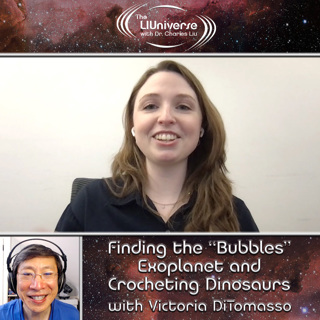
Finding the “Bubbles” Exoplanet and Crocheting Dinosaurs with Victoria DiTomasso

Finding the “Bubbles” Exoplanet and Crocheting Dinosaurs with Victoria DiTomasso

How do we find exoplanets? What is the Milky Way’s “Thick Disk” and what makes it so special? To find out, Dr. Charles Liu and co-host Allen Liu welcome Harvard astronomer Dr. Victoria DiTomasso, who ...

11 Apr 47min
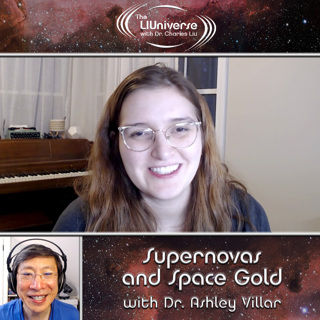
Supernovas and Space Gold with Dr. Ashley Villar

Supernovas and Space Gold with Dr. Ashley Villar

How do stars die? And what happens when they do? To find out, Dr. Charles Liu and co-host Allen Liu welcome Dr. Ashley Villar, who teaches astronomy at Harvard and whose team studies supernovas as the...

21 Mar 40min
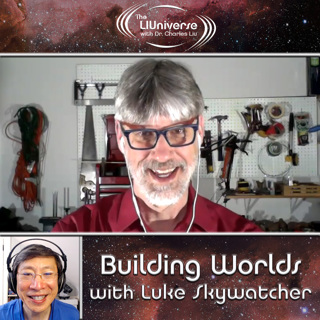
Building Worlds with Luke Skywatcher

Building Worlds with Luke Skywatcher

How do planetary systems form? If you wanted to observe them, where would you look and what would you look for? To find out, Dr. Charles Liu and co-host Allen Liu welcome Luke Keller, professor of Ast...

8 Mar 43min

Populært innen Vitenskap

fastlegen
tingenes-tilstand
romkapsel
rss-nysgjerrige-norge
liberal-halvtime
rekommandert
jss
villmarksliv
dekodet-2
abels-tarn
sinnsyn
vett-og-vitenskap-med-gaute-einevoll
fjellsportpodden
rss-overskuddsliv
rss-rekommandert
rss-paradigmepodden
tomprat-med-gunnar-tjomlid
diagnose
rss-inn-til-kjernen-med-sunniva-rose
nordnorsk-historie