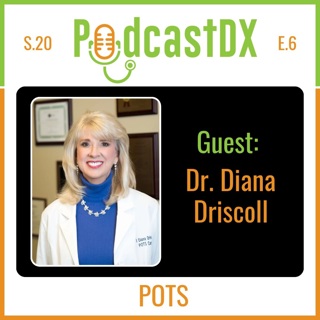

Understanding POTS with Dr. Diana Driscoll
PodcastDX9 Sep 2025

Understanding POTS with Dr. Diana Driscoll

This Week on PodcastDX: Understanding POTS with Dr. Diana Driscoll

This week we are honored to welcome none other than Dr. Diana Driscoll, a world-renowned authority on the autonomic nervous system. An optometrist and Fellow of the American Academy of Optometry (FAAO), Dr. Driscoll is internationally recognized for her groundbreaking research on Postural Orthostatic Tachycardia Syndrome (POTS) and other conditions once thought to be "invisible."

​ Dr. Driscoll has dedicated her career to improving the lives of those affected by autonomic disorders. Her journey began as a patient herself, battling POTS. Frustrated by the lack of answers, she self-funded much of her research to accelerate progress for patients today. That personal fight has fueled over a decade of innovation in diagnosis and treatment strategies that are transforming patient care.

​In this episode, we explore her unique perspective as both a former patient and a leading researcher. Dr. Driscoll shares her story, her research, and her vision for the future of POTS treatment.

​What is Postural Orthostatic Tachycardia Syndrome (POTS)?

POTS is a form of orthostatic intolerance that causes the heart to beat abnormally fast when moving from sitting or lying down to standing up. Breaking down the name helps explain the condition:

• Postural: Related to body position
• Orthostatic: Related to standing upright
• Tachycardia: A heart rate above 100 beats per minute
• Syndrome: A collection of symptoms occurring together

Normally, the autonomic nervous system keeps heart rate and blood pressure stable regardless of position. In POTS, that balance is disrupted. The body struggles to constrict blood vessels and regulate heart rate properly, leading to dizziness, lightheadedness, fainting, fatigue, and more.

​Who Does POTS Affect?

POTS affects an estimated 1 to 3 million Americans, most often women between the ages of 15 and 50. However, men can develop the condition as well.

Risk factors include:
• Viral or serious infections (such as mononucleosis)
• Pregnancy
• Physical trauma or surgery
• Certain autoimmune conditions (e.g., Sjögren's syndrome, lupus, celiac disease)

​How Does POTS Affect the Body?

When standing, gravity naturally pulls 10–15% of blood into the lower body. Normally, leg muscles and hormonal responses (like the release of epinephrine and norepinephrine) help keep blood circulating back to the brain and heart.

For people with POTS, too much blood pools below the heart. Their blood vessels don't constrict properly, forcing the heart to compensate by racing. This imbalance causes hallmark symptoms such as dizziness, exhaustion, brain fog, and even fainting.

​While POTS is not life-threatening, it can be life-altering. Daily tasks may become difficult, and symptoms often fluctuate over time. The good news: with the right combination of dietary adjustments, medications, and physical activity, many people experience meaningful improvements in their quality of life.

​Learn More

Join us as Dr. Diana Driscoll shares her remarkable journey, her patient-centered research, and her continuing mission to bring visibility and solutions to the millions living with POTS.

Denne episoden er hentet fra en åpen RSS-feed og er ikke publisert av Podme. Den kan derfor inneholde annonser.

Episoder(446)

L.A.T.E. A New Dementia (take two)

L.A.T.E. A New Dementia (take two)

This week on PodcastDX, we're talking about L.A.T.E., which stands for Limbic-predominant Age-related TDP-43 Encephalopathy. It's a type of dementia that many people have never heard of, but it's comm...

27 Okt 34min
Social Media Health Advice- How Do You Vet It?

Social Media Health Advice- How Do You Vet It?

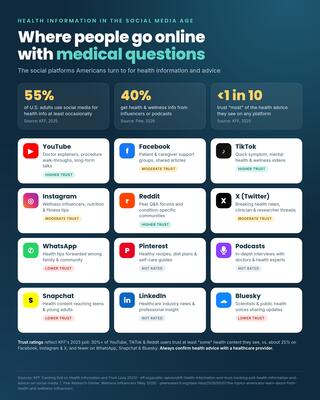
Welcome to PodcastDx, the show that helps you make sense of your health. I'm Jean Marie McNamara.  I'm joining you today with Lita Tomas, our Production Manager and of our co-hosts, Ron Rispoli (our t...

20 Okt 18min

Fatigue in Ehlers Danlos

Fatigue in Ehlers Danlos

Fatigue is more than feeling tired—for many people living with Ehlers-Danlos syndromes (EDS), it can mean overwhelming physical and mental exhaustion that affects even the simplest daily tasks. Chroni...

13 Okt 16min

Product Recalls (AGAIN!) and Your Health

Product Recalls (AGAIN!) and Your Health

This week we will discuss product recalls and your health.  According to WEBMD: A product safety recall happens when a consumer watch group or a manufacturer finds problems with a product. Lots of ite...

15 Sep 15min
Stage 4 Cancer as an ER Doc

Stage 4 Cancer as an ER Doc

Our guest today is a physician, author and activist.  The topic this week is "Stage 4 Cancer as an ER Doc".   Dr. James Maskalyk practices emergency medicine at St. Michael's, Toronto's inner-city tr...

8 Sep 1h 3min

Ai and Robotics in Medicine

Ai and Robotics in Medicine

This week on PodcastDX, Dr. Sanjeev Kumar joins Lita, Ron, and Jean Marie to discuss AI and robotics in medicine—from surgical robots and rehabilitation technology to hospital automation, patient safe...

1 Sep 47min

EECP The Most Underutilized Therapy in Medicine

EECP The Most Underutilized Therapy in Medicine

Retired U.S. Coast Guard Master Chief Petty Officer Jack Clifford joins PodcastDX to share how severe chronic angina once limited even everyday activities and left him facing the possibility of triple...

25 Aug 44min
Diary of An Epileptic

Diary of An Epileptic

In this episode of PodcastDX, we speak with Allany Muniz, founder of Diary of an Epileptic, about the realities of living with epilepsy beyond what most people see. Allany shares how her diagnosis cha...

18 Aug 28min

Populært innen Helse

fastlegen
rss-gukild-johaug
lydartikler-fra-aftenposten
psykodrama
hvordan-har-du-det-mann
fryktlos
leger-om-livet
relasjonspodden-med-dora-thorhallsdottir-kjersti-idem
rss-skravla-gar
foreldreradet
rss-ekteskapet
klimaks
morten-ramm-lar-kakla-ga-til-du-sovner
rss-kunsten-a-leve
g-punktet
treningsprat
rss-kull
rss-lopedrommen
rss-loping-for-nybegynnere
hjernesterk