Do we need a 'moral reckoning' on aquaculture's environmental impacts?

Do we need a 'moral reckoning' on aquaculture's environmental impacts?

Animal aquaculture, the farming of fish, has outpaced the amount of wild-caught fish by tens of millions of metric tons each year, bringing with it negative environmental impacts and enabling abuse, says Carl Safina, an ecologist and author.

On this episode of Mongabay's podcast, Safina speaks with co-host Rachel Donald about his recent Science Advances essay describing the "moral reckoning" that's required for the industry, pointing to environmental laws in the United States, which put hard limits on pollution, as examples to follow.

"In the 1970s in the U.S., we had this enormous burst of environmental legislation. We got the Endangered Species Act, the Clean Air Act, the Clean Water Act, the Toxic Substances Control Act … all of these things were not because somebody invented something new. It's because we felt differently about what was important," he says.

The global fishing industry also contributes to forced labor and other worker abuses, as revealed by whistleblowers and media outlets, including Mongabay. Read our award-winning 2022 investigation, which revealed systemic abuse of foreign workers by China's offshore tuna fleet.

Like this podcast? Share it with a friend, and please leave a review.

Subscribe to or follow the Mongabay Newscast wherever you listen to podcasts, from Apple to Spotify, and you can also listen to all episodes here on the Mongabay website or download our free app for Apple and Android devices to gain instant access to our latest episodes and all of our previous ones.

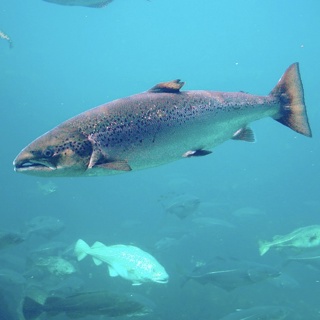
Image caption: An Atlantic salmon. In the U.S., the Washington state legislature banned farming of Atlantic salmon in 2018. A state official banned all commercial finfish aquaculture. Alaska and California have similar bans. Image by Hans-Petter Fjeld via Wikimedia Commons (CC BY-SA 2.5).

---

Timecodes

(00:00) Aquaculture and its impacts

(15:32) How values shape environmental policy

(32:56) The tragedy of the commons

(35:52) Ecological empathy

(45:07) Credits

Denne episoden er hentet fra en åpen RSS-feed og er ikke publisert av Podme. Den kan derfor inneholde annonser.

Episoder(370)

'Remembering Wildlife' before it goes extinct

'Remembering Wildlife' before it goes extinct

British wildlife photographer Margot Raggett says she created the book Remembering Elephants after she heard David Attenborough say, "The question is, are we happy to suppose that our grandchildren ma...

18 Aug 46min

Historic fire seasons are the 'new normal' without 'serious action' on climate change

Historic fire seasons are the 'new normal' without 'serious action' on climate change

Elizabeth Goldman is a co-director of Global Nature Watch, previously known as Global Forest Watch, a database measuring forest loss that's frequently cited in Mongabay reporting. She joins this week'...

11 Aug 28min

The 'quiet revolution' inspired by Delhi's urban wildlife

The 'quiet revolution' inspired by Delhi's urban wildlife

In her upcoming book, My Wild City: Finding Nature, Meaning, and Hope in India's Capital, conservation biologist Neha Sinha takes readers to the hidden and not-so-hidden ecosystems of India's largest...

4 Aug 54min

Why are forests in Liberia disappearing?

Why are forests in Liberia disappearing?

On this week's episode of the Mongabay Newscast, we speak with features writer Ashoka Mukpo, who traveled to southeastern Liberia to investigate what satellite images indicated was a spike in deforest...

28 Jul 38min

Oil has brought destruction to the Niger Delta; women and human rights may save it

Oil has brought destruction to the Niger Delta; women and human rights may save it

On this week's episode of the Mongabay Newscast, I speak with travel writer Noo Saro-Wiwa. She has documented the violence and natural destruction that the presence of oil companies have brought to th...

21 Jul 42min

The Mediterranean Sea's beauty hides an ecosystem under pressure

The Mediterranean Sea's beauty hides an ecosystem under pressure

The Mediterranean Sea accounts for less than 1% of the world's ocean surface water, but it contains roughly 18% of global marine biodiversity. It is home to 150 million people along its coastline (rou...

14 Jul 33min

Wildlife crossings are having a moment

Wildlife crossings are having a moment

Nearly three years ago, Newscast guest, author and journalist Ben Goldfarb discussed his book Crossings, which is about wildlife crossings and road ecology. Wildlife crossings help reconnect habitats...

7 Jul 37min

The radical plan to rethink work, wealth and planetary well-being

The radical plan to rethink work, wealth and planetary well-being

A group of more than 40 researchers spent 20 months devising a plan for the world to achieve ecological sustainability within planetary boundaries, all while seeing incomes rise for 98% of the global ...

30 Jun 52min

Populært innen Vitenskap

fastlegen
tingenes-tilstand
rss-nysgjerrige-norge
romkapsel
jss
villmarksliv
rekommandert
liberal-halvtime
rss-paradigmepodden
tomprat-med-gunnar-tjomlid
dekodet-2
sinnsyn
fjellsportpodden
vett-og-vitenskap-med-gaute-einevoll
abels-tarn
rss-rekommandert
rss-overskuddsliv
diagnose
nordnorsk-historie
rss-lundqvist-podden