
#024: Research on myelin repair – interview with Dr. Markley Silva Oliveira Junior on the effect of corticosteroid medrysone

#024: Research on myelin repair – interview with Dr. Markley Silva Oliveira Junior on the effect of corticosteroid medrysone

Dr. Markley Silva Oliveira Jr. has done research on astrocytes and how they can contribute to better myelin repair for PwMS using Medrysone.

You can find the full transcript to read on the corresponding blog article: https://ms-perspektive.com/024-research-on-myelin-repair

Episode 23 is about an exciting research work on myelin repair in the progressive course of MS with the help of astrocyte cells that contribute to it under administration of Medrysone, a corticosteroid.

My interview guest is Dr. Markley Silva Oliveira Junior, who wrote his doctoral thesis on this topic at Heinrich Heine University in Düsseldorf. It didn't stop at writing alone, though; Markley did a lot of experimentation and found amazing things about astrocytes, whose impact used to be viewed rather negatively, but which make a crucial contribution to repair.

And since Medrysone is already an approved drug in the field of ophthalmology, it could go faster with the approval, if the successful results from animal experiments, are equally good for humans.

This episode was originally recorded for the German MS-Perspektive podcast in May 2023. As I feel, it is emotionally helpful to hear about research on myelin repair every now and then, I decided to publish it again for the international MS-Perspektive podcast.

The podcast and blog post are also available in German.

Introduction of Dr. Markley Silva Oliveira-Junior

Hi everyone. Just glad to be here in invitation from Nele, many thanks for having me. Well, I'm a very honored Brazilian guy, neuroscientist, married, I love a good hiking, travelling, good food (quite spoiled I am for being Brazilian, but France and Italy have my heart on that) and of course hangout with my friends and family.

How and where can interested people follow the most recent research activities?

In my LinkedIn I'm always sharing things that I found interesting about research. Sometimes, I do my own posts, otherwise I'm sharing what I think is interesting there. For me, if you're interested in MS, for example, the MS UK portal is one of the key ones to be looking into, if you are a layperson or if you are an expert. You can get things regarding to that. As a scientist, my key portal to be looking into is basically PubMed, but if you want to know more about what I'm doing, my LinkedIn is actually the best recommendation that I can do to follow what I've been working with. For example, I'm planning to do a post next week, where I will address a little bit more what I've been working with some clients, regarding Alzheimer's and also MS. I will not tell everything, of course, because of the patent issue and we are planning inside our company to start to share a little bit more of what we've been working, regarding health promotion, which is basically what we scientists are here to do. Even though we are in academia or not, we are here to promote health.

Is there anything else you would like to share with the listeners?

One thing in particular is that I love science communication, and I think this is really necessary to make science be better for everyone. And podcasts like the one that you have are actually giving people the opportunity to talk, is giving voice to express what they think about it. Every time that you listen, you will filter… you need to put something out of your mouth, out of your chest, do it kindly but always think about the audience. We, as scientists, we have changed the way that we talk about science over the years and I think that one of the things that makes me happy to be a scientist is how important science communication is today, so we can give people the right to know.

I think this is one of the most important things in science communication. It's giving the people the right to know. Because we, as scientists, back in years we were thought we were crazy guys, with "Eureka" all the time, living in a dark place, not sharing, or not knowing how to explain what we do to people, and this was actually what media put out about what being a scientist was. And we're not really like this. We're normal people, who like to go out … I think one of the things that your podcast gives opportunities to scientists is to talk more in a simple way about their work, about their research. Science communication is for this, is for everyone.

---

Many thanks to Markley for the insight into the exciting research around astrocytes, their role in demyelination, and how to possibly stimulate them in the human brain using Medrysone.

Make the most of your life and become or remain a well-informed patient,
Nele

For more information and positive thoughts, subscribe to my newsletter for free.

Click here for an overview of all podcast episodes published so far.

Denne episoden er hentet fra en åpen RSS-feed og er ikke publisert av Podme. Den kan derfor inneholde annonser.

Episoder(192)

#190: Living with multiple sclerosis. Gabriela's story and the "(un)seen faces of MS" Art Project

#190: Living with multiple sclerosis. Gabriela's story and the "(un)seen faces of MS" Art Project

https://ms-perspektive.de/en/190-unseen-faces-of-ms/Living with multiple sclerosis often means experiencing symptoms that others cannot see. Austrian artist Gabriela Romagna shares her journey to an M...

4 Nov 32min
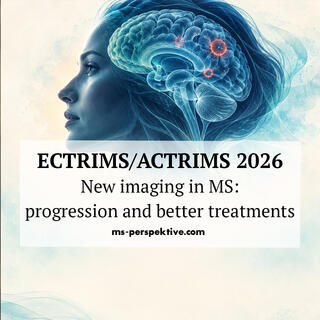
#189: New imaging in MS: understanding progression and finding better treatments | ECTRIMS 2026

#189: New imaging in MS: understanding progression and finding better treatments | ECTRIMS 2026

How could new imaging in MS help us understand progression and develop better treatments? In this episode, I explore key insights from Daniel Reich's MSToronto2026 lecture and related research. Learn ...

28 Okt 15min
#188: Jan Van Amstel on EMSP's Four-Year Presidency and the Future of MS Advocacy in Europe

#188: Jan Van Amstel on EMSP's Four-Year Presidency and the Future of MS Advocacy in Europe

"Get rid of MS as soon as possible and make ourselves superfluous." — Jan van Amstel What can a stronger European voice achieve for people living with MS? In episode #188, EMSP President Jan van Amste...

21 Okt 31min

#187: Aging in multiple sclerosis: relapses, progression and treatment choices with Dr. Yi Chao Foong

#187: Aging in multiple sclerosis: relapses, progression and treatment choices with Dr. Yi Chao Foong

Aging in multiple sclerosis brings new questions about relapses, gradual progression and treatment choices. In episode 187, Dr. Yi Chao Foong, an MS neurologist and researcher in Tasmania, explains wh...

14 Okt 29min
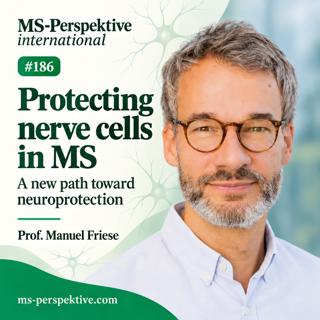
#186: Protecting nerve cells in multiple sclerosis: A new path toward neuroprotection with Prof. Manuel Friese

#186: Protecting nerve cells in multiple sclerosis: A new path toward neuroprotection with Prof. Manuel Friese

Why can multiple sclerosis progress even when relapses are well controlled? In episode 186, I speak with Prof. Manuel Friese about the next challenge in MS research: protecting nerve cells from damage...

7 Okt 43min

#185: Living with MS in Mexico – who gets diagnosed, who gets treated, and who gets left behind?

#185: Living with MS in Mexico – who gets diagnosed, who gets treated, and who gets left behind?

An MS diagnosis can depend on where you live, whether you can reach a neurologist and how quickly you can get an MRI. In this episode, Nele speaks with neurologist and neuroimmunologist Dr. Enrique Go...

30 Sep 36min

#184: MS treatment across the disease course – treat early, think long-term, don't give up too soon with Prof. Klaus Schmierer

#184: MS treatment across the disease course – treat early, think long-term, don't give up too soon with Prof. Klaus Schmierer

Read the full blog post and interview here: https://ms-perspektive.de/en/184-klaus-schmierer/ How early should MS treatment start, how strongly should we treat, and is there ever a point when it becom...

23 Sep 41min

#183: Silent progression in MS. Can we really detect it early?

#183: Silent progression in MS. Can we really detect it early?

Can we detect gradual MS progression before it becomes obvious? In this episode, I look at what current research can — and cannot — tell us about subtle worsening without an obvious relapse. The key d...

16 Sep 34min

Populært innen Fakta

fastlegen
dine-penger-pengeradet
fryktlos
relasjonspodden-med-dora-thorhallsdottir-kjersti-idem
rss-strid
rss-ekteskapet
rss-bisarr-historie
foreldreradet
treningspodden
jakt-og-fiskepodden
rss-kunsten-a-leve
rss-kull
rss-orjasater
sinnsyn
mikkels-paskenotter
gravid-uke-for-uke
rss-flydilla
hverdagspsyken
rss-mind-body-podden
rss-impressions-2