Deep(er) Ecology: William Rees, Nora Bateson & Rex Weyler | Reality Roundtable #02

Deep(er) Ecology: William Rees, Nora Bateson & Rex Weyler | Reality Roundtable #02

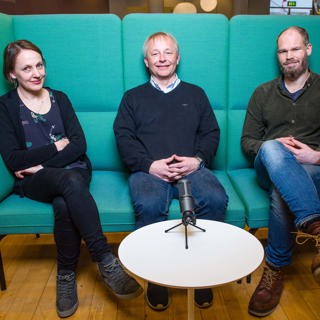
On this segment of Reality Roundtable, Nate is joined by William Rees, Nora Bateson, and Rex Weyler to discuss the purpose of ecology and what it might look like to have a civilization centered around it. Despite our tendency to think of ourselves as separate from the biosphere, humans are a part of it, just like any other animal. What sets us apart now is our outsized impact on the world around us, as we and our societies take up more space and resources, degrading the ecosystems that support ourselves, our descendants, and other species. How can an understanding of systems and relationships help us rethink how we interact with the planet? Could ecologically literate governments and citizens create wider boundaries across time and space in which decisions are made? What might the parameters be for a civilization centered around ecology, and how can we navigate there through declining energy and resource availability? Most of all, how can we as individuals and communities root ourselves into a deep(er) ecological knowledge and way of being?

About Nora Bateson

Nora Bateson is an award-winning filmmaker, writer and educator, as well as President of the International Bateson Institute, based in Sweden. Her work asks the question "How can we improve our perception of the complexity we live within, so we may improve our interaction with the world?".

An international lecturer, researcher and writer, Nora wrote, directed and produced the award-winning documentary, An Ecology of Mind, a portrait of her father, Gregory Bateson. Her work brings the fields of biology, cognition, art, anthropology, psychology, and information technology together into a study of the patterns in ecology of living systems. Her book, Small Arcs of Larger Circles, released by Triarchy Press, UK, 2016 is a revolutionary personal approach to the study of systems and complexity.

About William Rees

William Rees is a population ecologist, ecological economist, Professor Emeritus and former Director of the University of British Columbia's School of Community and Regional Planning in Vancouver, Canada. He researches the implications of global ecological trends for the longevity of civilization, with special focus on urban (un)sustainability and cultural/cognitive barriers to rational public policy. Prof Rees is best known as the originator and co-developer with Dr Mathis Wackernagel of 'ecological footprint analysis' (EFA), a quantitative tool that estimates human demands on ecosystems and the extent to which humanity is in 'ecological overshoot.' Dr Rees is a founding member and former President of the Canadian Society for Ecological Economics; a founding Director of the OneEarth Living Initiative; a Fellow of the Post-Carbon Institute and an Associate Fellow of the Great Transition Initiative.

About Rex Weyler

Rex Weyler is a writer and ecologist. His books include Blood of the Land; the Government and Corporate War Against First Nations, nominated for a Pulitzer Prize; Greenpeace: The Inside Story, a finalist for the BC Book Award and the Shaughnessy-Cohen Award for Political Writing; and The Jesus Sayings, a deconstruction of first century history, a finalist for the BC Book Award.

In the 1970s, Weyler was a cofounder of Greenpeace International and editor of the Greenpeace Chronicles. He served on campaigns to preserve rivers and forests and to stop whaling, sealing, and toxic dumping.

He currently posts the "Deep Green" column at the Greenpeace International website. He lives on Cortes Island in British Columbia, with his wife, artist Lisa Gibbons.

Watch on YouTube: https://youtu.be/GE39xfNRRyw

For Show Notes and More visit: https://www.thegreatsimplification.com/episode/rr02-bateson-rees-weyler

Episoder(370)

Behavioral Thermodynamics Part 1: Beyond the 4th Law?

Behavioral Thermodynamics Part 1: Beyond the 4th Law?

In this week's Frankly, Nate takes thermodynamics out of the physics classroom, utilizing its principles to explain the invisible forces behind growth, competition, and complexity in our world. Compet...

19 Des 202530min

End of Year Reflections: Four Years of The Great Simplification with Nate Hagens

End of Year Reflections: Four Years of The Great Simplification with Nate Hagens

In this week's episode, Nate reflects on four years(!) of the podcast by answering listener-submitted questions, which cover a broad range of topics related to The Great Simplification. He invites sub...

17 Des 202527min

Sunk Cost and the Superorganism | Frankly 116

Sunk Cost and the Superorganism | Frankly 116

In this week's episode, Nate unpacks the pervasive behavioral pull of sunk cost as a force shaping our material reality, identities, and collective expectations about the future. Past investments – in...

12 Des 202523min

Fighting for a Livable Future: Exploring Frontier Climate Interventions with Kelly Erhart

Fighting for a Livable Future: Exploring Frontier Climate Interventions with Kelly Erhart

While current conversations about global heating tend to center around a few well-established pieces of science, we don't often hear about the scientists and leaders working at the frontier of what is...

10 Des 20251h 6min

Inflation, Deflation, & Simplification: The 8 Things That Influence Prices | Frankly 115

Inflation, Deflation, & Simplification: The 8 Things That Influence Prices | Frankly 115

In this week's Frankly, Nate explores how the prices we encounter in our daily lives are influenced by not only how much money is in the system, but also by resource depletion, technology, affordabili...

5 Des 202526min

If Anyone Builds It, Everyone Dies: How Artificial Superintelligence Might Wipe Out Our Entire Species with Nate Soares

If Anyone Builds It, Everyone Dies: How Artificial Superintelligence Might Wipe Out Our Entire Species with Nate Soares

Technological development has always been a double-edged sword for humanity: the printing press increased the spread of misinformation, cars disrupted the fabric of our cities, and social media has ma...

3 Des 20251h 40min

Reimagining Ourselves at the End of Our World: Kinship, Interconnection, and Spirituality in the Metacrisis with Samantha Sweetwater

Reimagining Ourselves at the End of Our World: Kinship, Interconnection, and Spirituality in the Metacrisis with Samantha Sweetwater

Over the past decade, the world has become increasingly chaotic and uncertain – and so, too, has our cultural vision for the future. While the events we face now may feel unprecedented, they are roote...

24 Nov 20251h 33min

Directional Advice for the (More Than) Human Predicament | Frankly 114

Directional Advice for the (More Than) Human Predicament | Frankly 114

Over the past decade, the world has become increasingly chaotic and uncertain – and so, too, has our cultural vision for the future. While the events we face now may feel unprecedented, they are roote...

22 Nov 202540min

Populært innen Vitenskap

fastlegen
rekommandert
tingenes-tilstand
forskningno
sinnsyn
rss-rekommandert
smart-forklart
liberal-halvtime
villmarksliv
jss
fjellsportpodden
pod-britannia
vett-og-vitenskap-med-gaute-einevoll
tomprat-med-gunnar-tjomlid
rss-paradigmepodden
psykopoden
dekodet-2
rss-nysgjerrige-norge
nevropodden
rss-overskuddsliv