Deep(er) Ecology: William Rees, Nora Bateson & Rex Weyler | Reality Roundtable #02

Deep(er) Ecology: William Rees, Nora Bateson & Rex Weyler | Reality Roundtable #02

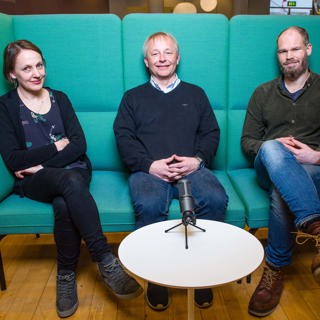
On this segment of Reality Roundtable, Nate is joined by William Rees, Nora Bateson, and Rex Weyler to discuss the purpose of ecology and what it might look like to have a civilization centered around it. Despite our tendency to think of ourselves as separate from the biosphere, humans are a part of it, just like any other animal. What sets us apart now is our outsized impact on the world around us, as we and our societies take up more space and resources, degrading the ecosystems that support ourselves, our descendants, and other species. How can an understanding of systems and relationships help us rethink how we interact with the planet? Could ecologically literate governments and citizens create wider boundaries across time and space in which decisions are made? What might the parameters be for a civilization centered around ecology, and how can we navigate there through declining energy and resource availability? Most of all, how can we as individuals and communities root ourselves into a deep(er) ecological knowledge and way of being?

About Nora Bateson

Nora Bateson is an award-winning filmmaker, writer and educator, as well as President of the International Bateson Institute, based in Sweden. Her work asks the question "How can we improve our perception of the complexity we live within, so we may improve our interaction with the world?".

An international lecturer, researcher and writer, Nora wrote, directed and produced the award-winning documentary, An Ecology of Mind, a portrait of her father, Gregory Bateson. Her work brings the fields of biology, cognition, art, anthropology, psychology, and information technology together into a study of the patterns in ecology of living systems. Her book, Small Arcs of Larger Circles, released by Triarchy Press, UK, 2016 is a revolutionary personal approach to the study of systems and complexity.

About William Rees

William Rees is a population ecologist, ecological economist, Professor Emeritus and former Director of the University of British Columbia's School of Community and Regional Planning in Vancouver, Canada. He researches the implications of global ecological trends for the longevity of civilization, with special focus on urban (un)sustainability and cultural/cognitive barriers to rational public policy. Prof Rees is best known as the originator and co-developer with Dr Mathis Wackernagel of 'ecological footprint analysis' (EFA), a quantitative tool that estimates human demands on ecosystems and the extent to which humanity is in 'ecological overshoot.' Dr Rees is a founding member and former President of the Canadian Society for Ecological Economics; a founding Director of the OneEarth Living Initiative; a Fellow of the Post-Carbon Institute and an Associate Fellow of the Great Transition Initiative.

About Rex Weyler

Rex Weyler is a writer and ecologist. His books include Blood of the Land; the Government and Corporate War Against First Nations, nominated for a Pulitzer Prize; Greenpeace: The Inside Story, a finalist for the BC Book Award and the Shaughnessy-Cohen Award for Political Writing; and The Jesus Sayings, a deconstruction of first century history, a finalist for the BC Book Award.

In the 1970s, Weyler was a cofounder of Greenpeace International and editor of the Greenpeace Chronicles. He served on campaigns to preserve rivers and forests and to stop whaling, sealing, and toxic dumping.

He currently posts the "Deep Green" column at the Greenpeace International website. He lives on Cortes Island in British Columbia, with his wife, artist Lisa Gibbons.

Watch on YouTube: https://youtu.be/GE39xfNRRyw

For Show Notes and More visit: https://www.thegreatsimplification.com/episode/rr02-bateson-rees-weyler

Episoder(384)

Dr. Simon Michaux: "Minerals and Materials Blindness""

Dr. Simon Michaux: "Minerals and Materials Blindness""

On this episode, we meet with Associate Professor of Geometallurgy at the Geological Survey of Finland, Dr. Simon Michaux. Why do humans ignore important mineral and material limits that will affect h...

18 Mai 20221h 19min

Thomas Murphy: "Physics and Planetary Ambitions"

Thomas Murphy: "Physics and Planetary Ambitions"

On this episode, we meet with Professor of Physics at UCSD and the Associate Director of CASS, the Center for Astrophysics and Space Sciences, Tom Murphy. Murphy shows us how continued growth and ener...

11 Mai 20221h 9min

Chuck Watson: "Nuclear War - All the Questions You Were Afraid to Ask"

Chuck Watson: "Nuclear War - All the Questions You Were Afraid to Ask"

Show Summary: On this episode, we meet again with risk expert Chuck Watson. How can we avoid a nuclear conflict? Watson gives a primer on how to reduce the risk of nuclear conflict and the measures w...

4 Mai 20221h 38min

Tristan Harris: "Social Media: Bringing the Ring to Mordor"

Tristan Harris: "Social Media: Bringing the Ring to Mordor"

On this episode, we meet with Co-Founder of the Center for Humane Technology and co-host of Your Undivided Attention Podcast, Tristan Harris. Harris explores the intersection of society and social med...

27 Apr 20221h 21min

Daniel Pauly: "Peak Fish and Other Ocean Realities"

Daniel Pauly: "Peak Fish and Other Ocean Realities"

On this episode, we meet with Professor at the University of British Columbia and Founder of Sea Around Us, Dr. Daniel Pauly. Dr. Pauly shares the role warming sea water plays in fish migration. How d...

20 Apr 20221h 1min

John Gowdy: "Superorganisms, Crazy Ants, and Fire Apes, Oh My!"

John Gowdy: "Superorganisms, Crazy Ants, and Fire Apes, Oh My!"

On this episode, we meet with Ecological Economist, John Gowdy. Gowdy explores the revolution in biology and its significance in society. How do different cultures manifest human nature? What role has...

13 Apr 20221h 20min

Jamie Wheal: "Neuro-anthropology and Culture Architecture"

Jamie Wheal: "Neuro-anthropology and Culture Architecture"

On this episode, we meet with Executive Director of the Flow Genome Project, Jamie Wheal. Jamie discusses the evolutionary importance of music as a coping mechanism, how the United States' university ...

6 Apr 20221h 21min

Dennis Meadows: "Limits to Growth turns 50 - Checking In"

Dennis Meadows: "Limits to Growth turns 50 - Checking In"

On this episode, we meet with Professor Emeritus of Systems Management and author, Dennis Meadows. Meadows revisits Limits to Growth 50 years after it was published. Looking back, how does Meadows vi...

30 Mar 20221h 19min

Populært innen Vitenskap

fastlegen
tingenes-tilstand
jss
rekommandert
forskningno
sinnsyn
villmarksliv
rss-paradigmepodden
liberal-halvtime
rss-nysgjerrige-norge
tomprat-med-gunnar-tjomlid
nevropodden
fjellsportpodden
diagnose
tidlose-historier
kvinnehelsepodden
rss-inn-til-kjernen-med-sunniva-rose
psykopoden
dekodet-2
rss-rekommandert