
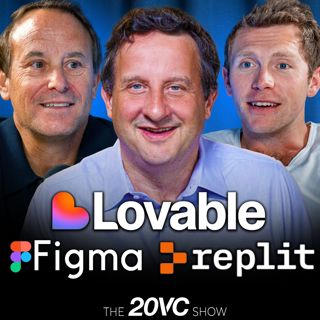
20VC: Lovable Raises at $2BN & Hits $100M ARR | Is Cursor Worth $28BN at $1BN in ARR | How Do All Providers Deal with Anthropic Dependency Risk | Are Seed Funds F******: Have Mega Funds Won | Figma IPO Breakdown: Where Does it Price?
Agenda: 00:00 – Did Jason Just Kill Replit? 03:45 – Why Claude Lies To You and Cannot Be Trusted 06:50 – You Cannot Trust Agents. Period. 10:20 – Why Windsurf Was Dead Without Claude 12:30 – Cursor vs. Lovable: What's the Better Bet? 14:40 – Should You Still Invest in Cursor at $28B? 18:05 – Would You Bet on Anthropic at $100B or OpenAI at $300B? 24:15 – Inside OpenAI's Secret Weapon: The Calvin French-Owen Memo 27:50 – Perplexity Just Crushed ChatGPT and Claude 32:15 – Will Cursor Build Their Own Models Before Anthropic Cuts Them Off? 33:20 – Figma's IPO at $16B: Outrageous or Fair Game? 41:55 – 90% of Seed Funds Are Cooked—Is Rob Go Right? 52:15 – How Often Do You Meet a Founder Who Can Return the Fund? 1:08:00 – Which Seed Fund Would You Back Today?
24 Jul 1h 21min

20VC: Scaling to $1BN+ in Revenue with No Funding: Surge AI | The Most Insane Scaling Story in Tech |
Edwin Chen is the Founder and CEO of Surge. Founded in 2020, Surge has scaled to $1BN+ in revenue with zero external funding. At the same time, their competitor, Scale.ai raised over $1.3BN to reach $850M ARR. Today, Surge have the world's largest model providers as customers and have just 120 employees. Agenda: 00:00 — "Everyone Else Is Just a Body Shop" — Edwin Calls Out the Whole Industry 01:05 — Why 90% of Big Tech Is Wasting Time on Useless Problems 03:45 — "I Don't Do 1-on-1s" — How Surge Kills Meetings and Still Moves 10x Faster 05:55 — Will a Single Person Build a $1B Company? 08:10 — 100x Engineers Are Real — Here's How to Spot Them 12:10 — Why Most PhDs Are Useless in AI Training 14:20 — Built to a Billion With Zero VC — Edwin Explains How and Why 17:00 — "No Sales Team, No PR, No BS" — Why Surge Stays in the Shadows 21:15 — The Real Reason AGI Might Take Until 2040 24:45 — Will Synthetic Data Kill Human Labelling? 29:00 — "Academic Benchmarks Are a Scam" 31:05 — Why the Real Bottleneck in AI Isn't Compute or Models — It's THIS 33:00 — What Every AI Company Should Be Asking (But Isn't) 35:15 — "No, I Wouldn't Sell Surge for $100B" 39:00 — Is the Application Layer Doomed? Edwin Predicts the Future of AI Startups 46:30 — Have the Leading Foundation Models Already Been Founded? 48:10 — AGI Could Be Dangerous — And Most People Are Ignoring Why 20VC: Scaling to $1BN+ in Revenue with No Funding: Surge AI | The Most Insane Scaling Story in Tech |
21 Jul 1h 6min
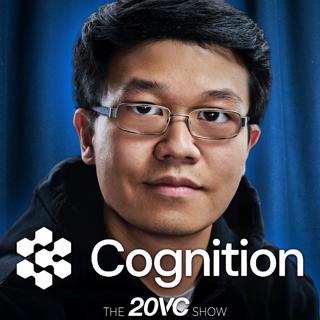
20VC: Cognition CEO Scott Wu on Acquiring Windsurf: The Process, The Deal, The Rationale | Did Google Overlook a Goldmine in the Core Asset and Did Founders Leave a Sinking Ship | How Cursor and Cognition Deal with Ever Increasing Reliance on Anthropic
Scott Wu is the co-founder and CEO of Cognition, the company behind Devin, the world's first AI software engineer. On Friday last week they pulled off the acquisition of the year, acquiring Windsurf, following their licensing agreement with Google. Previously a world-class competitive programmer, he was a gold medalist at the International Olympiad in Informatics and a member of the U.S. Math and Physics Olympiad teams. Before Cognition, he was a founding engineer at Scale AI, helping shape the early AI infrastructure stack. AGENDA: 00:00 – Why are founders walking away instead of going down with the ship? 01:05 – How did Cognition pull off the $220M Windsurf deal in just 72 hours? 04:45 – What really happened behind closed doors the weekend Windsurf was acquired? 07:15 – Did Google overlook a goldmine in the Windsurf team and IP? 09:00 – Who are the 100 people that secretly shape the future of AI? 12:30 – Can application startups ever gain leverage over foundation model giants like Anthropic? 14:15 – Is coding about to be replaced by simply describing what you want? 17:30 – 50% of new code is AI-written. Where does that go next? 20:45 – "We've gone from 0 to $80M ARR in 6 months. Quietly." 25:00 – Are IDEs and agents just the training wheels for the real future of software engineering? 28:20 – If you could only back one—OpenAI or Anthropic—who's the better bet? 30:00 – Why has Cognition kept its insane growth a secret… until now?
18 Jul 48min
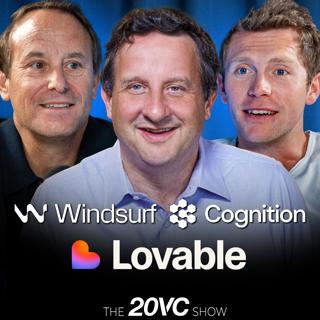
20VC: Windsurf x Google x Cognition: Full Breakdown: Who Made Money, Who Did Not | Lovable vs Replit: Will These Be $100BN Businesses | Why Elon Could Beat Sam Altman with the New Grok | Why Every S&P 500 Company Will Buy Bitcoin?
Agenda: 00:00 Windsurf was dead—then this deal changed everything 05:00 The Windsurf x Google x Cognition saga explained 09:00 The OpenAI deal collapsed—what really happened 15:00 FTC rules forced a brutal deal structure—who lost? 17:00 The investors' returns: who actually made money? 21:30 Will Google's corp dev team get fired over this? 23:00 Cognition's genius $220M acquisition of Windsurf: Most brilliant Deal of the Year 26:00 The biggest recruiting flex in Silicon Valley this year 35:00 "Roll your own SaaS" is complete nonsense 38:00 Lovable vs Cursor vs Replit: who wins the coding war? 41:00 Why Lovable could be the ChatGPT of builders 44:00 Will these vibe-coded apps become durable businesses? 48:00 The shocking churn rates hidden inside AI SaaS 55:00 Are these $2B valuations actually... cheap? 56:30 Grok just destroyed GPT-4 in benchmarks—WTF?! 01:01:00 Why Grok might overtake OpenAI in the next 12 months 01:11:00 Meta just invested $3.5B in Ray-Bans—WTF? 01:12:30 Should every S&P 500 company buy Bitcoin now? 01:15:00 Will Meta kill open source? What happens to Llama 5?
17 Jul 1h 21min

20VC: Vlad Tenev on Robinhood's $85BN Resurgence | Tokenizing SpaceX & OpenAI | Building Nine Revenue Lines Over $100M | Why Crypto Will Be Robinhood's Biggest Revenue Line | Why Stablecoins Will Replace Banking Rails
Vlad Tenev is the Founder and CEO of Robinhood, the greatest story on Wall St of the last decade. In the previous 18 months, Robinhood has increased its net revenue by 58% to nearly $3B; a $500M loss in 2023 turned into a $1.1B profit in 2024. Robinhood's stock is up roughly 4x, lifting their market cap to north of $80B. Today, Robinhood has nine lines of business that do over $100M in revenue. Agenda: 00:00 – "Tokenization Is The Biggest Innovation in Finance" 03:28 – How Robinhood 4x'd Its Market Cap in 8 Months 06:40 – AI Writes 50% of All Net New Code at Robinhood 10:02 – Why Robinhood Built a Secret ChatGPT for Support 12:11 – The One Customer Type That Transformed the Business 15:29 – "CoreWeave Is Retail's Way Into AI" — The Meme Stock Defense 18:05 – Inside Robinhood's Tokenized Private Shares Product 21:23 – "Capital as a Service" — Vlad's Wild Vision for Startup Fundraising 24:10 – The $100M Revenue Line Vlad Wishes He Could Kill 26:45 – Robinhood Is Building... Cash Delivery Trucks?! 29:55 – "We Were Shipping Nothing": Vlad on the 2020–2022 Culture Crisis 33:20 – What Line of Business Will Be the Biggest For Vlad in 5 Years Time 35:11 – The One Competitor Vlad Actually Respects 36:55 – From Men's Health to Japanese Toilets: Vlad's Weirdest Quickfire Yet 38:40 – "I Was in the Dumps": What 2022 Taught Vlad About Resilience 40:00 – Where Robinhood Is Headed: The Next Decade of Financial Infrastructure
14 Jul 57min

20Growth: The Death of Growth Teams? | How Hubspot Use AI to Triple Email Conversion | The Future of AI SEO | Why Prompt Engineering is the New Coding | What Every CMO Needs to Know About AI in 2025
Kieran Flanagan is the CMO at HubSpot, where he's led the transformation of their growth strategy from SEO-led to multi-channel and AI-powered. Formerly SVP of Marketing, he helped scale HubSpot's user base to millions and revenue past $2B. Before HubSpot, he drove breakout growth at Marketo and Salesforce. Kieran is one of the most respected voices in SaaS marketing and a pioneer in growth-driven content strategy. Agenda: 00:03 – The Death of Growth Teams? Kieran's Wild Prediction 06:44 – AI Innovation Pods: The New Org Structure for Startups 10:18 – Email Personalization That Tripled Conversions 13:21 – From Software Budget to Labor Budget: The Shift is Happening 16:35 – The Big Lie: Why Autonomous Agents Still Suck 19:24 – The Secret Sauce Behind HubSpot's Email AI Stack 21:44 – Segment-Based Marketing Is Dead. Enter Micro Audiences. 24:15 – Content Collapse: Why Google Organic Is Getting Torched 30:52 – The Future of AI SEO: 1 Product, 100 Pages, Infinite Prompts 33:16 – Memory = Moat: Why ChatGPT Is Becoming Unbeatable 35:46 – Prompt Engineering is the New Coding: Here's How to Win 41:03 – The Death of the Middle Manager Marketer 46:17 – OpenAI vs. Anthropic: Kieran's $400M Bet 48:00 – Europe Is Falling Behind: The Harsh Truth on Regulation 52:39 – CMO Playbook 2025: Micro-Audiences, Creator-Led, AI at Scale
11 Jul 1h 15min

20VC: Daniel Gross and Nat Friedman: Acquired by Meta | OpenAI's SBC Bombshell: More Stock Comp Than Revenue | Privat Equity is Back: Olo Bought for $2BN | Microsoft Lays Off 9,000 People: Is This Just the Start | Will Sequoia Part with Shaun Maguire
Agenda: [00:00] The AI Talent Crisis No One's Ready For [03:00] Daniel Gross and Nat Friedman: Why Two Legendary VCs Walked Away From $1B to Join Meta [12:00] Meta's AI Talent Magnet: Will It Actually Work? [15:00] Cursor Is Breaking the Market: Can Anyone Compete? [18:30] OpenAI's SBC Bombshell: More Stock Comp Than Revenue [22:00] CoreWeave's Power Play: Buying Their Landlords [26:00] Is Circle Next to Go Shopping with Meme Equity? [28:00] PE Is Back: The Olo Take-Private Explained [35:00] Why Triple, Triple, Double, Double Is No Longer Sexy [41:00] QSBS Hack: The Billionaire's Tax Loophole You're Missing [48:00] Microsoft's AI Layoffs: Salespeople Are Dead, Long Live Engineers [50:00] "If You Need a Week to Learn AI, You Should Be Fired" [53:00] Will Sequoia's Sean Maguire Be Pushed Out? Place Your Bets [57:00] Will There Be a Recession in 2025? Jason Bets $75K It's a No [1:00:00] Is Linda Yaccarino Still CEO of X by Year-End? [1:03:00] Circle and CoreWeave's Meme Rally: Real or Mirage?
10 Jul 1h 7min

20VC: Scott Galloway on Are Billionaires Happy & The Impact of Money on Psychology and Self-Worth | Becoming a Better Father & Husband | Why We Should Drink More and Not Work From Home | The Tinder Effect & How it Makes Young Men Radical
Scott Galloway is a Professor of Marketing at NYU Stern, where he's taught for over two decades. He's the founder of several successful companies, including L2 (acquired by Gartner for over $150M), Red Envelope, and Prophet. He's a New York Times bestselling author of four books on business and tech, and co-hosts the award-winning Pivot podcast. Galloway also serves on the boards of The New York Times Company and Panera, and his public talks have been viewed tens of millions of times globally. In Today's Episode We Discuss: 02:00 – How to Win in a New Economy of AI 06:00 – Should We Break Up Big Tech? 08:00 – Why Young People Have a Right to Be Angry? 11:00 – Why the Tax Code Is Rigged Against the Young 13:00 – Tax Changes That Would Make Young People Rich Again 17:00 – The Tinder Effect: Why Men Are Angry 20:00 – The Loneliness Epidemic in Men 23:00 – Remote Work & The Case for Alcohol 26:00 – Why Richer Families are Happier Families 30:00 – The Truth About Kids and Career 34:00 – Are Billionaires Happy? 38:00 – Becoming a Better Son, Father, Partner 46:00 – Behind the Persona: Who Scott Galloway Really Is
7 Jul 1h 10min