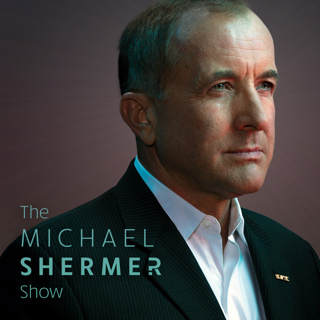
132. Leonard Mlodinow — Stephen Hawking: A Memoir of Friendship and Physics

132. Leonard Mlodinow — Stephen Hawking: A Memoir of Friendship and Physics

One of the most influential physicists of our time, Stephen Hawking touched the lives of millions. Recalling his nearly two decades as Hawking's collaborator and friend, Leonard Mlodinow brings this complex man into focus in a unique and deeply personal portrayal. We meet Hawking the genius, who employed his mind to uncover the mysteries of the universe — ultimately formulating a pathbreaking theory of black holes that reignited the discipline of cosmology and paved the way for physicists to investigate the origins of the universe in completely new ways. We meet Hawking the colleague, a man whose illness leaves him able to communicate at only six words per minute but who expends the effort to punctuate his conversations with humor. And we meet Hawking the friend, who could convey volumes with a frown, a smile, or simply a raised eyebrow. Modinow puts us in the room as Hawking indulges his passion for wine and curry; shares his feelings on love, death, and disability; and grapples with deep questions of philosophy and physics. This deeply affecting account of a friendship teaches us not just about the nature and practice of physics but also about life and the human capacity to overcome daunting obstacles. Shermer and Mlodinow discuss:

  • what it was like working with Stephen Hawking,
  • what Stephen Hawking was like as a person and personality,
  • Hawking's place in the pantheon of great physicists in the history of science,
  • Hawking's major contributions to physics,
  • What is grand about the grand design of the universe?
  • model dependent realism and the philosophy of science,
  • Can we ever know reality?
  • Why is there something rather than nothing?
  • What caused the Big Bang to bang?
  • What there was before time began?
  • Why does the universe look fine-tuned and designed?
  • Is the universe itself a giant black hole?
  • Did the universe begin in a singularity?
  • Hawking's beliefs about God and why the concept isn't necessary to explain the universe.

Leonard Mlodinow received his PhD in theoretical physics from the University of California, Berkeley, was an Alexander von Humboldt Fellow at the Max Planck Institute, and was on the faculty of the California Institute of Technology. His previous books include the best sellers The Grand Design and A Briefer History of Time (coauthored with Stephen Hawking), Subliminal (winner of the PEN/E. O. Wilson Literary Science Writing Award), and War of the Worldviews (with Deepak Chopra), as well as Elastic, Euclid's Window, Feynman's Rainbow, and The Upright Thinkers.

Denne episoden er hentet fra en åpen RSS-feed og er ikke publisert av Podme. Den kan derfor inneholde annonser.

Episoder(630)

America at 250: What Did the Founders Get Right?

America at 250: What Did the Founders Get Right?

Michael Shermer makes the case that the U.S. Founding Fathers were not only steeped in Enlightenment values on which the Declaration of Independence was based, but they were also scientists searching ...

6 Jul 17min

When History Goes on Trial: Demjanjuk, Eichmann, and Justice After Atrocity

When History Goes on Trial: Demjanjuk, Eichmann, and Justice After Atrocity

John Demjanjuk lived for decades as a retired autoworker in suburban Cleveland. Then investigators accused him of being "Ivan the Terrible," one of the most notorious guards at Treblinka. What followe...

27 Jun 1h 32min

Why I Joined the Government UAP Science Advisory Council

Why I Joined the Government UAP Science Advisory Council

Michael Shermer has been appointed to the newly formed UAP Science Advisory Council, formed at the request of the White House and in coordination with the All-domain Anomaly Resolution Office (AARO), ...

23 Jun 29min

Massimo Pigliucci on Doubt, Moral Courage, and Living Without Illusions

Massimo Pigliucci on Doubt, Moral Courage, and Living Without Illusions

What does it mean to live well when certainty is unavailable? Michael Shermer speaks with Massimo Pigliucci about moral character, ancient philosophy, and the difficult art of making decisions without...

20 Jun 1h 33min

Cathy Young: Why Free Societies Need Free Speech

Cathy Young: Why Free Societies Need Free Speech

Cathy Young returns to the show for a wide-ranging conversation about free speech, institutional trust, and the strange incentives shaping public debate today. What happens when universities, media ou...

16 Jun 1h 30min

The Zodiac Killer Wasn't Real

The Zodiac Killer Wasn't Real

The Zodiac Killer has been treated for decades as America's ultimate unsolved true crime mystery: one mysterious killer, taunting letters, cryptic ciphers, a strange costume, and a trail of victims ac...

13 Jun 1h 39min

How Algorithms Use Your Data to Control You

How Algorithms Use Your Data to Control You

Michael Shermer speaks with Oxford philosopher Carissa Véliz about the long human desire to know the future—from ancient oracles and astrology to AI, surveillance capitalism, predictive policing, and ...

9 Jun 1h 34min

Batya Ungar-Sargon: Why the Left Sees Jews Differently Now

Batya Ungar-Sargon: Why the Left Sees Jews Differently Now

Batya Ungar-Sargon joins Michael Shermer for a wide-ranging conversation about the historical relationship between Jews and the American left, and why that relationship has become increasingly straine...

6 Jun 54min

Populært innen Vitenskap

fastlegen
tingenes-tilstand
jss
forskningno
sinnsyn
vett-og-vitenskap-med-gaute-einevoll
rekommandert
liberal-halvtime
dekodet-2
villmarksliv
rss-nysgjerrige-norge
rss-inn-til-kjernen-med-sunniva-rose
diagnose
rss-rekommandert
fjellsportpodden
rss-overskuddsliv
nevropodden
rss-kunstig-intelligens-med-elisabeth-maren-og-morten
rss-paradigmepodden
smart-forklart