Pratima Singh - Exploring Alternatives to Biological Psychiatry

Pratima Singh - Exploring Alternatives to Biological Psychiatry

This week, we interview Dr. Pratima Singh. Dr. Singh completed her medical degree in India, before moving to the UK to work at the Maudsley NHS Hospital in London as an adult Psychiatrist. Dr. Singh has a deep interest in alternatives to biological approaches to psychiatry and the use of psychotropic medications.

I was keen to ask Dr. Singh about her background, what led her towards psychiatry as a medical speciality and what she feels about the future of psychiatric care.

In this episode, we discuss:

▪How Dr. Singh completed her medical degree in India and became interested in psychiatry

▪That Dr. Singh felt uncomfortable with the predominantly biological approach to psychiatry including the use of medications and that her interest was in psychotherapy as a therapeutic intervention

▪That there is a recruitment and retention problem within psychiatry

▪That 15 years in psychiatry has given Dr. Singh a nuanced and humble attitude to helping people with their mental health

▪That Dr. Singh felt that her discontent with biological psychiatry continued during her training

▪That, in the UK, General Practitioners (family doctors) actually deal with 80% of mental health problems

▪Patients may then be referred by the GP to therapy teams in secondary care, commonly known as Community Mental Health Teams (CMHT)

▪These teams include psychiatrists, occupational health specialists to try and address a range of service user needs

▪That there is also acute care, or crisis teams, where support is given for psychiatric emergencies

▪Recently there has been diversification to include specialisms like eating disorders, learning disabilities or neuropsychiatry but provision differs across the UK

▪That Dr. Singh feels that we have too rapidly and too dramatically cut down the amount of in-patient beds, leaving a gap and increasing the pressure on the community teams

▪That in the UK we struggle to provide a brief intervention model because many service users often require more time

▪That Dr. Singh feels that the majority of people that she sees have already been put onto psychotropic medications by their GP and often this is too early in the process

▪That there are patients now that say they do to want to try medication

▪That the evidence for using so much medication for emotional distress is weak

▪That psychiatrists do not have tests to help predict how a medication will affect a patient or if they will struggle to withdraw

▪That Dr. Singh would like us to understand the medications better especially why some people struggle even if they try to withdraw slowly

▪That, as professionals we need to listen to patients experiences of adverse effects or withdrawal difficulties

▪That Dr. Singh feels that it is a privilege to be able to engage with patients in this way but that we must be very carful not take advantage or to harm the patient despite our best intentions

▪That we need a completely different mindset to better manage mental health difficulties

▪That Dr. Singh prefers to look at the wider issues in a persons life to try and find the best way to support them including diet, exercise or other potential issues such as metabolic problems or nutritional deficiencies

▪How sometimes a therapeutic relationship can feel like an arranged marriage

▪That a new model would only work if the intervention is early enough in the process, if we engage with people too late, it can be more difficult to help

▪How Dr. Singh remembers her first interaction with a patient and uses this to guide her in listening to the patients own wisdom and experience

▪That Dr. Singh took some time to undertake a Leadership and Management fellowship and that this really helped her to stand back and appreciate the issues and to listen to the customer

▪That full disclosure and informed consent is so important

▪Functional medicine and how it differs to mainstream psychiatric approaches

▪That functional medicine is a holistic approach that considers the whole person

▪and underlying root cause of chronic illness

▪In a functional approach there are no specialities

▪The place of recovery colleges in co-producing training in holistic ways of

▪maintaining health

▪That we still tend to think about contemplative practices as something to try rather than a core skill necessary for good mental health

▪That there is not enough evidence to influence a closed mind

▪That many of the best discoveries in medicine come from observation rather than from a laboratory

▪Dr Singh's hope that psychiatry can return to a place of creativity and openness

To listen on Mad in America: https://goo.gl/tyyLmt

Podcast show notes: https://goo.gl/zbxncn

To get in touch with us email: podcasts@madinamerica.com

© Mad in America 2017

Denne episoden er hentet fra en åpen RSS-feed og er ikke publisert av Podme. Den kan derfor inneholde annonser.

Episoder(308)

When Stopping Prescription Drugs Isn't Simple: Alicia Martin and the TaperMate Story

When Stopping Prescription Drugs Isn't Simple: Alicia Martin and the TaperMate Story

Alicia Martin is an Australian community pharmacist, a member of the Not Broken Project and founder of TaperMate. Through her work in pharmacy, Alicia saw patients struggling with unusual and severe s...

16 Sep 34min
First-Person Knowledge and the Meanings of Madness: An Interview with Gail Hornstein

First-Person Knowledge and the Meanings of Madness: An Interview with Gail Hornstein

Gail Hornstein is Professor Emerita of Psychology at Mount Holyoke College. Across a long and influential career, her work has moved between psychology, psychoanalysis, history, qualitative research, ...

2 Sep 1h 8min
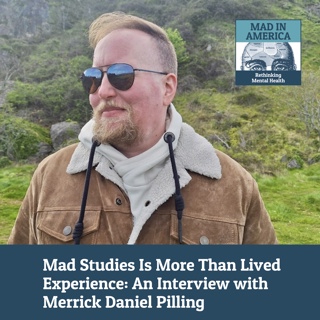
Mad Studies Is More Than Lived Experience: An Interview with Merrick Daniel Pilling

Mad Studies Is More Than Lived Experience: An Interview with Merrick Daniel Pilling

Merrick Daniel Pilling is an Associate Professor and Interim Co-Director of the School of Disability Studies at Toronto Metropolitan University. He is the author of Queer and Trans Madness: Struggles ...

19 Aug 49min
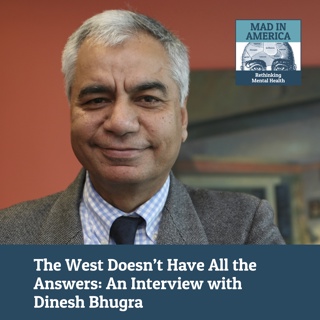
The West Doesn't Have All the Answers: An Interview with Dinesh Bhugra

The West Doesn't Have All the Answers: An Interview with Dinesh Bhugra

Dinesh Bhugra is a leading voice in social and cultural psychiatry. He is Emeritus Professor of Mental Health and Cultural Diversity at King's College London and has served as president of the Royal ...

12 Aug 36min
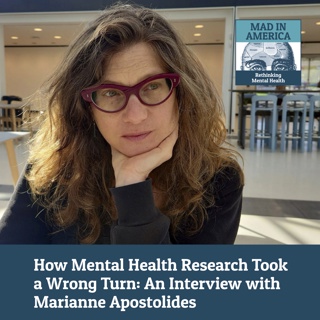
Go/No Go - How Mental Health Research Took a Wrong Turn: An Interview with Marianne Apostolides

Go/No Go - How Mental Health Research Took a Wrong Turn: An Interview with Marianne Apostolides

Marianne Apostolides is the award-winning author of eight books, four of which have been translated and published internationally. She is a two-time recipient of the Chalmers Arts Fellowship and winne...

29 Jul 48min
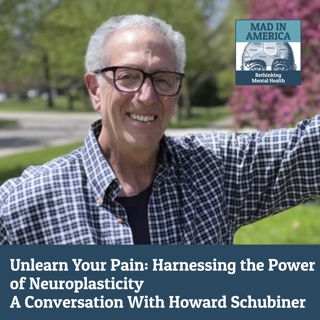
Unlearn Your Pain: Harnessing the Power of Neuroplasticity – A Conversation With Howard Schubiner

Unlearn Your Pain: Harnessing the Power of Neuroplasticity – A Conversation With Howard Schubiner

Welcome to the Mad in America podcast. My name is Brooke Siem, and I am the author of the award-winning memoir on antidepressant withdrawal, May Cause Side Effects. Today, I'm excited to have Dr. Howa...

15 Jul 41min
The Empire of Madness: Why Psychiatry Must Rethink Human Suffering - An Interview with Khameer Kidia

The Empire of Madness: Why Psychiatry Must Rethink Human Suffering - An Interview with Khameer Kidia

Khameer Kidia is a physician and an anthropologist, works at Harvard Medical School and the University of Zimbabwe, and spends his life between Washington DC and Harare. Kidia has many accolades to hi...

8 Jul 48min
A Mother's Journey Through Psychiatric Drug Harm and Healing

A Mother's Journey Through Psychiatric Drug Harm and Healing

Chelsea McVeigh began her journey with psychiatric medications at 16, never imagining where it would lead. At 31, during a new pregnancy, she suffered a severe adverse reaction that turned her world u...

1 Jul 24min

Populært innen Helse

fastlegen
rss-gukild-johaug
psykodrama
hvordan-har-du-det-mann
leger-om-livet
relasjonspodden-med-dora-thorhallsdottir-kjersti-idem
rss-skravla-gar
foreldreradet
g-punktet
rss-dagen-for-dagen
hjernesterk
rss-lopedrommen
klimaks
morten-ramm-lar-kakla-ga-til-du-sovner
treningsprat
bak-fasaden-en-reise-i-livet-med-sykepleier-ine
rss-loping-for-nybegynnere
lydartikler-fra-aftenposten
rss-kunsten-a-leve
kjed-deg-i-sovn-verdens-kjedeligste-podcast