Michael O'Loughlin - Exploring Narrative Approaches to Psychological Distress

Michael O'Loughlin - Exploring Narrative Approaches to Psychological Distress

This week, Mad in America's news editor Justin Karter interviews Professor Michael O'Loughlin.

Professor O'Loughlin is a college professor and researcher at Adelphi University on Long Island. He is a licensed psychologist and a psychoanalyst in private practice in New Hyde Park, New York. Dr O'Loughlin writes critically about the biomedical model of psychiatry and psychology and also has a deep interest in psychiatric rights and social justice issues.

In 2015 as an editor he launched a book series entitled Psychoanalytic Studies: Clinical, Social, and Cultural Contexts, with Lexington Books.

In August 2017, with colleagues Dr. Awad Ibrahim (University of Ottawa), Dr, Gabrielle Ivinson (Manchester Metropolitan University), and Dr. Marek Tesar (University of Auckland), as series co-editors, he launched a book series, Critical Childhood & Youth Studies: Clinical, educational, social and cultural inquiry, to be published by Lexington Books.

Professor O'Loughlin talks about his childhood experiences and how they influenced his narrative and conversational approach to psychological distress.

In this episode we discuss

How Dr O'Loughlin's early experiences growing up in Ireland led to a deep interest in social justice issues, particularly poverty and inequality.

That as a young man in college he engaged in charity work and activism.

How, more recently, he became interested in psychiatry when he was appointed as a lecturer in clinical psychology, but realised that there weren't required courses on trauma or psychosis.

That this led to teaching courses in intergenerational trauma and the way that our history shapes us as people.

That Michael has engaged in autobiographical writing to understand the way that deprivations and injustices that he experienced had a formative impact on his own thinking and writing.

That another course on madness and psychosis was perceived by clinical psychology students as radical, leading to a realisation that mainstream psychology is a very conservative discipline.

How he became interested in interviewing psychiatric patients and telling stories that represented a diverse group of people and experiences of psychiatric services.

That this led to a project at Fountain House in New York City to see if narratives could be reinforced and shared.

That Michael does not himself use the terms mental illness or disorder because he feels that we need to be flexible and that even this terminology can be traumatising.

How he has recently focused on creating spaces where participants can share their experiences and stories and it shouldn't be a classification or categorization exercise.

That he has found many that have experienced the psychiatric system have felt that the system impeded their recovery.

That a collaborative team of Adelphi academics, Fountain House staff and Fountain House members will together publish research.

That Professor O'Loughlin feels that psychology and psychiatry are traditional and reactive disciplines and that psychiatry has been driven by pharmacological concerns.

How Michael's work with children is grounded in his own childhood experiences and a sense that human beings need nurturing spaces and validation.

That Michael is extremely disturbed about the medicating young children with drugs that are not known to be safe for them such as antipsychotic drugs.

The unwillingness to understand that a child's distress has an origin and that we have a responsibility to engage with the child and create a space for them to communicate.

How we define normality within such a narrow range that children find it very difficult to conform to society's expectations.

That there seems to be little room for a child in school, only room for a student.

That psychoanalysis has tools to understand our emotions and experiences but also has tools to help understand societal drivers that may underlie psychological distress.

The worry that talking therapies are being replaced by tick lists and categories and that we need to bring stories back into psychology.

Relevant links:

Michael O'Loughlin, PhD

Psychoanalytic Studies: Clinical, Social, and Cultural Contexts

Arthur Frank

Kathryn Bond Stockton

To get in touch with us email: podcasts@madinamerica.com

© Mad in America 2017

Denne episoden er hentet fra en åpen RSS-feed og er ikke publisert av Podme. Den kan derfor inneholde annonser.

Episoder(308)

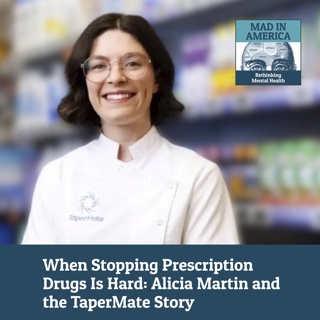
When Stopping Prescription Drugs Isn't Simple: Alicia Martin and the TaperMate Story

When Stopping Prescription Drugs Isn't Simple: Alicia Martin and the TaperMate Story

Alicia Martin is an Australian community pharmacist, a member of the Not Broken Project and founder of TaperMate. Through her work in pharmacy, Alicia saw patients struggling with unusual and severe s...

16 Sep 34min
First-Person Knowledge and the Meanings of Madness: An Interview with Gail Hornstein

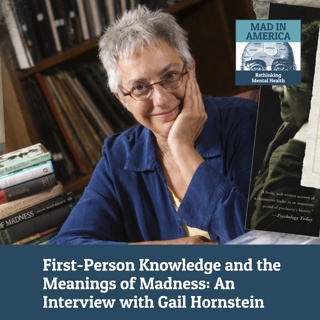
First-Person Knowledge and the Meanings of Madness: An Interview with Gail Hornstein

Gail Hornstein is Professor Emerita of Psychology at Mount Holyoke College. Across a long and influential career, her work has moved between psychology, psychoanalysis, history, qualitative research, ...

2 Sep 1h 8min
Mad Studies Is More Than Lived Experience: An Interview with Merrick Daniel Pilling

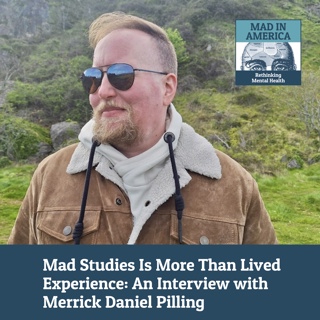
Mad Studies Is More Than Lived Experience: An Interview with Merrick Daniel Pilling

Merrick Daniel Pilling is an Associate Professor and Interim Co-Director of the School of Disability Studies at Toronto Metropolitan University. He is the author of Queer and Trans Madness: Struggles ...

19 Aug 49min
The West Doesn't Have All the Answers: An Interview with Dinesh Bhugra

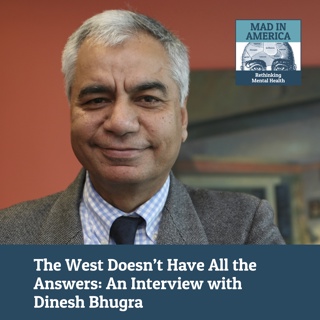
The West Doesn't Have All the Answers: An Interview with Dinesh Bhugra

Dinesh Bhugra is a leading voice in social and cultural psychiatry. He is Emeritus Professor of Mental Health and Cultural Diversity at King's College London and has served as president of the Royal ...

12 Aug 36min
Go/No Go - How Mental Health Research Took a Wrong Turn: An Interview with Marianne Apostolides

Go/No Go - How Mental Health Research Took a Wrong Turn: An Interview with Marianne Apostolides

Marianne Apostolides is the award-winning author of eight books, four of which have been translated and published internationally. She is a two-time recipient of the Chalmers Arts Fellowship and winne...

29 Jul 48min
Unlearn Your Pain: Harnessing the Power of Neuroplasticity – A Conversation With Howard Schubiner

Unlearn Your Pain: Harnessing the Power of Neuroplasticity – A Conversation With Howard Schubiner

Welcome to the Mad in America podcast. My name is Brooke Siem, and I am the author of the award-winning memoir on antidepressant withdrawal, May Cause Side Effects. Today, I'm excited to have Dr. Howa...

15 Jul 41min
The Empire of Madness: Why Psychiatry Must Rethink Human Suffering - An Interview with Khameer Kidia

The Empire of Madness: Why Psychiatry Must Rethink Human Suffering - An Interview with Khameer Kidia

Khameer Kidia is a physician and an anthropologist, works at Harvard Medical School and the University of Zimbabwe, and spends his life between Washington DC and Harare. Kidia has many accolades to hi...

8 Jul 48min
A Mother's Journey Through Psychiatric Drug Harm and Healing

A Mother's Journey Through Psychiatric Drug Harm and Healing

Chelsea McVeigh began her journey with psychiatric medications at 16, never imagining where it would lead. At 31, during a new pregnancy, she suffered a severe adverse reaction that turned her world u...

1 Jul 24min

Populært innen Helse

fastlegen
rss-gukild-johaug
psykodrama
hvordan-har-du-det-mann
leger-om-livet
relasjonspodden-med-dora-thorhallsdottir-kjersti-idem
rss-skravla-gar
foreldreradet
g-punktet
rss-dagen-for-dagen
hjernesterk
rss-lopedrommen
klimaks
morten-ramm-lar-kakla-ga-til-du-sovner
treningsprat
bak-fasaden-en-reise-i-livet-med-sykepleier-ine
rss-loping-for-nybegynnere
lydartikler-fra-aftenposten
rss-kunsten-a-leve
kjed-deg-i-sovn-verdens-kjedeligste-podcast