Peter Breggin and Michael Cornwall - Stop the Psychiatric Abuse of Children

Peter Breggin and Michael Cornwall - Stop the Psychiatric Abuse of Children

This week on MIA Radio, we interview Drs. Peter Breggin and Michael Cornwall their new initiative, Stop the Psychiatric Abuse of Children (SPAC!).

Peter Breggin, MD is a Harvard-trained psychiatrist and a former consultant at the National Institute of Mental Health who has been called "The Conscience of Psychiatry." For decades, he has made successful efforts to reform the field, including bringing a stop to lobotomy and psychosurgery. He has testified before the FDA and Congress, been an expert witness in many court cases involving the pharmaceutical industry and has appeared on Oprah and 60 Minutes, among other programs.

Dr. Breggin continues to criticize psychiatric drugs and "electroconvulsive therapy," and promotes more caring, empathic and effective therapies. To that end, with his wife Ginger, he founded the Center for the Study of Empathic Therapy, Education and Living. He is the author of more than 20 books, most recently Guilt, Shame and Anxiety: Understanding and Overcoming Negative Emotions. Dr. Breggin maintains a private practice in Ithaca, New York where he treats adults, couples, and families with children.

Michael Cornwall, PhD has done therapy with children, teens and families since 1980 as well as specializing in therapy with people of all ages experiencing extreme states. He completed doctoral research on medication-free treatment of extreme states and is the editor of a two-volume special edition of the Journal of Humanistic Psychologyon extreme states. Dr. Cornwall has been a prolific MIA blogger since 2012 and a frequent Esalen Institute workshop leader on alternative approaches to extreme states. He is the director of the SPAC! project for Dr. Breggin's Center for Empathic Therapy.

(audio)

We discuss:
  • How SPAC was started in response to the introduction of the Monarch eTNS, an electric stimulation device worn on a child's forehead at night that is touted as an alternative to ADHD medication, which was fast-tracked by FDA with little testing
  • The extensive, downplayed adverse reactions found in testing the Monarch on children
  • How the device is purported to work to target brain activity in certain areas, but likely affects other important neural areas and how this is likely to disrupt a child's normal brain function
  • Problems with the design of the studies on the Monarch and how deliberate intrusions into brain function make an individual child more docile but also more apathetic
  • The potential widespread adoption of the Monarch device due to a partnership between the manufacturer and a pharmacy chain, the many uses for which it is being marketed, and anticipated psychiatric prescribing of the treatment by primary care doctors
  • The nature and risks of ECT, another form of psychiatric "treatment" that targets the brain with electricity, intentionally causing a seizure and short- and long-term traumatic brain injury, and where to find ECT resources on Dr. Breggin's website
  • Reframing "ADHD" behavior as a sign of deficiencies in the teacher, classroom, or parenting approach rather than an illness in the child. What might cause inattentiveness in a young student and how doctors typically medicate the problem as a brain disorder
  • Alternatives to high-tech interventions and drugs for helping inattentive or severely troubled youth alike, including modifications at school and entering family therapy. The importance of parents' expressing love and discipline to change problematic behaviors, with examples from Breggin's private practice
  • How the medical model of psychiatry discourages identifying unmet human needs in young patients and their families, and the benefits of offering trauma-informed support and connection, with examples from Cornwall's work in the public mental health system
  • The importance of engaging children to identify what they need from adults in their lives, arming parents with new attitudes and communication tools for relating to their children, and the success they have had with such approaches
  • How listeners can learn more about SPAC! and get involved with advocacy against conventional psychiatric treatment for children and for more compassionate and commonsense alternatives. The groundswell of interest they have received from parents and a variety of online resources available on these topics
  • The right of parents to say no to dangerous drugs or devices doctors want to prescribe, and the importance of understanding the risks of resisting a medical professional's authority or challenging a child's school
  • Reasons for parents and teachers be optimistic that even seemingly incorrigible children can be reached.
Relevant Links

SPAC! webpage, part of Dr. Peter Breggin's Children's Resource Center

ECT Resource Center

Center for the Study of Empathic Therapy, Education, and Living

MIA blogs

Monarch eTNS Inspires "Stop the Psychiatric Abuse of Children!" (SPAC!)

FDA Approves Using Electricity All Night Long on Children's Brains

Denne episoden er hentet fra en åpen RSS-feed og er ikke publisert av Podme. Den kan derfor inneholde annonser.

Episoder(308)

When Stopping Prescription Drugs Isn't Simple: Alicia Martin and the TaperMate Story

When Stopping Prescription Drugs Isn't Simple: Alicia Martin and the TaperMate Story

Alicia Martin is an Australian community pharmacist, a member of the Not Broken Project and founder of TaperMate. Through her work in pharmacy, Alicia saw patients struggling with unusual and severe s...

16 Sep 34min
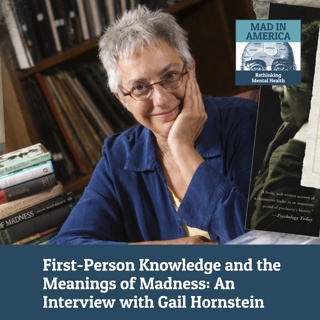
First-Person Knowledge and the Meanings of Madness: An Interview with Gail Hornstein

First-Person Knowledge and the Meanings of Madness: An Interview with Gail Hornstein

Gail Hornstein is Professor Emerita of Psychology at Mount Holyoke College. Across a long and influential career, her work has moved between psychology, psychoanalysis, history, qualitative research, ...

2 Sep 1h 8min
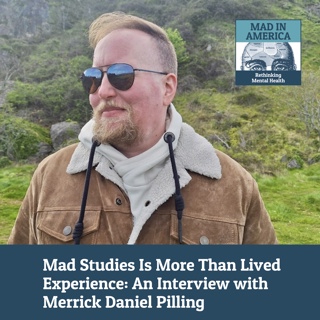
Mad Studies Is More Than Lived Experience: An Interview with Merrick Daniel Pilling

Mad Studies Is More Than Lived Experience: An Interview with Merrick Daniel Pilling

Merrick Daniel Pilling is an Associate Professor and Interim Co-Director of the School of Disability Studies at Toronto Metropolitan University. He is the author of Queer and Trans Madness: Struggles ...

19 Aug 49min

The West Doesn't Have All the Answers: An Interview with Dinesh Bhugra

The West Doesn't Have All the Answers: An Interview with Dinesh Bhugra

Dinesh Bhugra is a leading voice in social and cultural psychiatry. He is Emeritus Professor of Mental Health and Cultural Diversity at King's College London and has served as president of the Royal ...

12 Aug 36min
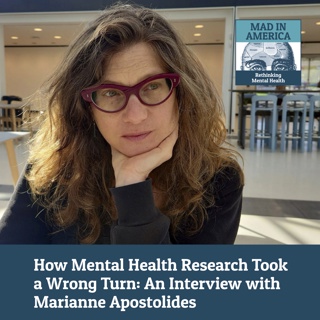
Go/No Go - How Mental Health Research Took a Wrong Turn: An Interview with Marianne Apostolides

Go/No Go - How Mental Health Research Took a Wrong Turn: An Interview with Marianne Apostolides

Marianne Apostolides is the award-winning author of eight books, four of which have been translated and published internationally. She is a two-time recipient of the Chalmers Arts Fellowship and winne...

29 Jul 48min
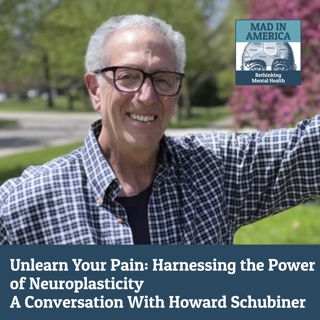
Unlearn Your Pain: Harnessing the Power of Neuroplasticity – A Conversation With Howard Schubiner

Unlearn Your Pain: Harnessing the Power of Neuroplasticity – A Conversation With Howard Schubiner

Welcome to the Mad in America podcast. My name is Brooke Siem, and I am the author of the award-winning memoir on antidepressant withdrawal, May Cause Side Effects. Today, I'm excited to have Dr. Howa...

15 Jul 41min
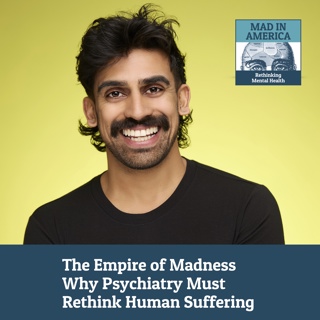
The Empire of Madness: Why Psychiatry Must Rethink Human Suffering - An Interview with Khameer Kidia

The Empire of Madness: Why Psychiatry Must Rethink Human Suffering - An Interview with Khameer Kidia

Khameer Kidia is a physician and an anthropologist, works at Harvard Medical School and the University of Zimbabwe, and spends his life between Washington DC and Harare. Kidia has many accolades to hi...

8 Jul 48min
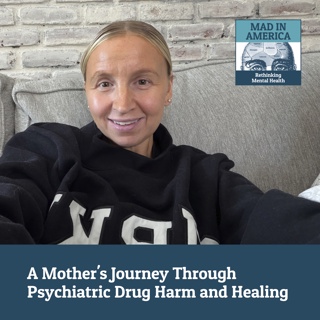
A Mother's Journey Through Psychiatric Drug Harm and Healing

A Mother's Journey Through Psychiatric Drug Harm and Healing

Chelsea McVeigh began her journey with psychiatric medications at 16, never imagining where it would lead. At 31, during a new pregnancy, she suffered a severe adverse reaction that turned her world u...

1 Jul 24min

Populært innen Helse

fastlegen
rss-gukild-johaug
psykodrama
hvordan-har-du-det-mann
relasjonspodden-med-dora-thorhallsdottir-kjersti-idem
leger-om-livet
rss-skravla-gar
foreldreradet
g-punktet
hjernesterk
morten-ramm-lar-kakla-ga-til-du-sovner
rss-loping-for-nybegynnere
bak-fasaden-en-reise-i-livet-med-sykepleier-ine
treningsprat
klimaks
rss-dagen-for-dagen
rss-lopedrommen
kjed-deg-i-sovn-verdens-kjedeligste-podcast
helsetipspodden
rss-kunsten-a-leve