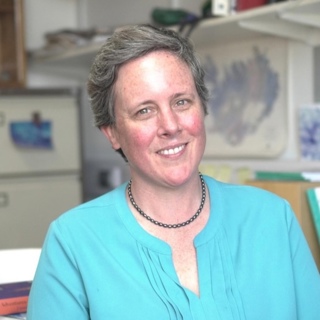

Kate Kirkpatrick - Sartre, Beauvoir and existentialism

Kate Kirkpatrick - Sartre, Beauvoir and existentialism

I’m the Tutorial Fellow in Philosophy and Christian Ethics at Regent's Park College, Oxford.

My research focuses primarily on Jean-Paul Sartre and Simone de Beauvoir, and I've written a few books on Sartre and Beauvoir and Existentialism more generally.

About Kate Kirkpatrick I’m the Tutorial Fellow in Philosophy and Christian Ethics at Regent's Park College, Oxford.

My research focuses primarily on Jean-Paul Sartre and Simone de Beauvoir, and I've written a few books on Sartre and Beauvoir and Existentialism more generally.

Key Points

• Sartre and Beauvoir’s view of Existentialism emerged in the 1940s. They thought that freedom is what is most valuable in life and that we must build an ethical system around it. • One of the ways that Sartre and Beauvoir expressed their ideas was through fiction. They wrote plays and novels because they thought that the truth couldn’t just be expressed in the form of philosophical treatises. • Beauvoir believes that the character of human beings is established by the kinds of projects that they adopt in life; part of being free is having the freedom to choose different projects to shape your life.

This question is still the subject of debate amongst philosophers today. On the one hand, you get very broad definitions of the category, which include thinkers from the 19th and 20th centuries, primarily – people like Kierkegaard, Nietzsche or Heidegger, as well as French existentialists Sartre and Beauvoir. However, some philosophers claim that the category is so broad that it ceases to pick out any meaningful similarities between the thinkers, because, although they share similar preoccupations, they wrote from very different contexts and came to radically different conclusions.

On the other hand, you get this narrow approach to defining Existentialism, which has appeared in the work of Jonathan Webber more recently. He says that we need to understand Existentialism as a theory of value, which says that freedom is what is valuable, and as an ethical system built on that – that we must treat other people in a way that acknowledges the freedom of each person and the structure of human existence. That view is something that emerged with Sartre and Beauvoir in the 1940s.

Denne episoden er hentet fra en åpen RSS-feed og er ikke publisert av Podme. Den kan derfor inneholde annonser.

Episoder(100)

The resurgence of civic duties | Simon Reid-Henry

The resurgence of civic duties | Simon Reid-Henry

Civic duties are essentially the ways in which citizens agree to abide by the rules and to contribute to the life of a national society. About Simon Reid-Henry "I am a research professor at the Peace ...

16 Mar 14min

What is "prejudice" ? | Jessie Munton

What is "prejudice" ? | Jessie Munton

I think prejudice is best conceptualized as a phenomenon that can be supported by a whole range of mental states that will include beliefs, habits, emotions, and also attentional dispositions. About J...

12 Mar 16min

Global Public Investment | Simon Reid-Henry

Global Public Investment | Simon Reid-Henry

The world today is overburdened with challenges that supersede the boundaries of nation states, and therefore of national governments, to address on their own. About Simon Reid-Henry "I am a research ...

9 Mar 18min

On ignorance and forgetting | Jessie Munton

On ignorance and forgetting | Jessie Munton

I'm interested in the beliefs that we're not forming, the evidence that we're not attending to or using, the belief states that perhaps we form. What I think of as negative epistemology is the project...

5 Mar 19min

The empire of democracy | Simon Reid-Henry

The empire of democracy | Simon Reid-Henry

"How do we understand, as it were, our era of democracy, which I argue began really as recently as the 1970s from previous eras, and what is it that is fundamentally at the core of the democracy we li...

2 Mar 19min

The life of the mind | Jessie Munton

The life of the mind | Jessie Munton

On the one hand, we have that sense of really close identification with our minds. On the other hand, we're often surprised at the ways in which they operate. About Jessie Munton "​​I'm an Associate P...

26 Feb 19min

Volcanoes and the origins of life | Tamsin Mather

Volcanoes and the origins of life | Tamsin Mather

We don't really understand how life got going on this planet. There are various candidates for where the first molecules of life might have evolved, and some of those candidates are deeply volcanic. A...

23 Feb 18min

The origin myth of the modern West | Naoíse Mac Sweeney

The origin myth of the modern West | Naoíse Mac Sweeney

We in the modern West still look back to ancient Greece as our imagined origin. We're still obsessed with ancient Greece. About Naoise Mac Sweeney  "I'm Professor of Greek Archaeology at the Universit...

19 Feb 14min

Populært innen Fakta

fastlegen
dine-penger-pengeradet
relasjonspodden-med-dora-thorhallsdottir-kjersti-idem
rss-strid
treningspodden
foreldreradet
rss-orjasater
jakt-og-fiskepodden
rss-kunsten-a-leve
hverdagspsyken
rss-bisarr-historie
rss-impressions-2
mikkels-paskenotter
sinnsyn
level-up-med-anniken-binz
takk-og-lov-med-anine-kierulf
rss-var-forste-kaffe
gravid-uke-for-uke
nevropodden
fryktlos