Winning the Weed Control Challenge on Organic Crops with Klaas Martens

Winning the Weed Control Challenge on Organic Crops with Klaas Martens

This week, I had the pleasure of interviewing a great farmer and friend of mine, Klaas Martens. Klaas has been farming for more than 30 years and has driven the adoption of sustainable farming practices through his work with numerous national organizations and advisory committees. This episode contains some really great information from Klaas's many years of experience developing sustainable farming systems.

In this episode, we talk about the cultural practices that form the basis of weed control, how Klaas thought he had discovered a pathogen that could become a new herbicide, and what it turned out to be, how to see and monitor field variables, crop rotations, and how Klaas has managed the weed control on his farm in upstate New York for the past 30 years.

Support For This Show & Helping You Grow

This show is brought to you by AEA, leaders in regenerative agriculture since 2006.

If you are a large-scale grower looking to increase crop revenue and quality, email hello@advancingecoag.com or call 800-495-6603 extension 344 to be connected with a dedicated AEA crop consultant.

Episode 8 - Klaas Martens - Highlights

2:50 - Going from conventional farming to completely organic

3:40 - Having to unlearn some things from a university education

4:20 - Klaas was noticing that his observations in farming were contradicting his learned models and assumptions

5:15 - What have been the memorable moments that have lead Klaas to where he is today?

  • Learning that cultural practices form the basis of all weed control - chemicals are auxiliary only
  • Cultural practices are everything you do in the tending of your fields - what you do to set up the situation the crop is growing in
  • What happens if you abandon a field? See the crop rotation in nature

10:20 - Why was Klaas looking for info in books written before 1945?

  • These chemicals were all recent - agriculture had existed long before
  • Knowledge was lost when chemicals came long

12:00 - How does this relate to how Klaas manages crops and weeds on his operation?

  • Klaas realized work today will have results later
  • Reframing from "How do I kill it?" to "Why is this here? What is its function?"
  • Klaas started to study what various weeds and pests actually did in the soil - How do you read what the soil is trying to tell you?

15:00 - The weed that frustrated Klaas and made it seem organic farming was going to be impossible

  • Pests were moving in because they were attracted to unhealthy weeds

18:00 - John's experience with Canadian thistles

  • There is an organism that lives on the deeper roots of Canadian thistles that it needs to survive - it can only live in anaerobic soil

21:30 - What advice would Klaas give to growers to emulate some of his success?

  • Shifting soil biology leads to shifting weed populations
  • Changing the microbiology of the soil

24:50 - What practices lead Klaas to this result?

  • Diverse rotation
  • Cover crops - tried not to have soil uncovered over winter
  • The importance of the smell of the soil
  • We are looking above ground at the plants when we should be looking below ground at the soil

27:00 - Healthy Soils, Sick Soils by Dr. Franz Sekera and Margareth Sekera

  • Sekera took soil and put it under a microscope to see what he could see - discovering the organisms were water living
  • Soil breaking down at 70 degrees F

31:00 - Klaas's experience with producing dry beans and mustard

  • Klaas had a great experience with dry beans, but it dropped very significantly over the years
  • Klaas's rotation wasn't reducing pathogens, it was promoting them
  • Some plots had great looking beans, some had beans that died - Some crops made the problem worse, some didn't have an effect, and some resulted in very healthy beans.
  • One that was very beneficial was yellow mustard

36:00 - How did Klaas's weed profile change after incorporating these changes?

  • The soil was trying to say something - that's why the mustard kept coming up

37:40 - What is Klaas's crop rotation?

  • 20-30 different crops
  • Flexible - Klaas wants to respond to what the soil is telling him
  • They used a basic rotation, but they worn it out

41:30 - What are the variables Klaas is monitoring?

  • Fields having a certain color point to different problems. Yellow points to sulfur. Blue is often a phosphorus indicator. White can be potassium or calcium.
  • These are little data points, still need to do soil testing'

45:40 - How has Klaas seen the ecosystem evolve in regards to disease and insect resistance?

  • Bugs don't hit healthy plants
  • Using epsom salts instead of insecticides when plants are low on magnesium
  • Insects will avoid plants when all three magnesium, sulfur, molybdenum are adequate supply

51:00 - Putting on a nutritional application resulting in all insects disappearing.

  • Plants can launch a defence when they have supplied proper nutrition

52:30 - Most nutritional imbalances are not a result of deficiencies, they are the results of excess of products that growers apply.

  • Overapplication causes imbalances

53:40 - What does Klaas believe to be true about modern agriculture that others do not believe to be true?

  • The soil is basically screaming when the farmer is doing something they shouldn't be - in the form of weeds, insects, etc. These are the symptoms.
  • We aren't dealing with the underlying problem
  • Too reliant on point and shoot solutions

56:00 - What are some books or resources that Klaas would recommend?

1:00:45 - What is a question Klaas wishes John had asked?

  • "Where do we find help and guiding in managing our farms?"
  • No one person is the source of knowledge for these topics
  • Sharing observations and ideas with other farmers is invaluable - but also to keep yourself and others grounded

Feedback & Booking

Please send your feedback, requests for topics or guests, or booking request have a Podcast episode recorded LIVE at your event -- to production@regenerativeagriculturepodcast.com. You can email John directly at John@regenerativeagriculturepodcast.com.

Sign Up For Special Updates

To be alerted via email when new episodes are released, and get special updates about John speaking, teaching, and podcast LIVE recordings, be sure to sign up for our email list.

Denne episoden er hentet fra en åpen RSS-feed og er ikke publisert av Podme. Den kan derfor inneholde annonser.

Episoder(226)

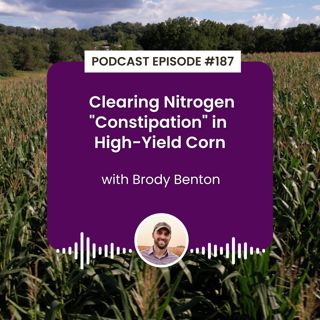
Episode 187: Clearing Nitrogen "Constipation" in High-Yield Corn with Brody Benton

Episode 187: Clearing Nitrogen "Constipation" in High-Yield Corn with Brody Benton

Brody Benton is an agronomist and no-till farmer in Guthrie County, Iowa, specializing in continuous corn rotations and hoop-barn hog manure management . Brody works with growers in Iowa and the midw...

27 Aug 1h 14min
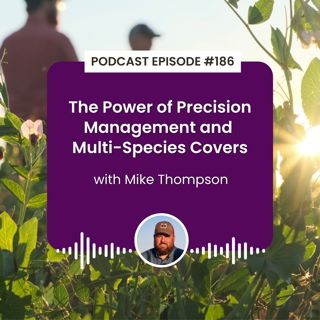
Episode 186: The Power of Precision Management and Multi-Species Covers with Mike Thompson

Episode 186: The Power of Precision Management and Multi-Species Covers with Mike Thompson

Mike Thompson is a fifth-generation farmer in West Texas who grew up in conventional "cotton-on-cotton" country. After leaving the farm for 16 years, he returned to face the region's harsh climate, ho...

13 Aug 52min
Podcast Extra: John Kempf on Soil Biophysics, Plant Immunity & Foliars on the Permaculture Orchard Podcast

Podcast Extra: John Kempf on Soil Biophysics, Plant Immunity & Foliars on the Permaculture Orchard Podcast

In this Podcast Extra episode, John Kempf joins Stefan Sobkowiak and his son, Zach, on the Permaculture Orchard Podcast . During the course of the episode, they discuss John's background growing up o...

31 Jul 1h 44min
Podcast Extra: Ask Me Anything with John Kempf - July 10, 2026

Podcast Extra: Ask Me Anything with John Kempf - July 10, 2026

In this Podcast Extra, Join John as he answers a wide range of grower-submitted questions covering challenges in agriculture. The discussion focuses on managing high summer leaf temperatures, optimizi...

23 Jul 1h 13min
Episode 185: Pioneering Solubilized Urea and Foliar Nutrition with the Fabian Family

Episode 185: Pioneering Solubilized Urea and Foliar Nutrition with the Fabian Family

Patrick Fabian and his two sons Andrew and Stephen operate a third and fourth-generation farm in Southern Alberta, Canada. Farming on 100% irrigated land, they specialize in producing a diverse range ...

16 Jul 1h 22min
Episode 184: The Crisis of Blandness in Agriculture with Mark Schatzker

Episode 184: The Crisis of Blandness in Agriculture with Mark Schatzker

Mark Schatzker's path into food science and journalism began in 1997 when an unforgettable Chilean steak completely changed his perspective on taste. Armed with a degree in philosophy, he became obses...

9 Jul 52min
Episode 183: Overcoming the Ammonium Death Spiral with Jim Dunlop

Episode 183: Overcoming the Ammonium Death Spiral with Jim Dunlop

Jim Dunlop is a senior agronomist with Advancing Eco Agriculture (AEA) whose journey into agriculture began after serving in the Marine Corps. He used the GI Bill to study biology and chemistry at CSU...

2 Jul 59min
Podcast Extra: Ask Me Anything with John Kempf - June 4, 2026

Podcast Extra: Ask Me Anything with John Kempf - June 4, 2026

In this Podcast Extra, Join John as he answers a wide range of grower-submitted questions covering challenges in agriculture. The discussion focuses on managing high summer leaf temperatures, optimizi...

18 Jun 56min

Populært innen Vitenskap

fastlegen
tingenes-tilstand
romkapsel
jss
liberal-halvtime
rekommandert
forskningno
villmarksliv
rss-paradigmepodden
sinnsyn
tomprat-med-gunnar-tjomlid
fjellsportpodden
rss-nysgjerrige-norge
rss-inn-til-kjernen-med-sunniva-rose
rss-kunstig-intelligens-med-elisabeth-maren-og-morten
dekodet-2
rss-overskuddsliv
rss-fuglehundfolk
rss-rekommandert
smart-forklart