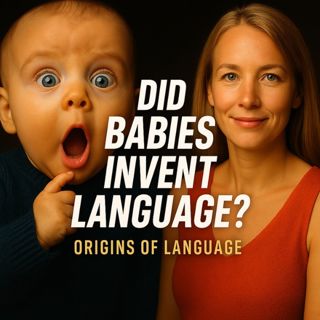
E164: The Real Reason You Can Speak: Explained by Evolutionary Biologist - Dr. Madeleine Beekman
El Podcast29 Okt 2025

E164: The Real Reason You Can Speak: Explained by Evolutionary Biologist - Dr. Madeleine Beekman

How human babies, big brains, and social life likely forced Homo sapiens to invent precise speech ~150–200k years ago—and what that means for learning, tech, and today’s kids.

Guest Bio:
Madeleine Beekman is a professor emerita of evolutionary biology and behavioral ecology at the University of Sydney and author of Origin of Language: How We Learned to Speak and Why. She studies social insects, collective decisions, and the evolution of communication.

Topics Discussed:

  • Why soft tissues don’t fossilize; language origins rely on circumstantial evidence
  • Three clocks for timing (~150–200k years): anatomy; trade/complex tech/art; phoneme “bottleneck”
  • Why Homo sapiens (not Neanderthals) likely had full speech
  • Language as a “virus” tuned to children; pidgin → creole via kids
  • Second-language learning: immersion over translation
  • Bees/ants show precision scales with ecological stakes
  • Evolutionary chain: bipedalism → narrow pelvis + big brains → helpless infants → precise speech
  • Ongoing human evolution (archaic DNA, altitude, Inuit lipid adaptations)
  • Flynn effect reversal, screens, AI reliance, anthropomorphism risks
  • Reading, early interaction, and the Regent honeyeater “lost song” lesson
  • Universities, online classes, and “degree over learning”

Main Points:

  • Multiple evidence lines converge on speech emerging with anatomically modern humans ~150–200k years ago.
  • Anatomical and epigenetic clues suggest only Homo sapiens achieved full vocal speech.
  • Extremely dependent infants created strong selection for precise, teachable communication.
  • Children’s brains shape languages; kids regularize grammar.
  • Communication precision rises when mistakes are costly (bee-dance analogy).
  • Humans continue to evolve; genomes show selected archaic introgression and local adaptations.
  • Tech-driven habits may erode cognition and language skill; reading matters.
  • AI is a tool that imitates human output; humanizing it can mislead and harm, especially for teens.
  • Start early: talk, read, and interact face-to-face from birth.

Top Quotes:

  • “Only Homo sapiens was ever able to speak.”
  • “Language will go extinct if it can’t be transmitted from brain to brain—the best host is a child.”
  • “The precision of communication is shaped by how important it is to be precise.”

🎙 The Pod is hosted by Jesse Wright
💬 For guest suggestions, questions, or media inquiries, reach out at https://elpodcast.media/
📬 Never miss an episode – subscribe and follow wherever you get your podcasts.
⭐️ If you enjoyed this episode, please rate and review the show. It helps others find us.

Thanks for listening!

Episoder(186)

E74: Costa Rica vs. Nicaragua in Retirement

E74: Costa Rica vs. Nicaragua in Retirement

A 67-year-old American expat shares thier journey from retiring in Nicaragua to settling in Costa Rica, revealing the realities of expat life, cost of living, and the importance of flexibility abroad....

3 Mai 202459min

E73: Reshaping Real Estate: The Impact of the Commission Settlement

E73: Reshaping Real Estate: The Impact of the Commission Settlement

Bankrate journalist Jeff Ostrowski breaks down the real estate commission lawsuit, what changes starting July 2025, and what it all means for homebuyers, agents, and the future of U.S. housing.👤 Gues...

20 Apr 202440min

E72: Retire in Portugal & See the World for Free by Pet Sitting

E72: Retire in Portugal & See the World for Free by Pet Sitting

Terry and Clyde share how they reinvented their lives—losing half their body weight, retiring early to Panama, house-sitting across the globe, and ultimately settling in Portugal—on a modest budget an...

13 Apr 20241h 21min

E71: Securing Our Genetic Future - Explained by a Doctor

E71: Securing Our Genetic Future - Explained by a Doctor

Dr. William Blau, emeritus professor and author of Our Genetic Future, explores how modern medicine and environmental changes may be weakening natural selection, with profound consequences for human g...

4 Apr 20241h 3min

E70: Population Collapse: The Looming Crisis

E70: Population Collapse: The Looming Crisis

Darrell Bricker, co-author of Empty Planet, explains why global population decline—not overpopulation—is the defining issue of the 21st century and what it means for cities, economies, and politics.Gu...

27 Mar 202450min

E69: How to make money in Real Estate (In 2024)

E69: How to make money in Real Estate (In 2024)

Real estate investor Scott Shindelar explains how Millennials can achieve financial freedom through leveraged rental property investing, tax strategy, and smart long-term planning.Guest Bio:Scott Shin...

21 Mar 20241h 1min

E68: Performance Coaching Secrets for Athlete Mastery w/ Dr.Fergus Connolly

E68: Performance Coaching Secrets for Athlete Mastery w/ Dr.Fergus Connolly

Sports scientist and high-performance coach Dr. Fergus Connolly shares insights on what elite athletes, special forces, and top organizations have in common—and why simplicity, trust, and human factor...

15 Mar 202457min
E67: AI Myths - Explained by AI Scientist

E67: AI Myths - Explained by AI Scientist

AI scientist Erik J. Larson explains why today's large language models, including ChatGPT, may impress but still fall far short of true artificial intelligence—and how that misunderstanding threatens ...

6 Mar 202456min

Populært innen Business og økonomi

stopp-verden
dine-penger-pengeradet
lydartikler-fra-aftenposten
e24-podden
rss-penger-polser-og-politikk
rss-borsmorgen-okonominyhetene
utbytte
pengepodden-2
finansredaksjonen
pengesnakk
morgenkaffen-med-finansavisen
tid-er-penger-en-podcast-med-peter-warren
rss-sunn-okonomi
livet-pa-veien-med-jan-erik-larssen
okonomiamatorene
liberal-halvtime
lederpodden
rss-markedspuls-2
rss-impressions-2
rss-investering-gjort-enkelt