
Sleep Questions, Portable Museums, Digital Health Records. May 25, 2018, Part 1
Science Friday25 Mai 2018

Sleep Questions, Portable Museums, Digital Health Records. May 25, 2018, Part 1

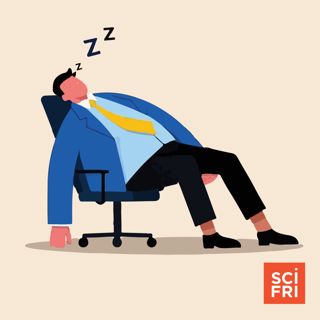
What’s the difference between being fatigued and sleepy? Do melatonin and other sleeping aids work? And what can you do if you just can’t sleep?Neurologist and sleep specialist W. Chris Winter, author of the book The Sleep Solution: Why Your Sleep is Broken and How to Fix It, talks about how the brain and body regulate sleep. He also gives ideas for controlling your behavior to improve your “sleep hygiene.”

Science museums can be a fun and educational way to spend a day—but what if you don’t have a day? What if there’s no museum near you? Or what if you don’t think you like science enough to spend money on an entry fee? All of these are reasons one nonprofit is working to shrink the museum, and bring it to you—starting with the Smallest Mollusk Museum. It’s a vending machine-sized exhibit on the slimy tricks, strange brains, and ecological importance of snails, squids, octopuses, and their chitinous cousins. Amanda Schochet, co-founder of the project and a former computational biologist, explains what goes into making a small museum that can still share big ideas.

In recent years, medical providers have largely moved away from scrawled paper charts to electronic health records. But a team of researchers argues that the transformation of medical records hasn’t gone far enough. While there has been widespread adoption of electronic health records, most are just static, flat translations of the format of the old fashioned paper file. If we can subscribe to specific categories of news online, the researchers say, why shouldn’t medical specialists be able to subscribe to a given patient’s medical records to get updates and alerts of specific interest to them? Why shouldn’t medical teams be able to get notifications and share information when patients needing special care plans arrive at the hospital?

Plus, a satellite launched this week would aid in planned Chinese lunar exploration.

Subscribe to this podcast. Follow our show on Instagram, TikTok, Facebook, and Bluesky @scifri and sign up for our newsletters. Got a science question that’s keeping you up at night? Call us: 877-472-4374


Hosted by Simplecast, an AdsWizz company. See pcm.adswizz.com for information about our collection and use of personal data for advertising.

Denne episoden er hentet fra en åpen RSS-feed og er ikke publisert av Podme. Den kan derfor inneholde annonser.

Episoder(1338)

Why do sports announcers talk like that?

Why do sports announcers talk like that?

If you watch sports, whether the recent NBA finals or the ongoing World Cup matches, you may have noticed that the athletes aren’t the only ones putting on a show. The announcers seem to be playing a ...

19 Jun 13min

Swords, cannibalism, poison: inside the world of killer microbes

Swords, cannibalism, poison: inside the world of killer microbes

There is a murderous crime spree happening right under—and perhaps inside—our noses. Killer microbes armed with weapons are eviscerating, assassinating, and detonating their fellow microbes. And the n...

18 Jun 21min

When music transports you to a different place

When music transports you to a different place

Do you ever hear a song that transports you to a specific place and time? This auditory wormhole has a name: musical daydreams. Music cognition expert Elizabeth Margulis studies why they happen, and w...

17 Jun 18min

A vast whale graveyard + Zombie sea cucumbers

A vast whale graveyard + Zombie sea cucumbers

Researchers just published details of a massive undersea graveyard of whales deep in the Indian Ocean. Spanning about 1,200 kilometers (745 miles), it contains whale remains dating back more than 5 mi...

16 Jun 18min

Should we bring mountain lions back to the Northeast?

Should we bring mountain lions back to the Northeast?

Big cats used to roam the entire United States. You might know them as mountain lions, pumas, cougars, or catamounts. Though they go by many names, they're actually all the same species.  Their curren...

15 Jun 12min

Blue Origin explosion hits NASA timeline + Artemis III crew

Blue Origin explosion hits NASA timeline + Artemis III crew

When Blue Origin’s New Glenn spacecraft exploded in an enormous fireball during a ground test a couple weeks ago, it sent shockwaves not only through the air, but through NASA’s timeline for the upcom...

12 Jun 12min

Why can I handle tequila but not rum?

Why can I handle tequila but not rum?

‘Tis the season for porch beers and happy hours, and we’re taking on listener questions about how alcohol affects us. Like, is a glass of wine at dinner really good for you? And why do sugary drinks g...

11 Jun 21min

AI + turfgrass science in the most high-tech World Cup yet

AI + turfgrass science in the most high-tech World Cup yet

The 2026 World Cup will be the largest one yet, and FIFA is trying to make it the most high-tech, too. The federation has partnered with tech giant Lenovo to launch Football AI Pro, which is designed ...

10 Jun 19min

Populært innen Vitenskap

fastlegen
tingenes-tilstand
jss
rss-nysgjerrige-norge
villmarksliv
rss-paradigmepodden
sinnsyn
liberal-halvtime
dekodet-2
rekommandert
forskningno
tomprat-med-gunnar-tjomlid
rss-overskuddsliv
rss-inn-til-kjernen-med-sunniva-rose
nevropodden
rss-rekommandert
hva-er-greia-med
fjellsportpodden
aldring-og-helse-podden
rss-bondevennen