
Medium Black Holes, World of Wonders, Warsaw Typhus. Sept 11, 2020, Part 2
Science Friday11 Sep 2020

Medium Black Holes, World of Wonders, Warsaw Typhus. Sept 11, 2020, Part 2

Why A Medium-Sized Black Hole Is Surprising Physicists

If you’re looking for a black hole, they normally come in two sizes. There’s the basic model, in which a large, dying star collapses in on itself, and the gravity of its core pulls in other matter. Then there are the supermassive black holes, millions of times the mass of our sun, that tend to be found at the center of a galaxy.

But recently researchers reported that they had evidence for two colliding black holes that created a surprising offspring. Their collision formed a middle-weight black hole, around 142 times the mass of our sun.

Daniel Holz, a member of the LIGO team that spotted the collision, and a professor of astronomy and astrophysics at the University of Chicago, joins Ira to talk about what the observation means for theories of how black holes form and grow.

Against Impossible Odds, The Warsaw Ghetto Stopped A Typhus Outbreak

This year marks the 80th anniversary of the establishment of the Warsaw Ghetto in November of 1940. The Nazis purposefully tried to starve to death almost half a million Jews, who were kept with little food and water in a space about the size of Central Park.

Theoretical mathematician Lewi Stone of Tel Aviv University has been studying a concurrent public health crisis that happened in the Warsaw Ghetto: a Typhus outbreak. The infectious disease is spread by lice, and can be deadly.

Typhus ran rampant in the Warsaw Ghetto for the better part of 1941. But when the winter rolled around, the expected second wave never came. Researchers have found evidence that public health measures enacted under these impossible circumstances—think public education and social distancing—actually worked.

Stone talks to SciFri producer Kathleen Davis about this research, and potential takeaways for 2020’s public health crisis.

It’s Still A Wild, Wonderful World

The table of contents for poet Aimee Nezhukumatathil’s new book of essays reads like a list of evolution’s most fantastic products. The comb jelly, which pulses with rainbow bioluminescence. The smiling-faced axolotl, which can regrow lost limbs and is a star of biology research labs, but is considered critically endangered in the wild. The human-sized corpse flower, which blooms for a mere 24 hours, smelling of dead flesh.

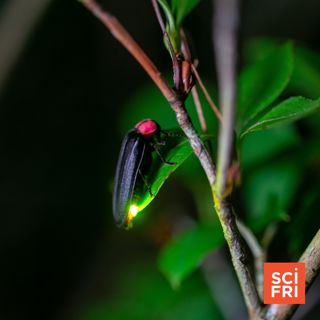
It’s also a deeply personal book: Nezhukumatathil says the screaming pink of dragonfruit signals “summertime, pop music, sunglasses balanced on the top of my head, weather too warm for socks.” A firefly’s spark might send her back to her grandmother’s backyard, or “to splashing in an ice-cold creek bed, with our jeans rolled up to our knees, until we shudder and gasp, our toes fully wrinkled.” Even the horizontal eye of an octopus becomes a “door that judges us,” as the oceans become increasingly difficult to inhabit, thanks to humans’ ravages.

Science Friday’s Christie Taylor talks to Nezhukumatathil about her experiences in natural wonder, and why in a world of changing climate, rising seas, and burning forests, she finds it important to share her joy in learning about the creatures we share the planet with.

Subscribe to this podcast. Follow our show on Instagram, TikTok, Facebook, and Bluesky @scifri and sign up for our newsletters. Got a science question that’s keeping you up at night? Call us: 877-472-4374


Hosted by Simplecast, an AdsWizz company. See pcm.adswizz.com for information about our collection and use of personal data for advertising.

Denne episoden er hentet fra en åpen RSS-feed og er ikke publisert av Podme. Den kan derfor inneholde annonser.

Episoder(1338)

Why do sports announcers talk like that?

Why do sports announcers talk like that?

If you watch sports, whether the recent NBA finals or the ongoing World Cup matches, you may have noticed that the athletes aren’t the only ones putting on a show. The announcers seem to be playing a ...

19 Jun 13min

Swords, cannibalism, poison: inside the world of killer microbes

Swords, cannibalism, poison: inside the world of killer microbes

There is a murderous crime spree happening right under—and perhaps inside—our noses. Killer microbes armed with weapons are eviscerating, assassinating, and detonating their fellow microbes. And the n...

18 Jun 21min

When music transports you to a different place

When music transports you to a different place

Do you ever hear a song that transports you to a specific place and time? This auditory wormhole has a name: musical daydreams. Music cognition expert Elizabeth Margulis studies why they happen, and w...

17 Jun 18min

A vast whale graveyard + Zombie sea cucumbers

A vast whale graveyard + Zombie sea cucumbers

Researchers just published details of a massive undersea graveyard of whales deep in the Indian Ocean. Spanning about 1,200 kilometers (745 miles), it contains whale remains dating back more than 5 mi...

16 Jun 18min

Should we bring mountain lions back to the Northeast?

Should we bring mountain lions back to the Northeast?

Big cats used to roam the entire United States. You might know them as mountain lions, pumas, cougars, or catamounts. Though they go by many names, they're actually all the same species.  Their curren...

15 Jun 12min

Blue Origin explosion hits NASA timeline + Artemis III crew

Blue Origin explosion hits NASA timeline + Artemis III crew

When Blue Origin’s New Glenn spacecraft exploded in an enormous fireball during a ground test a couple weeks ago, it sent shockwaves not only through the air, but through NASA’s timeline for the upcom...

12 Jun 12min

Why can I handle tequila but not rum?

Why can I handle tequila but not rum?

‘Tis the season for porch beers and happy hours, and we’re taking on listener questions about how alcohol affects us. Like, is a glass of wine at dinner really good for you? And why do sugary drinks g...

11 Jun 21min

AI + turfgrass science in the most high-tech World Cup yet

AI + turfgrass science in the most high-tech World Cup yet

The 2026 World Cup will be the largest one yet, and FIFA is trying to make it the most high-tech, too. The federation has partnered with tech giant Lenovo to launch Football AI Pro, which is designed ...

10 Jun 19min

Populært innen Vitenskap

fastlegen
tingenes-tilstand
jss
rss-nysgjerrige-norge
forskningno
liberal-halvtime
rekommandert
villmarksliv
dekodet-2
tomprat-med-gunnar-tjomlid
sinnsyn
rss-paradigmepodden
rss-inn-til-kjernen-med-sunniva-rose
rss-overskuddsliv
hva-er-greia-med
nevropodden
rss-rekommandert
rss-ingeniorpodden
rss-bondevennen
fjellsportpodden