
Greenland Plants, Privacy and Big Data, Rainbows. March 19, 2021, Part 2
Science Friday19 Mar 2021

Greenland Plants, Privacy and Big Data, Rainbows. March 19, 2021, Part 2

Under A Mile Of Ice, A Climate Clue

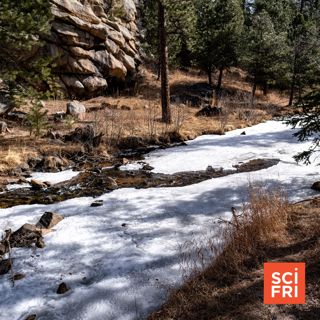
Scientists studying sediment taken from a core sample of the Greenland ice sheet just 800 miles from the North Pole have found remnants of ancient plants, freeze-dried under more than a mile of ice. Using several different dating techniques, they say the soil, twigs, and leaves date to sometime within the last million years—probably on the order of several hundred thousand years ago—a time when Greenland’s massive ice cap did not exist.

The finding that the ice sheet may have been missing so recently in geologic time provides clues to the stability of the ice, and just how sensitive it might be to modern global warming.

The samples themselves have an unusual history. In the 1960s, the US Army set out to build a base under the surface of the ice in Greenland. Ostensibly, the outpost, named Camp Century, was to be used for research into polar conditions, and how best to work in them. In reality, the US also hoped to secretly bury nuclear missiles under the ice cap within close reach of the Soviet Union. As part of that effort, codenamed Project Iceworm, core samples were taken of the ice and sediment. Year later, those samples would become the basis for this climate study, reported in the journal Proceedings of the National Academy of Sciences.

Drew Christ, one of the authors of that report and a geologist at the University of Vermont, joins Ira to talk about the study, and explain what ancient dirt can teach us about the future climate.

Decrypting Big Tech’s Data Hoard

The era of Big Data promised large-scale analytics of complex sets of information, harnessing the predictive power of finding patterns in the real world behaviors of millions of people.

But as new documentaries like The Social Dilemma, Coded Bias, and other recent critiques point out, the technologies we’ve built to collect data have created their own new problems. Even as powerhouses like Google says it’s done tracking and targeting individual users in the name of better advertising, educational institutions, housing providers, and countless others haven’t stopped.

Ira talks to two researchers, mathematician Cathy O’Neil and law scholar Rashida Richardson, about the places our data is collected without our knowing, the algorithms that may be changing our lives, and how bias can creep into every digital corner.

The Rainbow Connection—To Physics

You may have seen a double rainbow, but did you know there are moonbows at night, and even white rainbows? And did you know, if we stood next together to watch a rainbow, the colors we see are coming from two different sets of droplets in a rain shower. That means each of us have our own unique rainbow. This all has to do with the optics, physics, and atmospheric science, which Steven Businger studies at the University of Hawaii Mānoa.

Rainbows have captured many people’s attention (including Ira’s! Check out the cover of his book featuring rainbow science below). There is equally fascinating physics responsible for those multicolor beams, which Businger describes in a recent study published in Bulletin of the American Meteorological Society. Businger talks about the science behind rainbows, and discusses why Hawaii might be the rainbow capital of the world.

Subscribe to this podcast. Follow our show on Instagram, TikTok, Facebook, and Bluesky @scifri and sign up for our newsletters. Got a science question that’s keeping you up at night? Call us: 877-472-4374


Hosted by Simplecast, an AdsWizz company. See pcm.adswizz.com for information about our collection and use of personal data for advertising.

Denne episoden er hentet fra en åpen RSS-feed og er ikke publisert av Podme. Den kan derfor inneholde annonser.

Episoder(1339)

FDA approves a well-known sunscreen ingredient—finally

FDA approves a well-known sunscreen ingredient—finally

The FDA recently approved a sunscreen ingredient called bemotrizinol, or BEMT, that’s been used in Europe and Asia for years. This is the first new sunscreen ingredient approved in the United States i...

22 Jun 12min

Why do sports announcers talk like that?

Why do sports announcers talk like that?

If you watch sports, whether the recent NBA finals or the ongoing World Cup matches, you may have noticed that the athletes aren’t the only ones putting on a show. The announcers seem to be playing a ...

19 Jun 13min

Swords, cannibalism, poison: inside the world of killer microbes

Swords, cannibalism, poison: inside the world of killer microbes

There is a murderous crime spree happening right under—and perhaps inside—our noses. Killer microbes armed with weapons are eviscerating, assassinating, and detonating their fellow microbes. And the n...

18 Jun 21min

When music transports you to a different place

When music transports you to a different place

Do you ever hear a song that transports you to a specific place and time? This auditory wormhole has a name: musical daydreams. Music cognition expert Elizabeth Margulis studies why they happen, and w...

17 Jun 18min

A vast whale graveyard + Zombie sea cucumbers

A vast whale graveyard + Zombie sea cucumbers

Researchers just published details of a massive undersea graveyard of whales deep in the Indian Ocean. Spanning about 1,200 kilometers (745 miles), it contains whale remains dating back more than 5 mi...

16 Jun 18min

Should we bring mountain lions back to the Northeast?

Should we bring mountain lions back to the Northeast?

Big cats used to roam the entire United States. You might know them as mountain lions, pumas, cougars, or catamounts. Though they go by many names, they're actually all the same species.  Their curren...

15 Jun 12min

Blue Origin explosion hits NASA timeline + Artemis III crew

Blue Origin explosion hits NASA timeline + Artemis III crew

When Blue Origin’s New Glenn spacecraft exploded in an enormous fireball during a ground test a couple weeks ago, it sent shockwaves not only through the air, but through NASA’s timeline for the upcom...

12 Jun 12min

Why can I handle tequila but not rum?

Why can I handle tequila but not rum?

‘Tis the season for porch beers and happy hours, and we’re taking on listener questions about how alcohol affects us. Like, is a glass of wine at dinner really good for you? And why do sugary drinks g...

11 Jun 21min

Populært innen Vitenskap

fastlegen
tingenes-tilstand
jss
rss-nysgjerrige-norge
forskningno
liberal-halvtime
rekommandert
villmarksliv
sinnsyn
dekodet-2
rss-paradigmepodden
rss-overskuddsliv
rss-inn-til-kjernen-med-sunniva-rose
tomprat-med-gunnar-tjomlid
nevropodden
rss-rekommandert
rss-ingeniorpodden
hva-er-greia-med
fjellsportpodden
rss-bondevennen