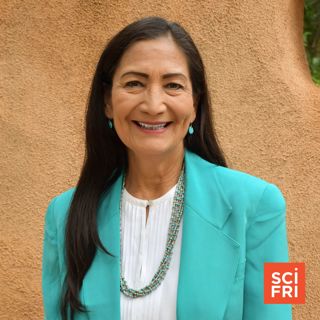

Saving Manatees, Nighttime Satellite Streaks, Webb Telescope Update. Jan 28, 2022, Part 1
Science Friday28 Jan 2022

Saving Manatees, Nighttime Satellite Streaks, Webb Telescope Update. Jan 28, 2022, Part 1

Space-X Booster To Hit The Moon, After Years Of Hurtling Through Space

A Space-X rocket booster is on track to slam into the moon, which scientists predict will happen on March 4. The rocket was originally launched in 2015 to deploy a space weather satellite. Now, it’s a piece of space junk that’s been caught in limbo for the past seven years.

Sophie Bushwick, technology editor at Scientific American, joins guest host Miles O’Brien to talk about that and other science stories of the week, including implications of Russian cyber warfare, climate scientist Lisa Goddard’s legacy, a Lego robot with an “organic” brain, and everlasting bubbles.

A Race To Save Florida’s Manatees

Florida’s waterways are home to a charismatic mammal: the manatee. These gentle giants are sometimes called “sea cows” for the way they graze on seagrass, the long, green plants that grow underwater in their habitat.

But in Florida’s Indian River Lagoon, the seagrass is disappearing fast due to algae, which is caused by pollution in the water. This loss of food has put the manatees in great peril. Last year, over 1,000 of them died—more than any year on record.

While threats to manatees are not new, this accelerated die-off concerns scientists, and is prompting a search for novel ways to help the Sunshine State’s sea cows. Joining guest host Miles O’Brien to talk about manatee conservation in Florida are Patrick Rose, executive director of Save the Manatees Club in Maitland, Florida, and Cynthia Stringfield, senior vice president of animal health, conservation and education at ZooTampa in Tampa, Florida.

It’s A Bird. It’s A Plane. It’s An Astronomical Photo Bomb.

Anyone who’s spent any time gazing at the stars at night has had the experience of seeing an occasional satellite whizz by—a sighting that usually happens around twilight. But if you’ve been out in the dark lately, you may have noticed that there’s a lot more traffic in space these days. With keen eyes, you might spot a series of dots moving in a straight line. That line is a “train” of satellites in low earth orbit, launched to provide broadband internet access from space.

Starlink is the main company behind such efforts currently, with thousands of satellites in orbit already, but other players, such as Amazon, are joining the market as well. The companies behind them say they can provide high-speed broadband internet access to rural areas that might be out of range of a fiber optic cable or a good cellular connection.

But just as you can see those lines of glowing dots, astronomers and their telescopes can see them too, making their jobs more difficult. The problem is especially acute in long-duration exposures of the night sky—in which the dots become bright streaks across an entire image. Over the past few years, astronomers and some of the companies behind the large satellite constellations have been trying to find ways to mitigate the optical interference the satellites can cause.

Dr. Bruce Cameron, the director of the System Architecture Group at MIT, describes the capabilities of some of these huge satellite constellations, and who might stand to benefit from them. Dr. Connie Walker, a scientist with NSF’s NOIRLab and the co-chair of four panels looking at the impact of these satellite constellations on astronomy, joins guest host Miles O’Brien to discuss the challenges these constellations could pose in the future, and her hopes for collaboration with industry to solve the problems.

Webb Telescope Arrives To Its Final Home In Deep Space

After weeks of travel, the James Webb Space Telescope, or JWST, moved into its final orbit this week. Following a Christmas day launch, the spacecraft has spent a month in transit, deploying its solar array, unfolding its heat shield, and unpacking its hexagonal mirror segments. On Monday, the craft fired its engines to brake into a circular orbit around a point in space known as L2, where astronomers hope it will operate for at least 10 years.

Amber Straughn, an astrophysicist at the Goddard Space Flight Center and Deputy Project Scientist for James Webb Space Telescope Science Communications, joins guest host Miles O’Brien to talk about the telescope’s journey to L2. Straughn explains what will need to happen in the months ahead to fine-tune the mirrors and commission the science instruments on board before the telescope takes its first science images sometime this summer.

Subscribe to this podcast. Follow our show on Instagram, TikTok, Facebook, and Bluesky @scifri and sign up for our newsletters. Got a science question that’s keeping you up at night? Call us: 877-472-4374


Hosted by Simplecast, an AdsWizz company. See pcm.adswizz.com for information about our collection and use of personal data for advertising.

Denne episoden er hentet fra en åpen RSS-feed og er ikke publisert av Podme. Den kan derfor inneholde annonser.

Episoder(1339)

FDA approves a well-known sunscreen ingredient—finally

FDA approves a well-known sunscreen ingredient—finally

The FDA recently approved a sunscreen ingredient called bemotrizinol, or BEMT, that’s been used in Europe and Asia for years. This is the first new sunscreen ingredient approved in the United States i...

22 Jun 12min

Why do sports announcers talk like that?

Why do sports announcers talk like that?

If you watch sports, whether the recent NBA finals or the ongoing World Cup matches, you may have noticed that the athletes aren’t the only ones putting on a show. The announcers seem to be playing a ...

19 Jun 13min

Swords, cannibalism, poison: inside the world of killer microbes

Swords, cannibalism, poison: inside the world of killer microbes

There is a murderous crime spree happening right under—and perhaps inside—our noses. Killer microbes armed with weapons are eviscerating, assassinating, and detonating their fellow microbes. And the n...

18 Jun 21min

When music transports you to a different place

When music transports you to a different place

Do you ever hear a song that transports you to a specific place and time? This auditory wormhole has a name: musical daydreams. Music cognition expert Elizabeth Margulis studies why they happen, and w...

17 Jun 18min

A vast whale graveyard + Zombie sea cucumbers

A vast whale graveyard + Zombie sea cucumbers

Researchers just published details of a massive undersea graveyard of whales deep in the Indian Ocean. Spanning about 1,200 kilometers (745 miles), it contains whale remains dating back more than 5 mi...

16 Jun 18min

Should we bring mountain lions back to the Northeast?

Should we bring mountain lions back to the Northeast?

Big cats used to roam the entire United States. You might know them as mountain lions, pumas, cougars, or catamounts. Though they go by many names, they're actually all the same species.  Their curren...

15 Jun 12min

Blue Origin explosion hits NASA timeline + Artemis III crew

Blue Origin explosion hits NASA timeline + Artemis III crew

When Blue Origin’s New Glenn spacecraft exploded in an enormous fireball during a ground test a couple weeks ago, it sent shockwaves not only through the air, but through NASA’s timeline for the upcom...

12 Jun 12min

Why can I handle tequila but not rum?

Why can I handle tequila but not rum?

‘Tis the season for porch beers and happy hours, and we’re taking on listener questions about how alcohol affects us. Like, is a glass of wine at dinner really good for you? And why do sugary drinks g...

11 Jun 21min

Populært innen Vitenskap

fastlegen
jss
tingenes-tilstand
forskningno
liberal-halvtime
rss-nysgjerrige-norge
rekommandert
sinnsyn
tomprat-med-gunnar-tjomlid
villmarksliv
rss-paradigmepodden
dekodet-2
rss-overskuddsliv
rss-inn-til-kjernen-med-sunniva-rose
rss-ingeniorpodden
hva-er-greia-med
fjellsportpodden
nevropodden
rss-rekommandert
rss-lundqvist-podden